




Europol dismantles €50M online fraud network using scam call centers
Key Takeaways A sophisticated online fraud network, operating corporate-style call centers, has been dismantled by Europol and national authorities. The criminal enterprise defrauded victims of over...

Key Takeaways
- A sophisticated online fraud network, operating corporate-style call centers, has been dismantled by Europol and national authorities.
- The criminal enterprise defrauded victims of over EUR 50 million through fake investment platforms.
- Ten individuals were arrested, and nearly EUR 900,000 in cash was seized during coordinated raids in Albania.
- The network employed a deceptive “recovery scam” to re-target previous victims, extracting further funds under the guise of helping them recover losses.
International Operation Targets EUR 50 Million Online Investment Fraud
A major international law enforcement effort, spearheaded by Europol, has successfully disrupted an extensive online fraud operation responsible for illicitly gaining more than EUR 50 million from victims globally. The sophisticated criminal network, which mimicked legitimate corporate structures, utilized scam call centers to ensnare individuals in fraudulent investment schemes.
Table Of Content
- Key Takeaways
- International Operation Targets EUR 50 Million Online Investment Fraud
- The Bust: Arrests and Seizures
- Anatomy of a Corporate-Style Scam
- Deceptive Roles and Lucrative Commissions
- The Investment Lure and Money Laundering
- The Investigation Timeline
- A Second Layer of Fraud: Targeting Past Victims
- What You Should Do
On April 17, 2026, Austrian and Albanian authorities executed a coordinated action day. This operation followed a rigorous joint investigation spanning over two years, with significant support from Europol and Eurojust.
The Bust: Arrests and Seizures
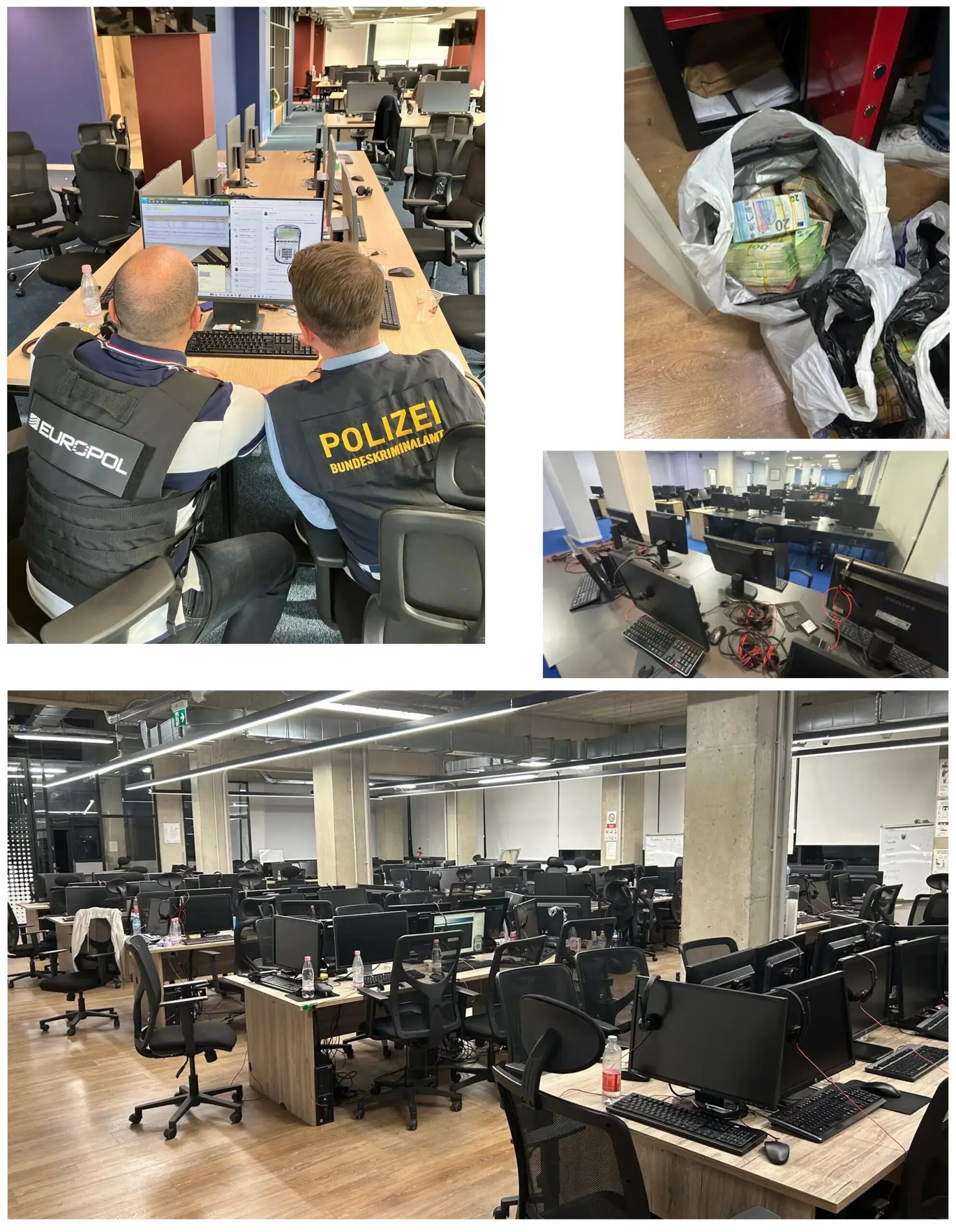
The coordinated raids in Tirana, Albania, led to the apprehension of ten individuals. Authorities simultaneously searched three call centers and nine private residences, seizing approximately EUR 900,000 in cash. Further details on the operation and seized assets are available in Europol’s official report.
Anatomy of a Corporate-Style Scam
The criminal enterprise operated multiple call centers from Albania’s capital, Tirana, employing up to 450 individuals across various organized departments. Europol highlighted the network’s corporate-like management as a critical enabler for its large-scale operations and its ability to project the image of a legitimate financial entity. The structure included specialized teams for customer acquisition, customer service, management, finance, IT, human resources, and back-office support.
Deceptive Roles and Lucrative Commissions
The fraud scheme involved “conversion agents” who initially lured victims, and “retention agents” who then posed as investment advisors. These retention agents meticulously managed and manipulated victims’ accounts over extended periods. Operators received a monthly salary of around EUR 800, supplemented by progressive commissions tied to the success of each fraudulent transaction.
To maximize reach and build trust, operators were organized into language-specific teams of six to eight members, covering German, English, Italian, Greek, and Spanish. This allowed them to target victims in their native languages, a tactic crucial for sustaining the elaborate deception.
The Investment Lure and Money Laundering
Victims were typically drawn into the scheme through misleading advertisements on social media platforms or search engine results, promoting fictitious investment platforms that promised unrealistic high returns. Upon registration, victims were assigned a “personal investment advisor.” These advisors would eventually use remote access software to gain full control over the victims’ computers, exerting psychological pressure to compel them into making additional deposits. None of the funds were ever invested; instead, they were siphoned off through an international money-laundering network, disappearing into the hands of the criminals.
The Investigation Timeline
The investigation commenced in June 2023, when Austrian authorities in Vienna observed a surge in fraud reports. By April 2024, Austria leveraged Europol’s framework to connect with Albanian law enforcement, providing an IP address linked to the suspected perpetrators operating from Albanian territory. Albania promptly initiated its own criminal investigation. Subsequently, Eurojust facilitated the establishment of a joint investigation team between Austria and Albania, providing essential funding, interpretation, and logistical support that culminated in the successful April 2026 raids.
During the raids, law enforcement recovered EUR 891,735 in cash, alongside 443 computers, 238 mobile phones, 6 laptops, and numerous data carriers and storage devices. Europol deployed expert teams to secure the vast amount of digital evidence, which will be shared with authorities in other affected nations, including Italy, Germany, Greece, Spain, Canada, and the United Kingdom. A Virtual Command Post was established to facilitate real-time data exchange among all participating teams, as detailed in the Europol press release.
A Second Layer of Fraud: Targeting Past Victims
One of the most insidious aspects of this scheme involved the network re-targeting previous victims. Fraudsters contacted these individuals, offering to “recover” their lost funds. Victims were instructed to open new cryptocurrency accounts and deposit EUR 500 to initiate the supposed recovery process. Operators used different usernames and pseudonyms to avoid detection, effectively perpetrating a second round of fraud on those they had already victimized.
What You Should Do
- Verify Investment Platforms: Always verify the legitimacy of any online investment platform through an official financial regulator before committing any funds.
- Beware of Unsolicited Offers: Exercise extreme caution with unsolicited recovery offers from unknown parties claiming to retrieve lost investments.
- Report Suspected Fraud: Report any suspected online investment fraud or unsolicited recovery offers directly to your national law enforcement agency or a designated cybercrime reporting authority without delay.
- Protect Personal Information: Never grant remote access to your computer to unknown individuals, especially those claiming to be investment advisors or recovery agents.
- Educate Yourself: Stay informed about common online investment scams and phishing tactics to recognize and avoid deceptive schemes.
Disclaimer: HackersRadar reports on cybersecurity threats and incidents for informational and awareness purposes only. We do not engage in hacking activities, data exfiltration, or the hosting or distribution of stolen or leaked information. All content is based on publicly available sources.








No Comment! Be the first one.