


Hackers News Hackers News
  • CyberSecurity News
  • Threats
  • Attacks
  • Vulnerabilities
  • Breaches
  • Comparisons

Social Media

Hackers News Hackers News
  • CyberSecurity News
  • Threats
  • Attacks
  • Vulnerabilities
  • Breaches
  • Comparisons
Search the Site
Popular Searches:
technology Amazon AI
Recent Posts
Qilin Ransomware Lists RDP Auth History on Enumerates Authentication
April 30, 2026
Phoenix PhaaS Fuels Brand Smishing in Finance Platform Drives
April 30, 2026
Targeted Large-Scale Campaign Attacking U.S. Organizations with
April 30, 2026
Home/Threats/ErrTraffic Cybercrime Tool Automates ClickFix Attacks
Threats

ErrTraffic Cybercrime Tool Automates ClickFix Attacks

Jennifer sherman
Jennifer sherman
January 1, 2026 One Min Read
7 0

Tool Automates ClickFix Attacks

Listen up, because there’s a new Cybercrime Tool Automates what security experts call ClickFix attacks, where fake error messages push people to manually execute malicious commands.

Unlike older methods that tried to secretly download files, ClickFix works by creating fake problems on websites that seem to require users to fix them by running specific codes.

What makes ErrTraffic particularly concerning is its professional design and low cost, allowing even less skilled criminals to launch effective attacks across multiple platforms including Windows, Android, macOS, and Linux.

The tool was first spotted on Russian-language cybercrime forums in early December 2025, advertised by a threat actor using the name LenAl.

For just $800, criminals can purchase the complete ErrTraffic package, which includes a control panel and script system that creates convincing fake glitches on compromised websites.
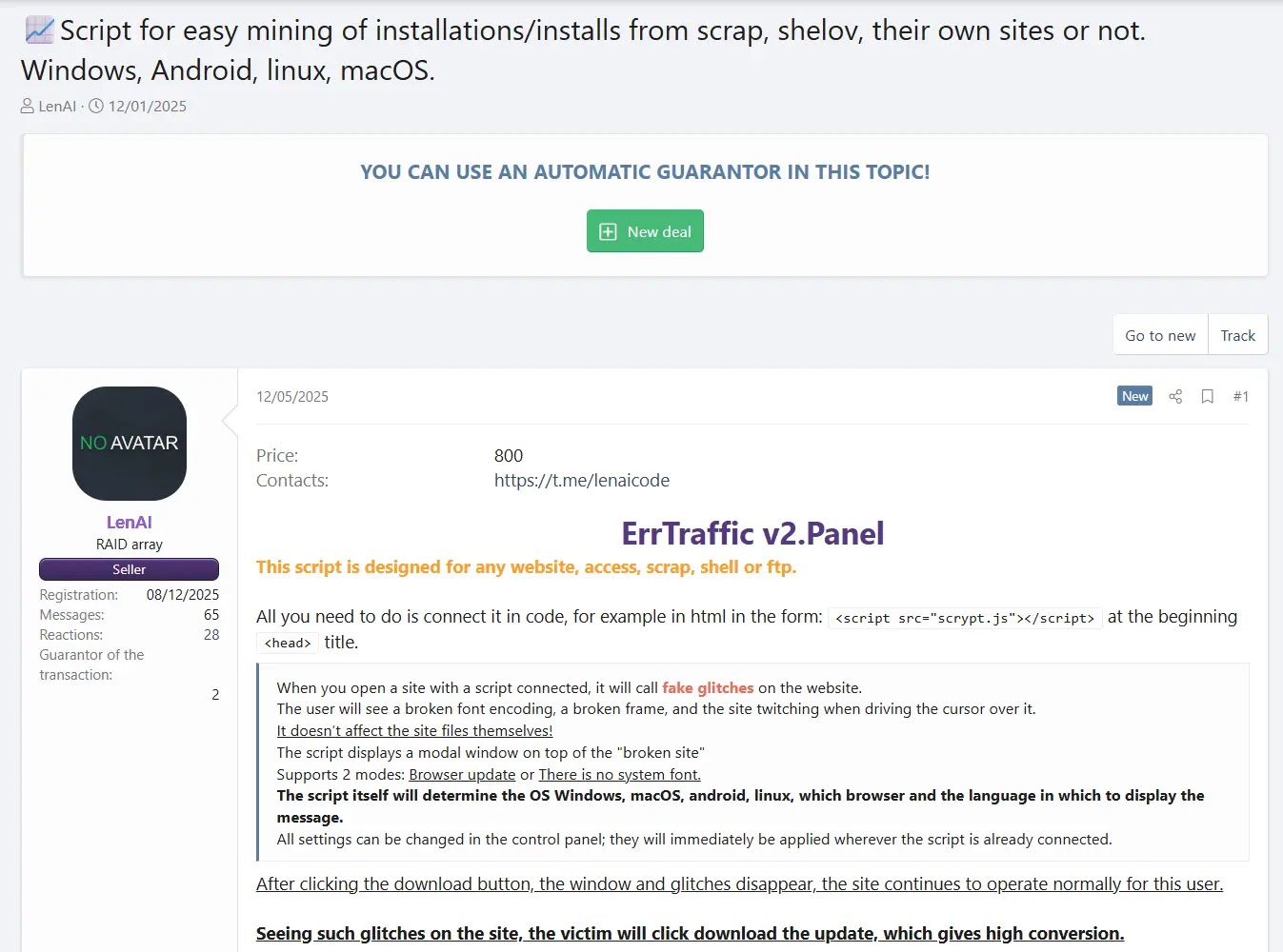
The forum post by threat actor ‘LenAI’ advertising the ErrTraffic v2 Panel (Source - Infostealers)
The forum post by threat actor ‘LenAI’ advertising the ErrTraffic v2 Panel (Source – Infostealers)

When visitors land on an infected site, they see broken text, scrambled fonts, and visual errors that make the website appear corrupted. A popup window then appears offering to fix the problem through a browser update or missing system font installation.

Hudson Rock Threat Intelligence Team analysts identified the tool after tracking promotional posts and analyzing its technical capabilities.

JavaScript injection

Behind the scenes, ErrTraffic operates through a simple JavaScript injection. Attackers who compromise a website can add one line of code that connects to their control panel.
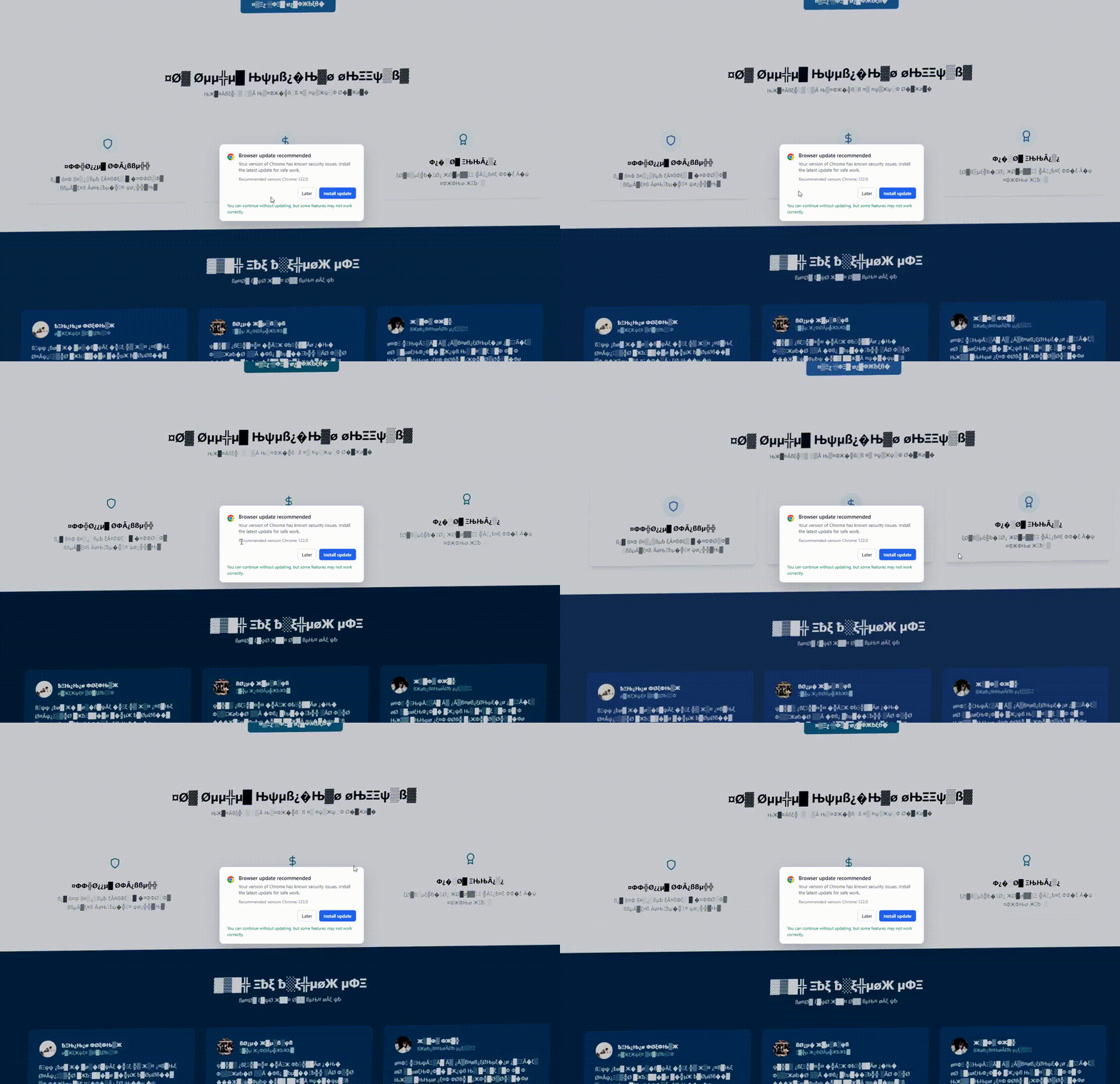
The ‘Chrome Update’ Lure (Source - Infostealers)
The ‘Chrome Update’ Lure (Source – Infostealers)

The script automatically detects what device and browser each visitor uses, then displays a customized fake error message in the appropriate language.

The infection happens when users click the fix button, which copies a PowerShell command to their clipboard and instructs them to paste it into their system.

This technique bypasses traditional security software because browsers see the action as legitimate text copying, and security tools see users opening PowerShell as normal behavior.

Analysis of active ErrTraffic campaigns reveals shocking effectiveness. Dashboard data from real attacks shows conversion rates approaching 60 percent, meaning nearly six out of every ten people who see the fake error message fall for the trick and install malware.

The tool delivers whatever payload the attacker uploads, typically infostealers like Lumma or Vidar for Windows devices, and banking trojans for Android phones.

The control panel even includes geographic filtering, with hardcoded blocks for Russia and neighboring countries to avoid local law enforcement.

Once infected, victim computers can have their login credentials stolen, which criminals then use to compromise more websites and spread the attack further, creating a self-sustaining cycle of infection.


Tags:

AndroidAttackChromeLinuxMalwareSecurityThreatUpdateWindows

Share Article

Jennifer sherman

Jennifer sherman

Jennifer is a cybersecurity news reporter covering data breaches, ransomware campaigns, and dark web markets. With a background in incident response, Jennifer provides unique insights into how organizations respond to cyber attacks and the evolving tactics of threat actors. Her reporting has covered major breaches affecting millions of users and has helped organizations understand emerging threats. Jennifer combines technical knowledge with investigative journalism to deliver in-depth coverage of cybersecurity incidents.

Previous Post

Top 10 High-Risk Vulnerabilities Exploited in Wild

Next Post

Dentsu’s U.S. Attack Disclosed U.S.-based that Subsidiary

No Comment! Be the first one.

Leave a Reply Cancel reply

Your email address will not be published. Required fields are marked *

Popular Posts
Google Gemini CLI Flaws Allow Remote Code Execution on Hosts
April 30, 2026
Jenkins Fixes High-Severity Plugin Flaws: Patches Including
April 30, 2026
WordPress Plugin Hacked Since 2020 to Inject Malicious
April 30, 2026
Top Authors
Marcus Rodriguez
Marcus Rodriguez
Sarah simpson
Sarah simpson
Emy Elsamnoudy
Emy Elsamnoudy
Let's Connect
156k
2.25m
285k

Related Posts

Jennifer sherman
By Jennifer sherman
Threats

GlassWorm Attacks macOS via Malicious VS Code…

January 1, 2026
Emy Elsamnoudy
By Emy Elsamnoudy
Attacks

ClickFix Attack Hides Malicious Code via Stegan Security

January 1, 2026
Sarah simpson
By Sarah simpson
Vulnerabilities

MongoBleed Detector Tool Detects Critical MongoDB CVE-

January 1, 2026
Emy Elsamnoudy
By Emy Elsamnoudy
Breaches

Conti Ransomware Gang Leaders & Infrastructure Exposed

January 1, 2026
Hackers News Hackers News
  • [email protected]

Quick Links

  • Contact Us
  • Privacy Policy
  • Terms of service

Categories

Attacks
Breaches
CyberSecurity News
Threats
Vulnerabilities

Let's keep in touch

receive fresh updates and breaking cyber news every day and week!

All Rights Reserved by HackersRadar ©2026

Follow Us