



Top Container Security Tools for 2024
Key Takeaways Container security is crucial across the entire application lifecycle, from development (build) to deployment (ship) and operation (run) within modern multi-cloud environments....

Key Takeaways
- Container security is crucial across the entire application lifecycle, from development (build) to deployment (ship) and operation (run) within modern multi-cloud environments.
- Specialized tools like Aqua Security and Sysdig offer deep capabilities, while Cloud Native Application Protection Platforms (CNAPPs) such as Palo Alto Prisma Cloud, Wiz, and CrowdStrike are integrating container security into broader security graphs.
- Organizations must balance “shift-left” vulnerability scanning with robust runtime protection, as neither approach alone provides complete security.
- Open-source solutions like Trivy and Falco offer a strong foundational layer for engineering-capable teams, often serving as the basis for commercial offerings.
Securing containerized applications is a complex, multi-faceted challenge that spans the entire software development and deployment lifecycle. From initial image creation and infrastructure-as-code (IaC) configurations to registry management, admission controls, and real-time runtime detection, comprehensive container security demands vigilance across modern multi-cloud architectures.
Table Of Content
- Key Takeaways
- The Decision Matrix
- What Actually Separates These Solutions
- The 10 Best, Briefly
- 1. Aqua Security — best full lifecycle
- 2. Sysdig — best runtime
- 3. Palo Alto (Prisma Cloud) — best platform breadth
- 4. Wiz — best context-first
- 5. Snyk — best developer-first
- 6. CrowdStrike — best endpoint-consolidated
- 7. Red Hat Advanced Cluster Security (StackRox) — best for OpenShift
- 8. Microsoft (Defender for Containers) — best AKS economics
- 9. Trend Micro — best hybrid
- 10. Anchore — best open-source SBOM and policy
- Buyer’s Guide
In the evolving landscape of 2024, distinct leaders have emerged. Specialized vendors such as Aqua Security and Sysdig continue to offer deep, focused solutions. Meanwhile, Snyk has solidified its position as a leader in developer-first, “shift-left” security. Concurrently, major Cloud Native Application Protection Platforms (CNAPPs) including Palo Alto Prisma Cloud, Wiz, and CrowdStrike are increasingly embedding container security within their expansive security frameworks, leveraging broader threat intelligence and correlation capabilities.
This report identifies the top ten container security tools available today, aligning each solution with specific organizational needs and risk profiles across the container lifecycle.
The Decision Matrix
Effective container security involves protecting applications throughout their existence: during the build phase (e.g., image scanning, IaC analysis), the ship phase (e.g., registry security, admission control), and the run phase (e.g., runtime threat detection, drift prevention, and supply-chain integrity verification via SBOMs and signing).
| If this describes you | Choose | Why |
| Container-first, want full lifecycle | Aqua Security — best full lifecycle | Provides the deepest “scan-assure-run” capabilities with an open-source on-ramp. |
| Runtime and Kubernetes are the priority | Sysdig — best runtime | Offers unparalleled runtime depth, stemming from its Falco lineage. |
| Already buying CNAPP breadth | Palo Alto (Prisma Cloud) — best platform breadth | Integrates container security seamlessly into its comprehensive platform graph. |
| Want context-first agentless | Wiz — best context-first | Excels at graph correlation for rapid, context-rich visibility without agents. |
| Developer-first shift-left | Snyk — best developer-first | Features superior developer workflows and actionable fix recommendations. |
| Endpoint-consolidated estate | CrowdStrike — best endpoint-consolidated | Delivers container runtime protection as part of its Falcon platform. |
| OpenShift / Red Hat estate | Red Hat Advanced Cluster Security (StackRox) — best for OpenShift | Offers a native fit for Kubernetes security, especially within Red Hat environments. |
| Azure / AKS gravity | Microsoft (Defender for Containers) — best AKS economics | Provides integrated container security with favorable economics for Azure users. |
| Hybrid legacy + containers | Trend Micro — best hybrid | Combines container protection with virtual patching for hybrid environments. |
| Open-source SBOM and policy | Anchore — best open-source SBOM and policy | Specializes in compliance-grade image analysis and automated SBOM generation. |
What Actually Separates These Solutions
The distinction between “shift-left” security and runtime protection is often presented as a choice, but in reality, both are indispensable. While scanning images for vulnerabilities pre-deployment (e.g., with Snyk or Trivy) is a cost-effective measure, it cannot prevent all future compromises. Images that pass initial scans can still be exploited later due to new vulnerabilities or misconfigurations. The most robust security programs integrate scanning during continuous integration (CI) with strict enforcement and drift prevention at runtime.
The baseline for open-source container security is remarkably high. Tools like Trivy for image and IaC scanning, and Falco for runtime detection, are freely available, production-grade, and form the core of several commercial offerings. Organizations with strong engineering capabilities can effectively leverage these open-source tools, opting to purchase commercial solutions primarily for enhanced enforcement, centralized management, and dedicated support, rather than for core security capabilities.
Increasingly, the category of standalone container security solutions is being absorbed by broader Cloud Native Application Protection Platforms (CNAPPs). For most enterprises, container security now comes as a module within a larger CNAPP framework. Dedicated container security purchases are becoming more common only for organizations with a container-first strategy or those building upon an open-source security layer. Decision-makers must determine whether they require a specialized container security vendor or a comprehensive platform module.
The 10 Best, Briefly
1. Aqua Security — best full lifecycle

Aqua Security sets the industry standard for continuous container vulnerability scanning and runtime protection. Leveraging Trivy for scanning and Tracee eBPF for runtime visibility, it delivers deep “scan-assure-run” capabilities, robust assurance policies, and effective drift prevention with enforceable runtime controls.
Wins: Unmatched lifecycle depth; excellent open-source integration; highly enforceable runtime protection.
Strains: Broader cloud-native coverage beyond containers can be thinner; user experience is functional rather than polished.
2. Sysdig — best runtime
As the commercial powerhouse behind Falco, Sysdig provides unparalleled runtime threat detection and behavioral analysis. It features rich cloud context, eBPF-driven visibility, and robust drift control, complemented by strong pre-deployment scanning capabilities.
Wins: Exceptional runtime depth; strong ties to the Falco community; truly Kubernetes-native design.
Strains: Its breadth for VM and Windows environments lags behind larger platforms.
3. Palo Alto (Prisma Cloud) — best platform breadth

Prisma Cloud integrates container security into the industry’s broadest CNAPP offering. It unifies build-to-run policies within a single console, alongside comprehensive cloud workload protection and posture management.
Wins: Seamless platform integration; strong capabilities across the entire lifecycle.
Strains: Complex credit-based pricing model; user experience can be heavy.
4. Wiz — best context-first

Wiz offers agentless container visibility, directly mapping findings to its renowned cloud security and vulnerability graph. This approach correlates container image vulnerabilities with runtime exposure, secrets, and cloud IAM permissions, providing rapid, contextual insights.
Wins: Exceptional correlation capabilities; rapid visibility; intuitive user experience.
Strains: Runtime sensor technology is relatively newer; positioned as a premium solution.
5. Snyk — best developer-first

Snyk excels at “shift-left” security, featuring native integration with IDEs and CI/CD pipelines. It provides actionable fix recommendations and comprehensive DevSecOps and code security testing, fostering strong adoption among development teams.
Wins: High developer adoption rates; robust fix guidance; deep analysis of open-source dependencies.
Strains: Runtime protection is not its primary focus; requires pairing with a runtime specialist for full lifecycle coverage.
6. CrowdStrike — best endpoint-consolidated
CrowdStrike delivers container runtime defense through its Falcon Cloud Security platform. It unifies container workload monitoring, adversary intelligence, and endpoint protection under a single agent and console, offering a consolidated security posture.
Wins: Strong consolidation benefits; robust runtime protection; rich adversary context.
Strains: Build-side and developer tooling capabilities are not as deep as dedicated specialists.
7. Red Hat Advanced Cluster Security (StackRox) — best for OpenShift
Leveraging StackRox technology, Red Hat ACS provides Kubernetes-native security specifically engineered for OpenShift environments. Its focus is on mitigating privileged cluster paths and preventing container privilege escalation through declarative policy-as-code.
Wins: Excellent Kubernetes-native integration; deep OpenShift compatibility; strong policy-as-code capabilities.
Strains: Delivers its deepest value primarily within existing Red Hat infrastructures.
8. Microsoft (Defender for Containers) — best AKS economics
Defender for Containers integrates container protection within Microsoft Defender for Cloud. It offers image scanning, Kubernetes posture management, and runtime threat detection, all enhanced by Azure Arc for multi-cloud extension, providing compelling economics for Azure users.
Wins: Favorable Azure/AKS economics; seamless Defender platform integration; continuously improving eBPF sensor.
Strains: Depth of features can sometimes trail dedicated specialists in specific areas.
9. Trend Micro — best hybrid
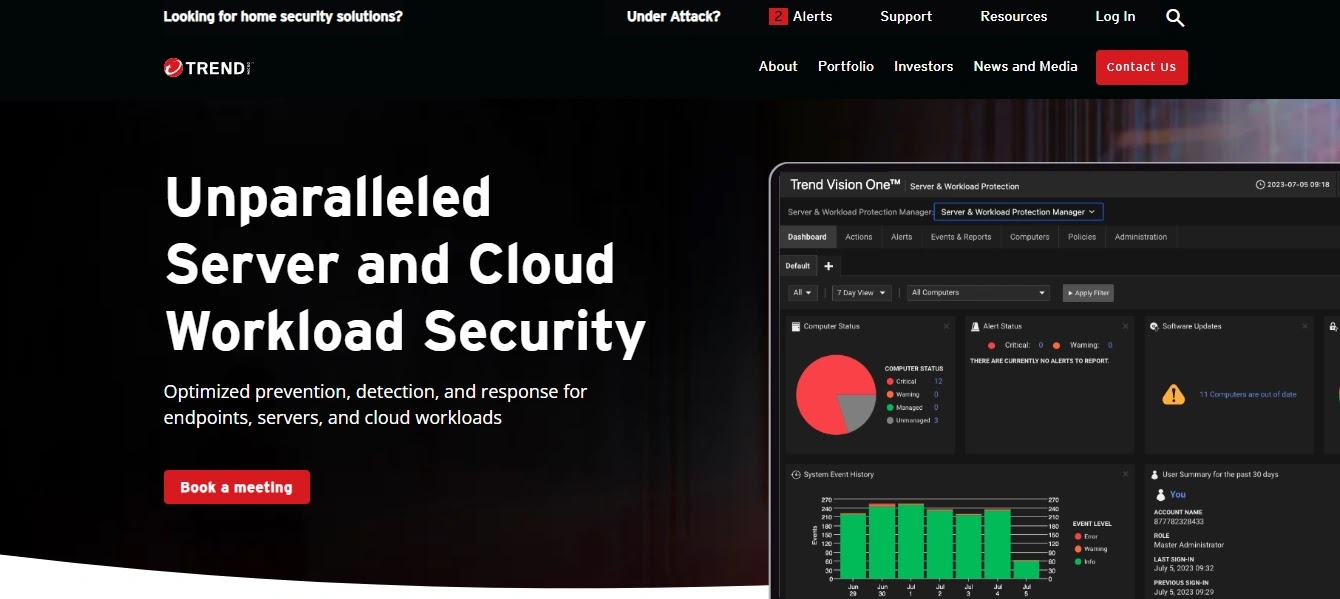
Trend Micro combines container security with its Deep Security heritage, offering unified visibility for containerized workloads, hybrid server, and network perimeter defense. This allows organizations to protect both legacy VMs and modern microservices under a single management umbrella, including virtual patching capabilities.
Wins: Comprehensive hybrid environment coverage (legacy + containers); strong virtual patching features.
Strains: Container-native depth is mid-tier compared to specialists; undergoing product naming migrations.
10. Anchore — best open-source SBOM and policy

Anchore specializes in compliance-grade container image analysis, automated Software Bill of Materials (SBOM) generation, and policy gating. Built on open-source tools like Syft and Grype, it addresses software supply chain risks and compliance drift effectively.
Wins: Deep expertise in SBOM and supply-chain security; robust policy gating; strong open-source lineage.
Strains: Scope is narrower than full lifecycle platforms; not a runtime security tool.
Buyer’s Guide
To establish a truly resilient container security posture, organizations must implement both pre-deployment scanning and runtime enforcement. Relying solely on image scanning creates a documented vulnerability gap, as images can pass initial checks only to be exploited later. Runtime drift prevention catches threats that scanning cannot predict.
For engineering-proficient teams, leveraging open-source foundations like Trivy for scanning and Falco for runtime detection is a highly credible starting point. Commercial solutions can then be integrated to provide necessary management, enhanced enforcement, and dedicated support as operational demands grow.
Crucially, integrate enforcement at the admission controller level. By configuring Kubernetes to reject unsigned or critically vulnerable images before they even execute, organizations can prevent many common attacks. This “shift-left” enforcement is significantly more cost-effective than attempting to remediate a compromise at runtime. For more information, consult our Kubernetes security guide.
Finally, carefully consider whether a specialized container security tool or a module within a broader CNAPP is the right fit. Container-first organizations or those building on an open-source layer may benefit most from specialists. However, for many enterprises, container security is increasingly bundled into their existing CNAPP investments. Avoid redundant coverage by purchasing both a specialist and a platform module for the same capabilities.
Common pitfalls include: solely scanning images without runtime enforcement
Disclaimer: HackersRadar reports on cybersecurity threats and incidents for informational and awareness purposes only. We do not engage in hacking activities, data exfiltration, or the hosting or distribution of stolen or leaked information. All content is based on publicly available sources.









No Comment! Be the first one.