



Best Multi-Cloud Security Platforms for 2026
Key Takeaways Organizations are increasingly adopting multi-cloud strategies, integrating services from AWS, Azure, GCP, and other providers, often alongside on-premises infrastructure. Effective...

Key Takeaways
- Organizations are increasingly adopting multi-cloud strategies, integrating services from AWS, Azure, GCP, and other providers, often alongside on-premises infrastructure.
- Effective multi-cloud security requires platforms that normalize disparate identity, networking, and service models into a unified policy framework and risk view.
- The market is bifurcated: CNAPP platforms focus on securing workloads, configurations, and identities within clouds, while cloud-networking security platforms address secure connectivity between diverse cloud environments.
- Choosing between cloud-agnostic platforms (offering equal depth across providers) and native-extended solutions (strongest in their home cloud) is a critical decision for achieving true multi-cloud parity.
- Recent developments, such as Google’s proposed acquisition of Wiz for approximately $32 billion, introduce important neutrality considerations for buyers of cloud-agnostic solutions.
The contemporary enterprise IT landscape is defined by multi-cloud deployments, a complex environment where organizations routinely integrate services from Amazon Web Services (AWS), Microsoft Azure, Google Cloud Platform (GCP), and often Oracle Cloud Infrastructure (OCI), alongside their existing on-premises infrastructure. This heterogeneous setup presents a significant challenge: each cloud provider implements identity management, networking protocols, and various services in fundamentally different ways.
Table Of Content
- Key Takeaways
- Addressing Your Multi-Cloud Security Challenges
- Identifying Your Specific Multi-Cloud Security Problem
- The Neutrality Dilemma in Multi-Cloud Security
- Cloud-Agnostic vs. Native-Extended Platforms
- Top 10 Multi-Cloud Security Platforms by Fit
- Palo Alto (Prisma Cloud) — best breadth across clouds
- Wiz — best correlation across clouds
- Check Point CloudGuard — best with network adjacency
- Fortinet — best network-security consistency
- Aviatrix — best multi-cloud networking security
- Microsoft (Defender for Cloud) — best Azure-anchored economics
- Trend Micro — best hybrid legacy + multi-cloud
- CrowdStrike — best endpoint-consolidated multi-cloud
- Orca Security — best agentless multi-cloud
- Tenable — best exposure-framed multi-cloud
- Deploying Multi-Cloud Security Without Gaps
- Key Deployment Considerations
- Verifying Your Multi-Cloud Security Commitment
- Verification Steps
- Situational FAQ
- What is a multi-cloud security platform?
- What is the best multi-cloud security platform in 2026?
To navigate this complexity, dedicated multi-cloud security platforms have emerged as essential tools. These solutions are designed to standardize these architectural disparities, offering a consolidated policy framework, a coherent risk graph, and a single management console that spans across diverse multi-cloud security architectures.
The market for multi-cloud security broadly divides into two primary categories. The first comprises Cloud-Native Application Protection Platforms (CNAPP), exemplified by vendors like Wiz, Prisma Cloud, and CrowdStrike, which focus on securing applications and data running within cloud environments. The second category consists of cloud-networking-security platforms, such as Aviatrix, which specialize in securing the intricate connections and traffic flows between different cloud providers.
This report details the top ten multi-cloud security platforms for 2026, categorizing them by their optimal fit to help organizations identify the most suitable solution for their specific security challenges.
Addressing Your Multi-Cloud Security Challenges
Before selecting a platform, organizations must clearly define their most pressing multi-cloud security issues. This strategic assessment determines whether a CNAPP, a cloud networking security solution, or a broader network security platform is required.
Identifying Your Specific Multi-Cloud Security Problem
Most searches for “multi-cloud security platforms” are driven by a need for CNAPP capabilities. However, if the primary concern revolves around securely connecting cloud environments, a specialized networking platform like Aviatrix is the appropriate solution. It is crucial not to confuse these distinct problem sets.
| Your problem | Market | Options |
| One risk view across cloud workloads/config/identity | CNAPP | Wiz, Prisma, CrowdStrike, Orca, Defender, Trend, Tenable |
| Consistent security networking between clouds | Cloud networking security | Aviatrix |
| Network/firewall consistency across clouds | Network security platform | Fortinet, Check Point, Palo Alto |
| Governance/compliance across many clouds | Governance-led | Caveonix-class, Prisma, Defender |
The Neutrality Dilemma in Multi-Cloud Security
A pivotal decision in multi-cloud security involves choosing between a cloud-agnostic platform and extending the native security tools of your primary cloud provider across other environments.
Cloud-Agnostic vs. Native-Extended Platforms
- Cloud-agnostic solutions (e.g., Wiz, Prisma Cloud, CrowdStrike, Orca Security, Aviatrix) offer genuine neutrality, providing consistent and deep security capabilities across AWS, Azure, and GCP. This approach aligns with the core principle of multi-cloud security: achieving uniform protection regardless of the underlying cloud provider.
- Native-extended solutions, such as Microsoft Defender for Cloud, excel within their native cloud environment (Azure) and offer capabilities for AWS and GCP through Azure Arc and other connectors. While capable, their deepest integration and functionality typically remain anchored to their home cloud.
A common pitfall is to assume that the native security tools of a dominant cloud provider will offer equivalent coverage across other cloud environments. This is rarely the case. For organizations prioritizing multi-cloud parity, cloud-agnostic platforms are generally a more robust choice. Furthermore, the recent announcement of Google’s acquisition of Wiz for approximately $32 billion introduces a critical neutrality question for Wiz’s future offerings. Buyers should ensure this is addressed in contractual agreements.
Top 10 Multi-Cloud Security Platforms by Fit
Palo Alto (Prisma Cloud) — best breadth across clouds

Prisma Cloud stands out for its extensive CNAPP module set, providing consistent multi-cloud parity across posture management, workload protection, identity entitlements, data security, and code scanning. It operates across AWS, Azure, and GCP on a unified policy plane, setting a high standard for enterprise cloud security.
- Wins: Comprehensive breadth and neutrality; proven enterprise-grade multi-cloud capabilities.
- Strains: Complex credit modeling; potentially heavy user experience.
- Best for: Large enterprises seeking to consolidate multi-cloud security.
Wiz — best correlation across clouds
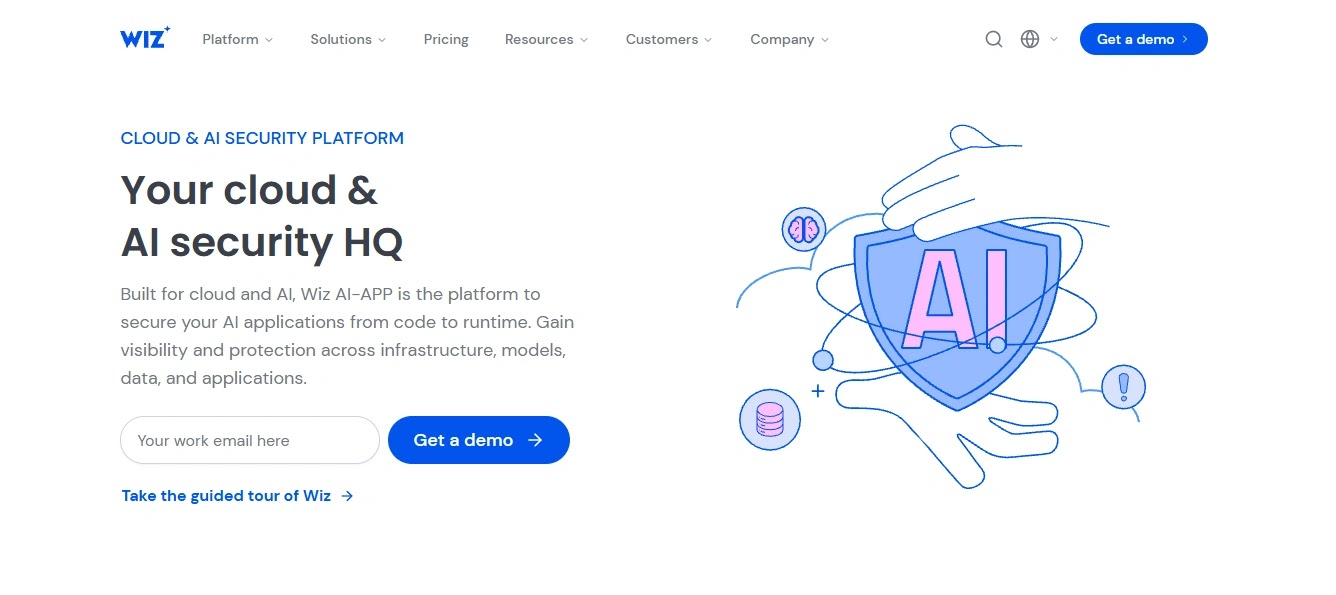
Wiz offers agentless multi-cloud visibility, leveraging a powerful graph architecture to normalize and correlate risks uniformly across AWS, Azure, and GCP. The platform actively addresses industry discussions regarding its acquisition by Google.
- Wins: Superior risk correlation; genuine multi-cloud parity; intuitive user experience.
- Strains: Premium pricing; potential neutrality concerns post-Google acquisition, requiring contractual safeguards.
- Best for: Multi-cloud enterprises prioritizing advanced correlation and parity, with careful contract negotiation.
Check Point CloudGuard — best with network adjacency

CloudGuard integrates multi-cloud posture governance and workload protection with robust cloud network security gateways. It delivers automated remediation for multi-cloud misconfigurations and compliance deviations across hybrid environments.
- Wins: Combines posture and network security across clouds; offers automated remediation; includes comprehensive compliance packs.
- Strains: Platform tends to favor existing Check Point infrastructure.
- Best for: Organizations with established Check Point estates extending into multi-cloud.
Fortinet — best network-security consistency

Fortinet provides consistent firewalling and network controls across multiple clouds through its Security Fabric. It combines FortiGate virtual appliances with FortiCNAPP to protect against infrastructure risks within the comprehensive Fortinet Security Fabric ecosystem.
- Wins: Unified network and firewall consistency across clouds; fabric automation; strong value proposition.
- Strains: FortiCNAPP integration requires confirmation; historical patch discipline for known exploited vulnerabilities (KEVs) needs attention.
- Best for: Network-centric organizations standardized on Fortinet solutions.
Aviatrix — best multi-cloud networking security

Aviatrix offers a specialized Multi-Cloud Networking Platform (MCNA) designed to secure inter-cloud traffic. It deploys distributed firewalls, egress filtering, and microsegmentation across AWS, Azure, GCP, and OCI.
- Wins: True multi-cloud network security and visibility; consistent policy enforcement across cloud networks; addresses connectivity challenges not covered by CNAPP.
- Strains: Primarily focused on networking security, not CNAPP for workload/configuration posture.
- Best for: Organizations whose primary multi-cloud challenge is secure and consistent connectivity.
Microsoft (Defender for Cloud) — best Azure-anchored economics
.webp)
Microsoft Defender for Cloud provides deep native visibility for Azure, extending posture management and threat detection to AWS and GCP via Azure Arc. It offers predictable per-resource economics under Microsoft’s enterprise security licensing.
- Wins: Favorable economics; strong integration with Defender XDR; extensive Azure depth.
- Strains: Parity is not equal across clouds, with deepest capabilities in Azure.
- Best for: Organizations with Azure as their primary cloud in a multi-cloud environment.
Trend Micro — best hybrid legacy + multi-cloud
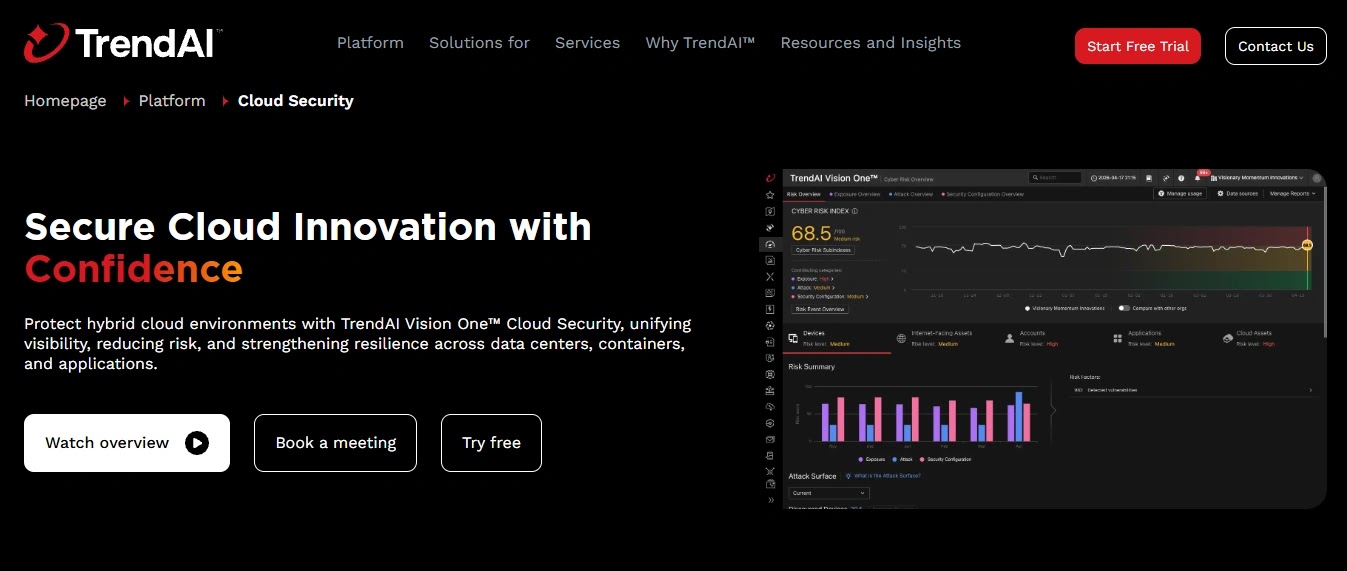
Trend Micro excels at bridging the security gap between traditional on-premises servers and modern multi-cloud workloads. It offers virtual patching, host intrusion prevention systems (IPS), and file integrity monitoring alongside contemporary server security and workload protection.
- Wins: Strong hybrid legacy and cloud support; virtual patching capabilities; sensible bundling options.
- Strains: CNAPP market mindshare is mid-tier; ongoing naming and product migration.
- Best for: Hybrid environments spanning both legacy infrastructure and multi-cloud deployments.
CrowdStrike — best endpoint-consolidated multi-cloud
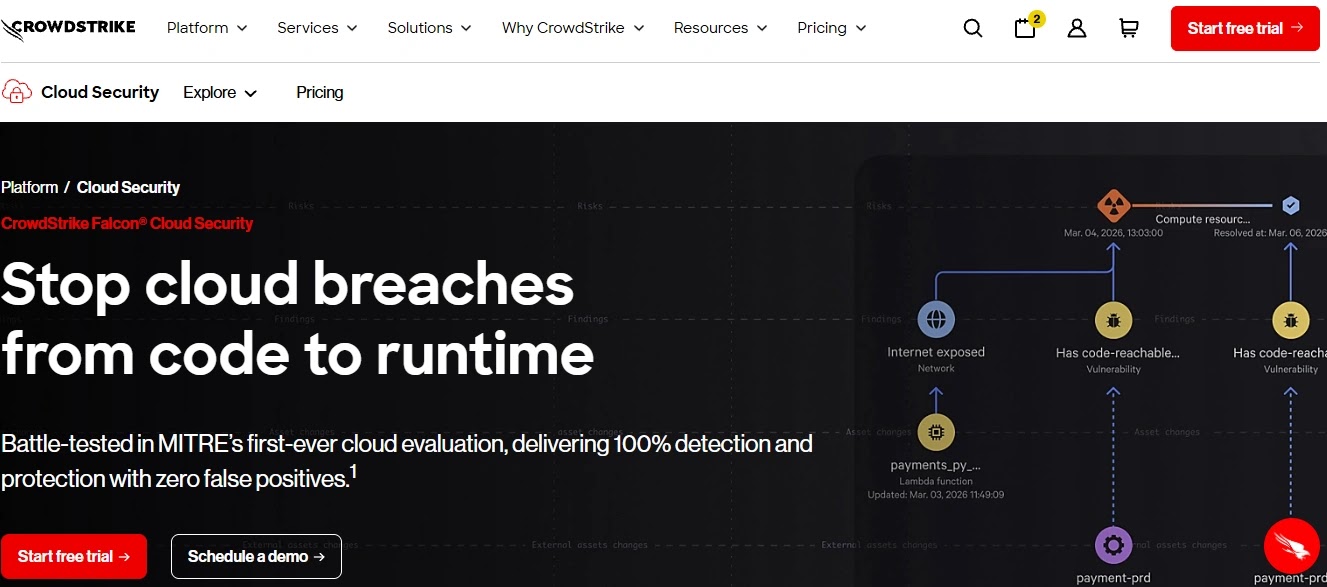
Falcon Cloud Security from CrowdStrike unifies workload protection and runtime threat detection across multiple cloud environments. It correlates cloud events with endpoint and identity data within a single console, simplifying threat management across distributed endpoints and cloud workloads.
- Wins: Excellent consolidation; robust runtime detection across clouds; strong adversary context.
- Strains: Cloud-native breadth may trail pure-play solutions in certain areas.
- Best for: Organizations standardized on CrowdStrike’s Falcon platform for their multi-cloud security needs.
Orca Security — best agentless multi-cloud
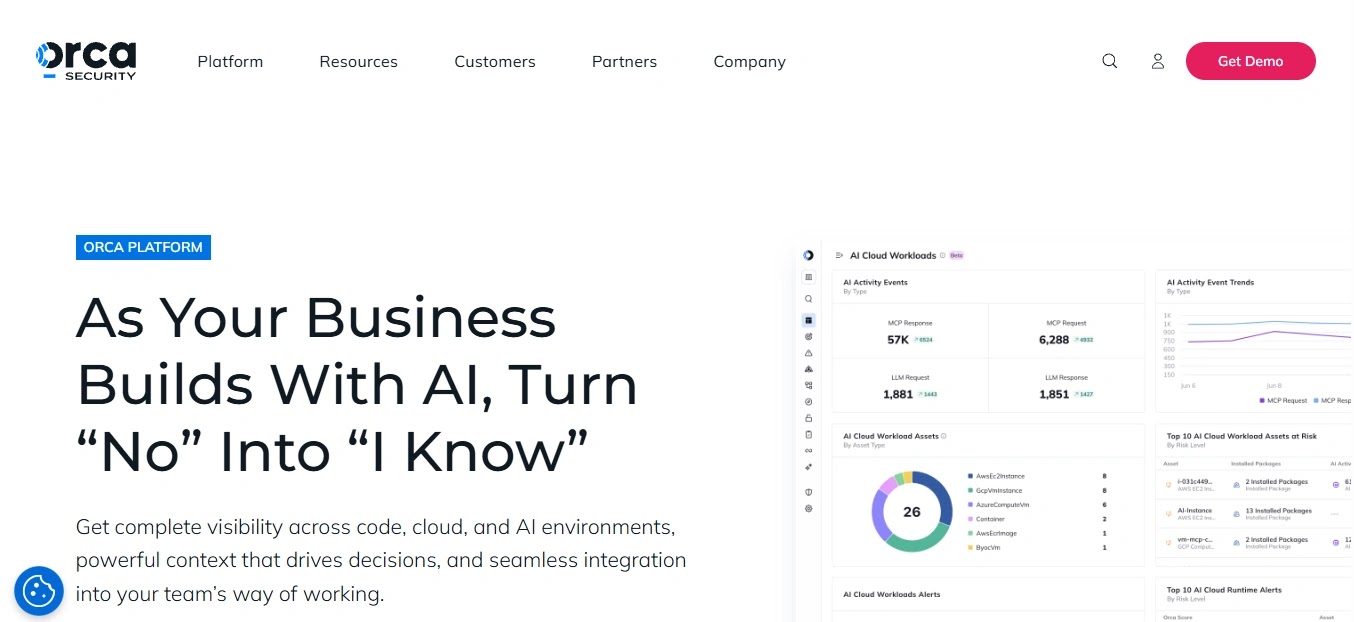
Orca Security utilizes its patented SideScanning technology to analyze cloud workloads, storage buckets, and configurations out-of-band. This enables organizations to discover exposed cloud resources and storage across AWS, Azure, and GCP without the need for agents.
- Wins: Agentless deployment offers neutrality and speed; provides strong contextual insights.
- Strains: Real-time runtime response may not match agent-based solutions.
- Best for: Multi-cloud environments prioritizing agentless coverage and ease of deployment.
Tenable — best exposure-framed multi-cloud
Tenable integrates cloud posture management and identity entitlement analysis (enhanced by the Ermetic acquisition) into Tenable One. This solution directly incorporates cloud risk scoring into existing exposure management tools and frameworks.
- Wins: Seamless integration with exposure management platforms; strong cloud identity capabilities; multi-domain coverage.
- Strains: Runtime breadth may not be as extensive as market leaders.
- Best for: Multi-cloud programs with a focus on exposure management.
Deploying Multi-Cloud Security Without Gaps
Successful multi-cloud security deployment requires careful planning to avoid common pitfalls and ensure comprehensive coverage.
Key Deployment Considerations
- Normalize Identity First: Each cloud provider models identity distinctively. The primary value of a multi-cloud security platform is to offer a single, unified view of “who can access what” across all environments. If Cross-Cloud Identity and Entitlement Management (CIEM) parity is weak, the platform’s multi-cloud effectiveness is compromised.
- Beware of the Parity Gap: Claims of “supporting AWS, Azure, GCP” can range from deep, equal integration to merely a superficial connector for non-primary clouds. Conduct pilot programs on your least-covered cloud to accurately assess the platform’s neutrality and capabilities, rather than relying on its performance in your dominant environment.
- Distinguish Connectivity from Posture: If secure inter-cloud networking is a genuine requirement, specialized solutions like Aviatrix, designed for network security, represent a distinct layer from CNAPP posture management. Budget for both, as one does not inherently cover the other.
- Consolidate Consoles Strategically: The fundamental goal is a unified risk view. If your deployment results in a CNAPP, multiple native cloud tools, and a separate networking platform all operating in silos, you have inadvertently recreated the problem you sought to solve. Establish a clear authoritative source for security insights.
- Common Mistakes to Avoid: Purchasing native tools from your dominant cloud provider and assuming multi-cloud parity; conflating network security with workload/configuration posture; neglecting cross-cloud identity normalization; and implementing multiple overlapping, uncorrelated platforms.
Verifying Your Multi-Cloud Security Commitment
Before making a long-term commitment, rigorous verification is essential to ensure the chosen platform meets your organization’s specific multi-cloud security needs.
Verification Steps
- Test on Your Least-Covered Cloud: This is the ultimate test of a platform’s neutrality and true multi-cloud capabilities.
- Confirm Cross-Cloud Identity Normalization: Verify that the platform provides a single, coherent view of effective permissions across AWS, Azure, and GCP, rather than three separate, siloed views.
- Enforce Zero Trust Verification: Implement strict microsegmentation and identity verification across all inter-cloud connections, adhering to the NIST Zero Trust Architecture guide.
- Contract for Neutrality: Given the Google-Wiz acquisition, it is imperative to include contractual clauses that protect roadmap commitments and ensure ongoing multi-cloud neutrality. Leverage this situation for favorable pricing.
- Model Consumption at Multi-Cloud Peak: Accurately project credit-based and per-resource pricing across all clouds, particularly during peak usage, as unexpected costs can accumulate rapidly. Determine if you require CNAPP, networking security, or both, and factor this into your budget.
Situational FAQ
What is a multi-cloud security platform?
A multi-cloud security platform standardizes security across various cloud providers (e.g., AWS, Azure, GCP), offering a single policy framework, a unified risk view, and a consolidated management console. This is crucial because each cloud provider has distinct models for identity, networking, and services. These platforms typically span two key markets: CNAPP (securing workloads and configurations within clouds) and cloud-networking security (securing the connections between different cloud environments).
What is the best multi-cloud security platform in 2026?
For cloud-agnostic CNAPPs, Prisma Cloud leads in
Disclaimer: HackersRadar reports on cybersecurity threats and incidents for informational and awareness purposes only. We do not engage in hacking activities, data exfiltration, or the hosting or distribution of stolen or leaked information. All content is based on publicly available sources.






No Comment! Be the first one.