




10 Best Network Security Providers for Healthcare Industry in 2026
It provides a comprehensive security solution, managed through a centralized portal. This encompasses a comprehensive cloud usage visibility solution designed to evaluate potential risks and...

It provides a comprehensive security solution, managed through a centralized portal. This encompasses a comprehensive cloud usage visibility solution designed to evaluate potential risks and safeguard sensitive health information (PHI).
Table Of Content
It also enforces data access and transmission control policies to prevent unauthorized access and data loss.
Encrypting data at rest and in transit eliminates the need for breach notification in case of a breach.
Additionally, it offers a hardware-free cloud VPN for secure remote access, application-by-application access permissions, comprehensive logging, and centralized management
Why do we Recommend It?
- Simplifies secure network, cloud, and application access for the modern and mobile workforce
- HIPAA-compliant and offers features such as 2FA, easy scalability, cost-effectiveness, and ease of use
- Helps healthcare providers meet compliance requirements by providing IT teams with a powerful array of unified networking and cybersecurity tools
- Uses a multi-layer approach to protect patient data
- Offers a single portal for administration
Pros:
- Streamlines meeting HIPAA and other regulations.
- Provides insights into cloud usage for better security.
- Encrypts data and enforces access controls.
Cons:
- It may not eliminate breach notification requirements.
- Scaling costs for more extensive networks.
2. Palo Alto Networks
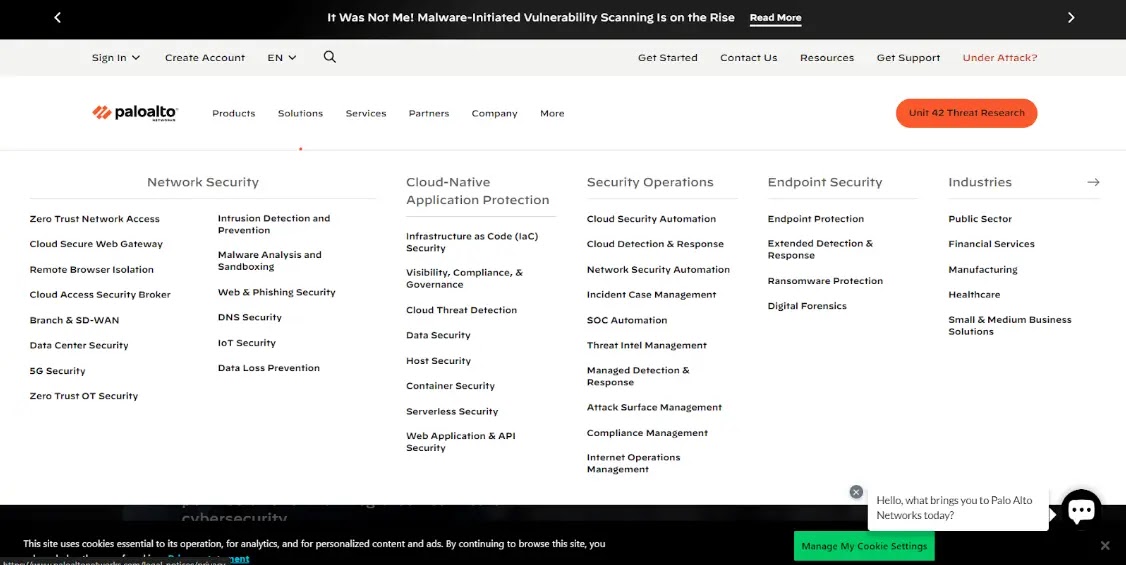
Palo Alto Networks offers a unified cybersecurity platform for healthcare organizations by integrating network security, cloud security, and security operations to address the industry’s unique challenges.
Allows healthcare providers to securely leverage cloud-based solutions, data analytics, and AI/ML for improved patient care and data sharing.
The platform strengthens regulatory compliance and secures remote workforces and telemedicine practices through automation and consistent security controls.
By consolidating security tools and automating threat analysis, healthcare organizations can reduce management complexity and costs while enhancing their overall cybersecurity posture.
It enables them to deliver efficient and secure patient care anywhere within the evolving healthcare landscape.
Pros:
- Integrates different security solutions into one platform for easier management and reduced complexity.
- Offers features like threat analysis, automation, and consistent security controls to strengthen healthcare cybersecurity.
- It enables secure use of the cloud, data analytics, and AI/ML for better patient care and data sharing.
- Reduces security sprawl and saves money by unifying security management.
- Adapts to the evolving healthcare landscape and growing number of connected devices.
Cons:
- It might be complex to set up and require expertise to manage the platform effectively.
- The cost of the platform itself might be a consideration for smaller healthcare organizations.
Why do we recommend it?
- Protects patient data and stays ahead of threats.
- Delivers value-based care with secure clouds, data analytics, and AI/ML.
- Improves security for the remote workforce and telemedicine patients.
- Unifies network and cloud security policy and management.
- It helps manage technology risks and elevates cyber resilience for patient safety and privacy.
3. Fortinet
Pros:
- It combines various security functions into a single system, simplifying management.
- Integrates security with physical security systems for better overall protection.
- Offers SD-WAN and secure networking solutions specifically for branch offices.
- Delivers strong performance even with data encryption.
Cons:
- It may be expensive, depending on the healthcare organization’s budget.
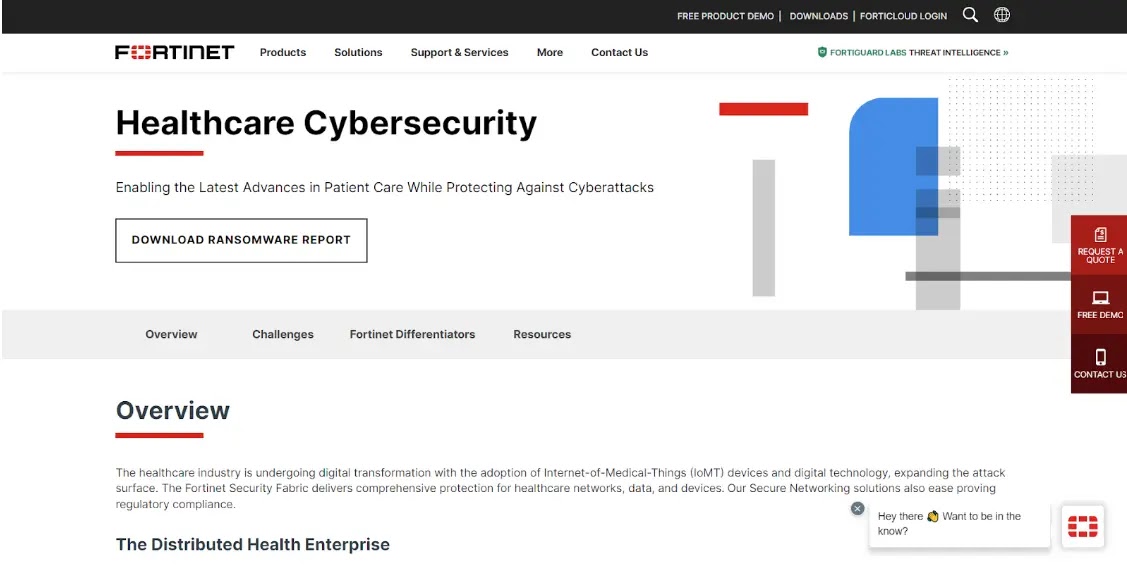
The Fortinet Security Fabric is a comprehensive cybersecurity solution for the healthcare industry.
Effectively tackles the obstacles of digital transformation by offering comprehensive security solutions for networks, data, and devices.
Offers features such as intelligent segmentation, Network Access Control (NAC), endpoint protection, and Identity and Access Management (IAM) to secure Internet of Medical Things (IoMT) devices and users.
Integrates physical security functions with cybersecurity solutions, providing a comprehensive view of security posture.
It also addresses low latency and high-performance processing needs for encrypted traffic, which helps healthcare organizations comply with regulations and improve operational efficiency.
Why do we recommend it?
- Integrates security and networking functions
- Secures internet-of-medical-things (IoMT) devices
- Complies with regulations
- Responds to cyber threats
- Delivers high-performance processing
- Secures branch locations
4. Cisco
Cisco offers healthcare providers a suite of technologies to improve patient care, staff workflows, and efficiency.
Their solutions include secure networking for connecting patients, providers, and staff and collaboration tools for remote care delivery.
Security is a significant focus, with Cisco providing threat assessment and security resilience strategies.
By enabling a hybrid work model, Cisco’s technology helps alleviate clinician burnout and improve the staff experience.
With extensive experience in the healthcare industry, it is a trusted partner for hospitals and clinics worldwide.
Why do we recommend it?
- It offers solutions to connect patients, providers, and staff.
- Security solutions to protect patient information.
- Help healthcare organizations improve patient care.
- The clinician’s experience can be improved with Cisco’s solutions.
- Data-driven care decisions can be made.
Pros:
- Improves workflows throughout healthcare organizations.
- Enables secure connections between providers, patients, and staff.
Cons:
- It requires building a strategy for security resilience.
- It is complex to implement and manage, requiring skilled IT staff, which can burden smaller healthcare organizations with limited IT resources.
- It is expensive, with licensing fees and potentially high implementation costs, which is a barrier for budget-conscious healthcare providers.
- While it offers solutions for IoT security, its core strength lies in traditional IT security.
5. Symantec
Symantec offers various security solutions to prevent data breaches, including Symantec Advanced Threat Protection (ATP), Symantec Endpoint Protection, and Symantec Hosted Email Security.cloud with Messaging Gateway.
ATP allows for centralized investigation and remediation of advanced threats across endpoints, networks, and email.
Symantec Endpoint Protection leverages global threat intelligence to protect against known and unknown threats on endpoints and virtual desktops.
Symantec Hosted Email Security. Cloud with Messaging Gateway utilizes threat intelligence and skeptic scanning to secure cloud-based email and block spam and phishing attacks.
It also analyzes email content to prevent data loss and encrypts emails for confidentiality.
Web Security. Cloud protects users from malicious downloads and enforces web browsing policies.
Why do we recommend it?
- It can expose, prioritize, and remediate advanced threats across endpoints, networks, and email, all from a single console.
- Scan for attack artifacts across the infrastructure, drill into the details of an attack, prioritize compromised systems, and quickly remediate all with a single click.
- Uncover attacks that would otherwise evade detection
Pros:
- Offers a single console to view and manage threats across various systems (endpoints, network, email).
- Allows for quicker identification, prioritization, and remediation of threats, potentially saving time compared to traditional methods.
- p+Provides a combination of Endpoint Protection, Email Security, and Web Security, offering a layered defense against various attack vectors.
- Email Security features like Policy-Based Encryption and Image Control can help prevent sensitive healthcare data from leaking.
Cons:
- While offering a centralized view, managing security across multiple systems can be complex for smaller IT teams.
6. Trend Micro
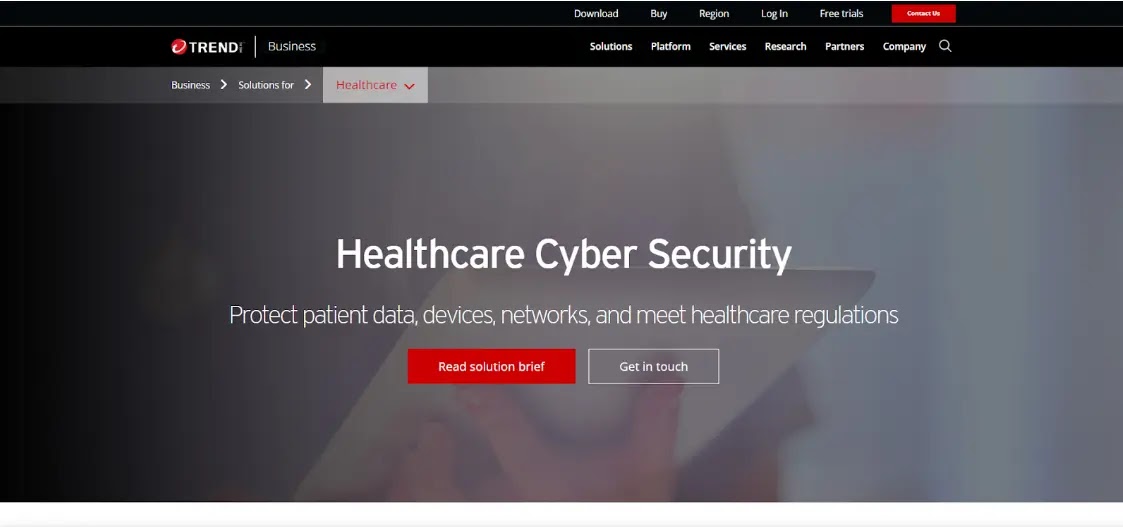
Trend Micro offers security solutions for healthcare organizations facing increasing cyber threats.
Their Network Defence solutions utilize advanced malware detection, network activity monitoring, and sandbox analysis to uncover and stop targeted attacks on Electronic Protected Health Information (ePHI).
As healthcare organizations move data to the cloud, it provides security solutions for hybrid cloud environments.
The User Protection solutions offer multi-layered security for various endpoints, mobile devices, and Internet of Things (IoT) devices, while integrating Data Loss Prevention (DLP) to prevent unauthorized data exfiltration.
They also offer supplementary security solutions for healthcare organizations using Office 365 in the cloud.
Why do we recommend it?
- Helps healthcare organizations address challenges faced in protecting patient data and complying with regulations.
- Keeps patient data safe.
- Meets compliance needs.
- It is hassle-free for smaller organizations.
Pros:
- Protects against various cyber threats, including ransomware
- Offers layered security with advanced protection techniques
- Manages security locally, remotely, or both
- Designed for the future and easy to integrate across enterprise systems
Cons:
- It is not ideal for small businesses in the healthcare industry, as it requires individual licenses for each device needing protection.
- It scored low in offline detection tests, a concern for the healthcare industry, where some devices may not always be connected to the internet.
7. Imprivata
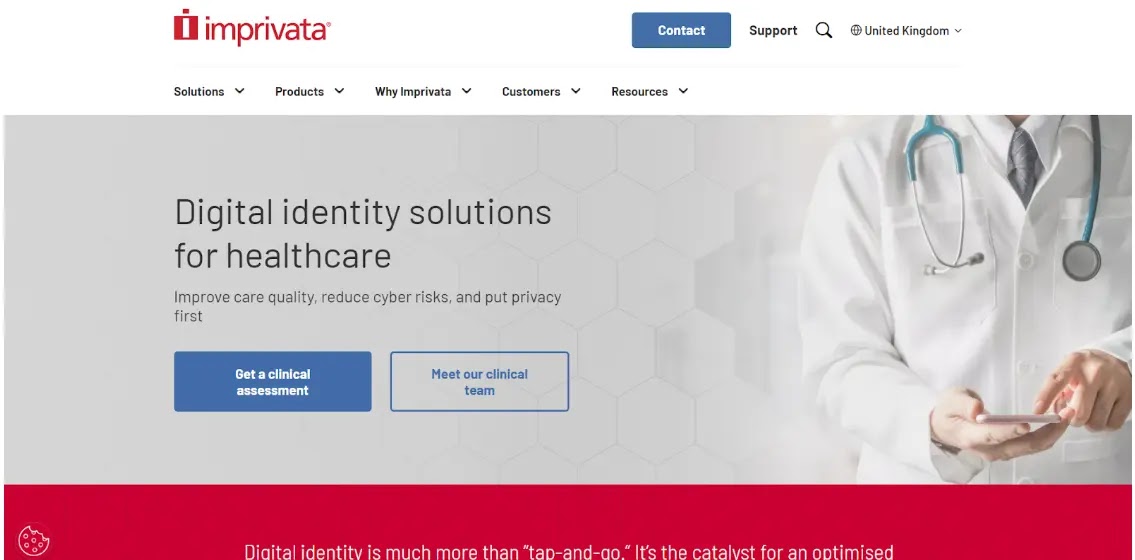
A digital identity system can significantly improve healthcare organizations by streamlining workflows and enhancing security.
It can achieve this by utilizing robust authentication methods to eliminate manual logins for mobile access (reducing 90% of steps).
The system can automatically detect unauthorized access to patient data, preventing 99% of incidents.
Improves patient privacy and regulatory compliance by safeguarding sensitive information throughout the care cycle.
Automated identity management simplifies access control for clinicians, allowing them to focus on patient care.
Overall, a digital identity system optimizes Electronic Patient Record (EPR) usage, manages third-party access risks, and improves clinical workflow efficiency.
Why do we recommend it?
- Streamlines clinical workflows, allowing for faster and more efficient care.
- Secures critical infrastructure, protecting patient data from cyberattacks.
- Protects patient privacy by ensuring only authorized personnel have access to medical records.
- Reduces manual authentication steps, saving clinicians time and reducing errors.
- Automatically identifies unauthorized access to patient health information (PHI).
- It can be tailored to meet the specific needs of modern identity and access management in healthcare.
Pros:
- Reduces manual authentication steps for mobile workflows, freeing up clinician time.
- Automatically identifies unauthorized access to patient data.
- Simplifies audit recordkeeping and reporting for regulatory requirements.
- Automates granting, revoking, and monitoring access to healthcare systems.
Cons:
- Setting up can be complex and requires assistance from IT.
- Conflict with existing software that has an auto login feature, causing inconvenience.
- It does not automatically log out users when they walk away from the computer, which can be a security concern for some users.
- Limited customization options may not be suitable for organizations that need a highly customized solution.
- The reporting functionality in Imprivata’s Admin Console may be limited.
8. CyberArk
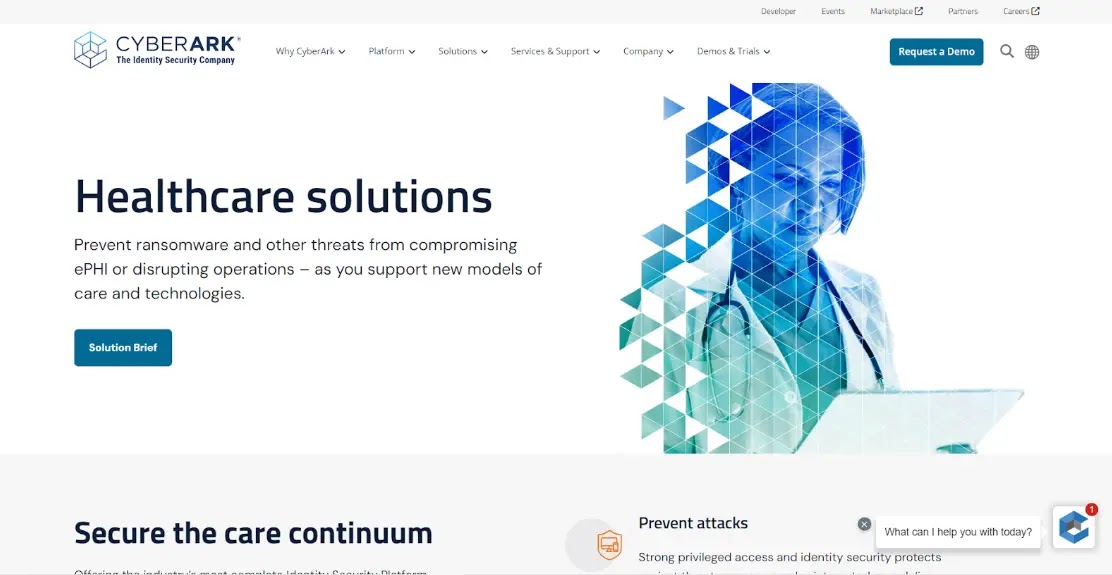
CyberArk offers healthcare organizations a comprehensive identity Security Platform that protects electronically protected health information (ePHI) and prevents ransomware attacks.
Their platform secures privileged access and user identities across complex care delivery networks, including virtual care and patient portals.
It helps healthcare organizations comply with regulations like HIPAA and ISO/IEC 27002 by reducing the burden on IT staff and enabling secure access to business applications for both human and machine identities.
The privileged access management solution helps prevent the lateral movement of ransomware and isolate compromised credentials.
We also offer customer and workforce identity solutions that leverage AI to secure access, provide a passwordless experience and secure DevOps environments without impacting agility.
Why do we recommend it?
- Industry’s most complete Identity Security Platform.
- Offers privileged solid access and identity security.
- Protects against threats across complex integrated care delivery networks.
- Help healthcare organizations meet compliance requirements.
- Secure patient confidentiality.
Pros:
- It stops ransomware and other threats with privileged access security and prevents lateral movement within the network.
- Ensures adherence to regulations like HIPAA with documented and auditable access controls.
- Reduces the burden on IT and staff by simplifying security solutions.
- Secures access to business applications for both human and machine users.
Cons:
- It may be expensive for smaller healthcare organizations.
9. Zscaler
The healthcare industry suffers the most from data breaches, with an average cost of $10.1 million per incident.
Zero Trust Architecture (ZTA) can mitigate this risk by enforcing access control and implementing multiple layers of threat prevention.
ZTA uses access control to limit access to externally managed applications and internet destinations based on user roles.
Threat prevention includes advanced threat protection, which delivers real-time protection from malicious content, and daily security updates to the Zscaler cloud to ensure comprehensive threat blockage.
Why do we recommend it?
- It offers a Zero-Trust Architecture (ZTA) compliant with HIPAA regulations, which can help reduce the risk of cyberattacks by limiting access to data and applications only to authorized users.
- It encrypts data at rest and in transit, which can help protect sensitive healthcare information.
- Inspects traffic for malware and other threats, which can help prevent data breaches.
- Provides cloud-based security, eliminating the need for on-premises security infrastructure and saving time and money.
- Easy to deploy and manage, which can help reduce IT costs
Pros:
- Enforces access control to patient data
- Provides multiple layers of threat protection
- Real-time protection from malicious Internet content
- Daily updates to Zscaler cloud to protect users
Cons:
- It relies on cloud security, which may not be mature in all healthcare organizations
10. CrowdStrike
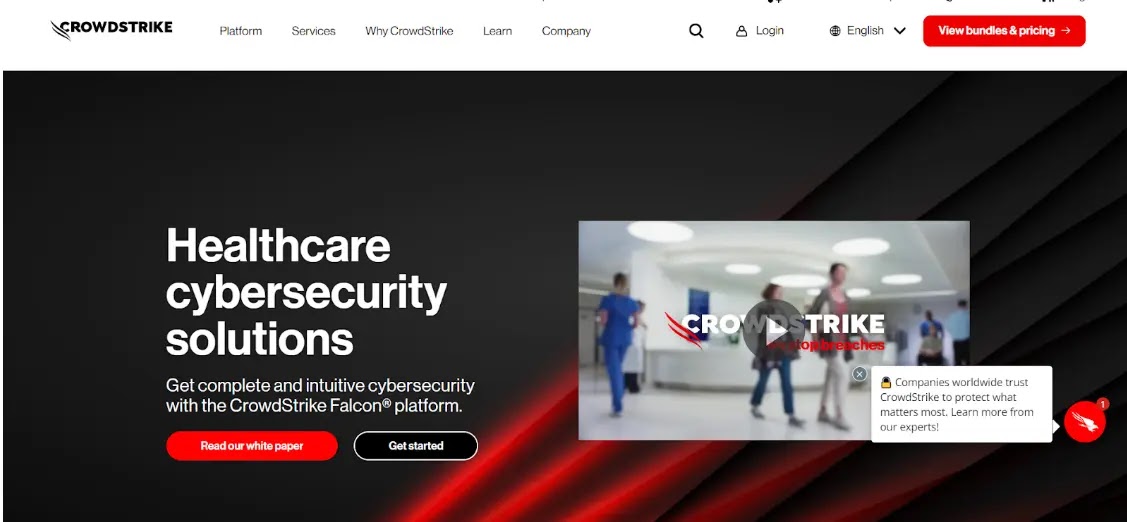
CrowdStrike offers a cloud-native security platform (Falcon) to address the rising cyber threats in healthcare.
Falcon protects endpoints (desktops, laptops, servers, etc.) on any network and uses threat intelligence to proactively detect and respond to attacks, allowing healthcare organizations to transition to remote workforces and telemedicine securely.
It consolidates security functions across various devices and platforms (Windows, Linux, Macs, etc.), potentially reducing IT security costs by 30%.
Additionally, CrowdStrike Falcon Complete offers managed security operations (24/7) and threat hunting to identify and stop sophisticated attacks.
Falcon Discover offers comprehensive visibility and robust protection for Internet of Medical Things (IoMT) devices.
Why do we recommend it?
- Protects against various cyber threats with an AI-native cybersecurity platform.
- Designed to be easy to use and deploy.
- Reduces IT security costs by 30%.
- Protects endpoints from any location.
- Provides visibility across various devices.
- Offers MDR (Managed Detection and Response) for continuous threat monitoring.
Pros:
- Easy and quick deployment
- Unified visibility across various devices and platforms
- Advanced endpoint protection with threat detection and prevention
- Managed security operations and threat-hunting
- Unmatched visibility for Internet of Medical Things (IoMT) devices
Cons:
- Requires skilled staff to interpret results
Conclusion
In 2026’s fast-evolving healthcare cybersecurity landscape, choosing the optimal network security solution is essential to protect sensitive patient data and meet rigorous regulations like HIPAA.
Perimeter 81 stands out as the premier option for healthcare organizations demanding robust, intuitive, and all-encompassing network defense.
Disclaimer: HackersRadar reports on cybersecurity threats and incidents for informational and awareness purposes only. We do not engage in hacking activities, data exfiltration, or the hosting or distribution of stolen or leaked information. All content is based on publicly available sources.








No Comment! Be the first one.