




BlobPhish Attack Steals Login Credentials via Browser Blob Objects
Key Takeaways A sophisticated phishing campaign, dubbed BlobPhish, has been actively stealing login credentials since October 2024. The attack leverages browser Blob URL APIs to generate phishing...

Key Takeaways
- A sophisticated phishing campaign, dubbed BlobPhish, has been actively stealing login credentials since October 2024.
- The attack leverages browser Blob URL APIs to generate phishing pages entirely within the victim’s browser, making them virtually invisible to traditional security tools.
- Microsoft 365 users, major U.S. banks, and various financial platforms are primary targets, with victims spanning multiple sectors globally.
- The campaign is ongoing and has shown a significant surge in activity in February 2026, indicating a well-maintained and mature threat operation.
- Mitigation strategies include advanced sandbox analysis, proactive threat hunting, phishing-resistant MFA, and continuous employee training.
Since October 2024, a highly advanced, memory-resident phishing operation known as BlobPhish has been relentlessly compromising user credentials. This campaign specifically targets Microsoft 365 accounts, prominent U.S. banking institutions, and other financial services by exploiting browser Blob URL APIs. A critical aspect of BlobPhish’s success is its remarkable ability to evade detection by conventional security measures.
Table Of Content
BlobPhish represents a significant evolution in credential-phishing tactics, fundamentally altering the method by which malicious login pages are delivered to unsuspecting victims.
Unlike traditional phishing attacks that host fake login pages on attacker-controlled web servers and serve them via standard HTTP, BlobPhish generates its phishing pages entirely within the victim’s browser using JavaScript Blob objects. This innovative approach results in a phishing payload that exists solely in memory, leaving no discernible forensic artifacts such as disk files, cache entries, or suspicious HTTP requests in proxy logs for security tools to flag.
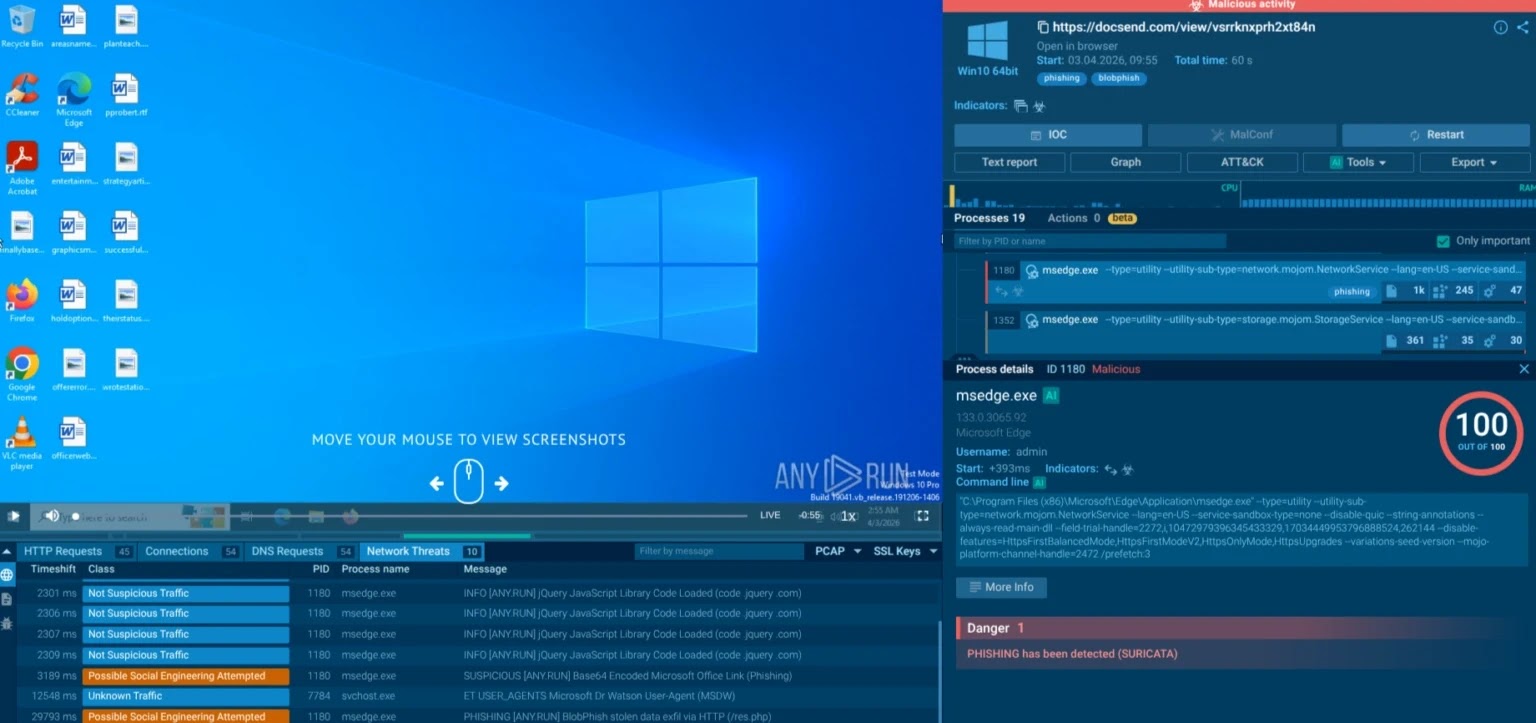
The campaign, first identified in October 2024, has persisted without interruption for over 18 months. A notable increase in activity was observed in February 2026, underscoring its status as a mature and continuously developed threat rather than a fleeting opportunistic assault.
BlobPhish Kill Chain
The BlobPhish kill chain is ingeniously designed to circumvent both network-based and file-based security defenses:
- Initial Access: Victims typically receive a phishing email, often disguised as a financial notification, invoice, or document-sharing alert. These emails contain links to seemingly trustworthy services like DocSend or shortened URLs from platforms such as t.co. Additionally, PDF attachments embedded with QR codes leading to malicious JavaScript pages have been observed, particularly targeting the energy sector.
- Loader Execution: Clicking the malicious link redirects the victim to an attacker-controlled HTML page hosting a JavaScript loader. This loader, utilizing jQuery, covertly creates a hidden
<a>anchor element. It then Base64-decodes a bundled phishing payload usingatob(), constructs aBlobobject of typetext/html, generates ablob:https://URL viawindow.URL.createObjectURL(), and finally forces the browser to navigate to this URL. All these actions occur without any visible user interaction.
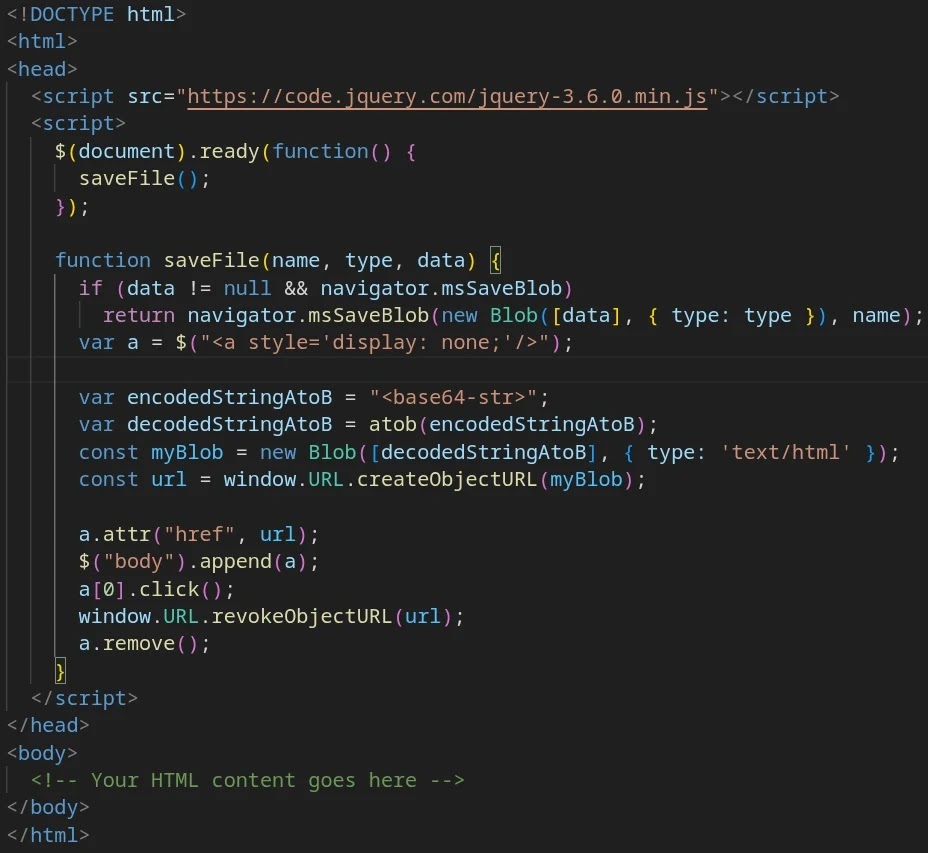
- Evidence Destruction: Immediately after the browser navigates to the Blob URL, the loader executes
window.URL.revokeObjectURL()and removes the anchor element from the Document Object Model (DOM). This action effectively eliminates any remaining in-memory traces of the loader’s operation.

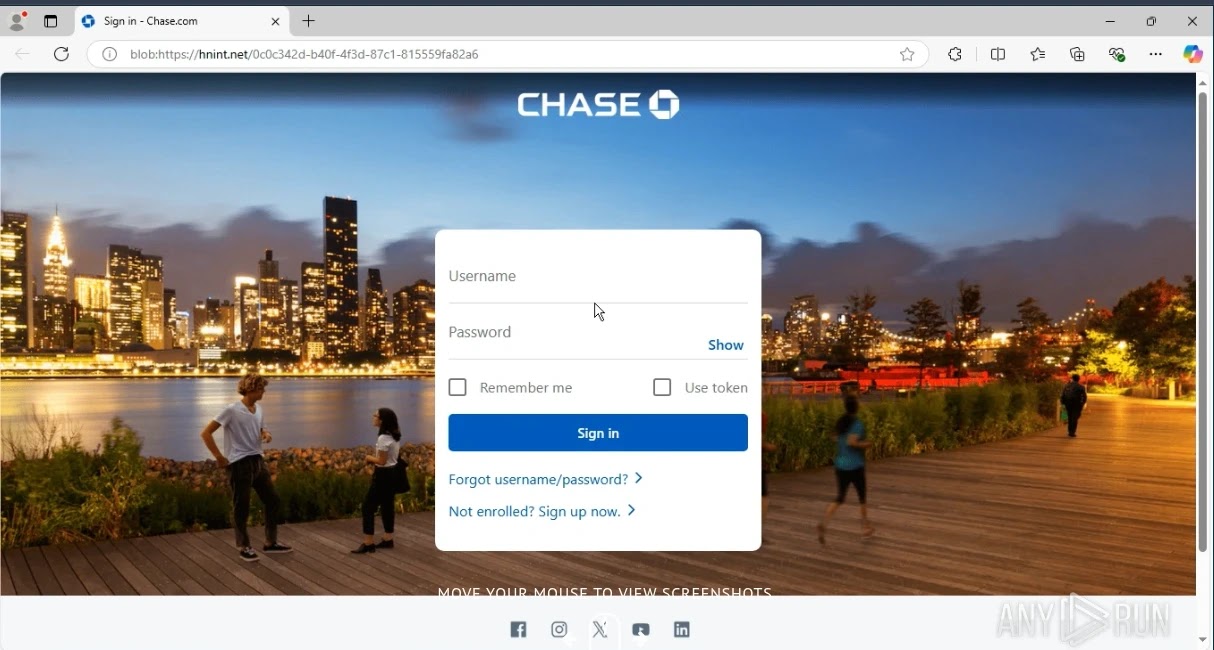
- Credential Harvest: The victim is then presented with a highly convincing replica of a login page for services such as Microsoft 365, Chase, Capital One, or other financial platforms. The browser’s address bar displays a
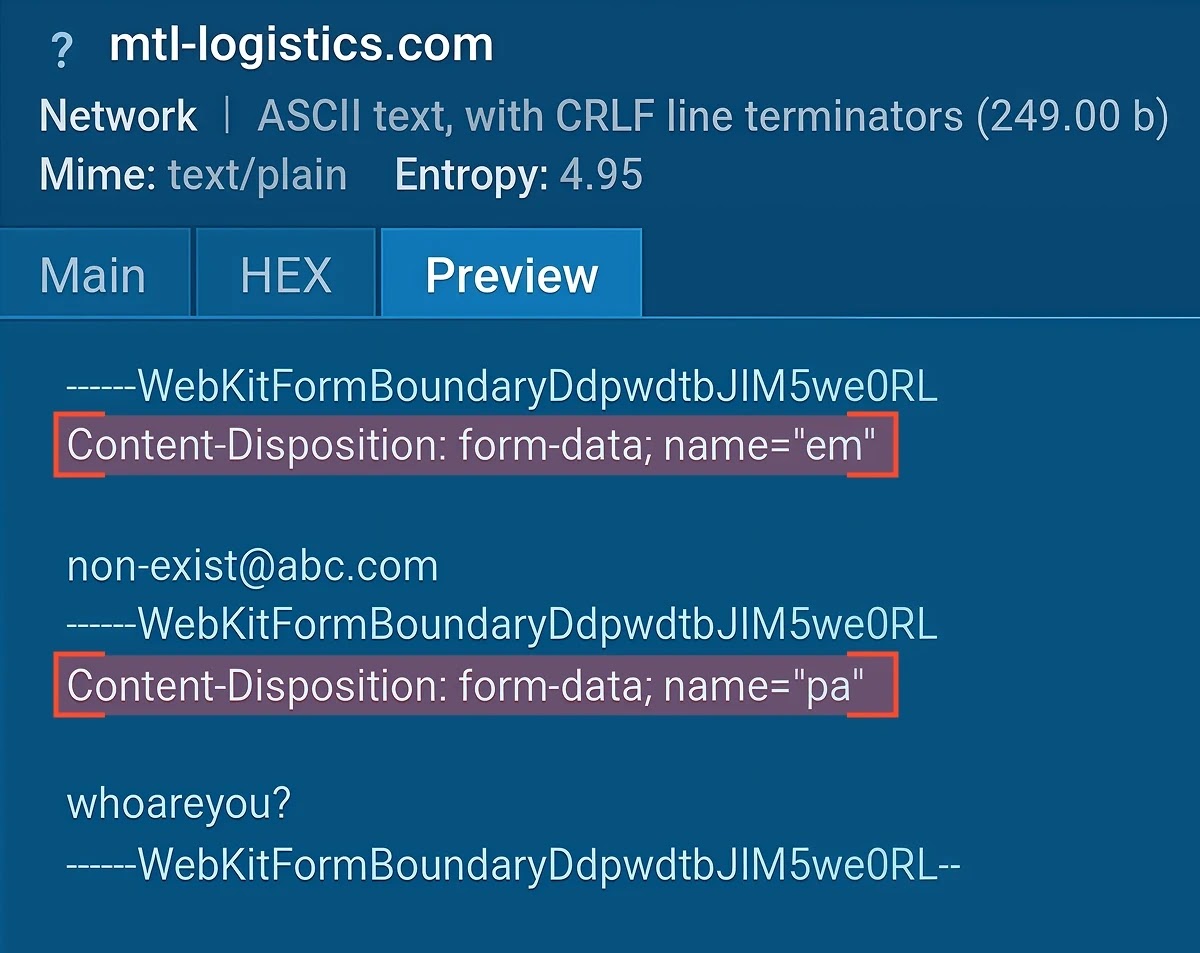
blob:https://URL, which can easily appear legitimate to an unsuspecting user. A built-in failed-login counter often prompts victims to re-enter their credentials multiple times, enhancing the accuracy of harvested data. Captured credentials are exfiltrated via HTTP POST requests to attacker-controlled endpoints, typically matching patterns like*/res.php,*/tele.php, or*/panel.php. These endpoints are predominantly hosted on compromised legitimate WordPress sites.
BlobPhish Evades Conventional Defenses
BlobPhish targets an extensive range of high-value platforms, including Microsoft 365, OneDrive, SharePoint, Chase, Capital One, FDIC, E*TRADE, Charles Schwab, Morgan Stanley/Merrill Lynch, American Express, PayPal, and Intuit.
While financial and cloud productivity lures are dominant, the victim organizations span diverse sectors, including Finance, Manufacturing, Education, Government, Transportation, and Telecommunications.
Geographically, approximately one-third of the observed victims are based in the United States, with additional activity noted across Germany, Poland, Spain, Switzerland, the UK, Australia, South Korea, Saudi Arabia, Qatar, Jordan, India, and Pakistan.
The campaign’s primary innovation for evasion lies in its use of the blob:https:// scheme. Since the phishing page is never transmitted over the network as a standalone HTTP response, it bypasses numerous security mechanisms:
- URL reputation engines are ineffective because there is no external URL for them to scan.
- Proxy logs show no suspicious requests related to the phishing page itself.
- Secure Email Gateways (SEGs) miss the payload, as it materializes only after email delivery.
- File-based endpoint solutions find nothing, as no file is ever written to disk.
- Cache forensics yield no results, as the Blob URL is revoked before investigators can inspect it.
A single successful BlobPhish compromise can lead to severe consequences, including Business Email Compromise (BEC) fraud, complete Microsoft 365 tenant takeover, unauthorized wire transfers, manipulation of investment accounts, and even ransomware deployment following lateral movement within a network.
Beyond operational damage, organizations face significant legal exposure due to regulatory requirements such as GDPR’s 72-hour breach notification, SEC cybersecurity incident disclosure, and FFIEC authentication guidance.
Key Indicators of Compromise (IOCs)
| IOC Type | Example |
|---|---|
| Loader URL | hxxps[://]mtl-logistics[.]com/blb/blob[.]html |
| Exfiltration endpoint | hxxps[://]mtl-logistics[.]com/css/sharethepoint/point/res[.]php |
| Capital One exfil | hxxps[://]wajah4dslot[.]com/wp-includes/certificates/tmp//res[.]php |
| Chase Banking exfil | hxxps[://]hnint[.]net/cgi-bin/peacemind//res[.]php |
| E*TRADE exfil | hxxps[://]ftpbd[.]net/wp-content/plugins/cgi-/trade/trade//res[.]php |
| tele.php variant | hxxps[://]_wildcard_[.]gonzalezlawnandlandscaping[.]com/…/tele[.]php |
Additional compromised domains identified include larva888[.]com, riobeautybrazil[.]com, i-seotools[.]com, and mts-egy[.]net.
What You Should Do
To defend against sophisticated attacks like BlobPhish, security teams must implement a multi-layered defense strategy focused on dynamic analysis and user education:
- Deploy Advanced Sandbox Analysis: Utilize sandbox environments capable of executing JavaScript within real browsers to safely detonate blob-based payloads before they reach end-users.
- Proactive Threat Hunting: Actively hunt for BlobPhish activity using the
BlobPhishLoaderHTMLYARA rule and pivot queries (e.g.,url:"/res.php$",url:"*/blob.html$") within threat intelligence platforms. - Enforce Phishing-Resistant MFA: Implement and enforce phishing-resistant Multi-Factor Authentication (MFA), such as FIDO2/hardware keys, on all critical platforms like Microsoft 365 and banking portals to significantly reduce the impact of successful credential compromise.
- Integrate Live Threat Intelligence: Automate the integration of real-time threat intelligence feeds that push BlobPhish Indicators of Compromise (IOCs) directly into firewalls, proxies, and SIEM rules to rapidly adapt defenses as attacker infrastructure evolves.
- Conduct Regular Employee Training: Educate employees to recognize the unique red flag of unexpected
blob:https://URLs in their browser address bars, fostering a culture of vigilance against novel phishing techniques.
Disclaimer: HackersRadar reports on cybersecurity threats and incidents for informational and awareness purposes only. We do not engage in hacking activities, data exfiltration, or the hosting or distribution of stolen or leaked information. All content is based on publicly available sources.








No Comment! Be the first one.