




Anthropic Claude Mythos Preview Boasts Zero-Day Detection
Key Takeaways Anthropic has launched Claude Mythos Preview, an advanced AI model capable of autonomously discovering and exploiting zero-day vulnerabilities. The model demonstrated the ability to...

Key Takeaways
- Anthropic has launched Claude Mythos Preview, an advanced AI model capable of autonomously discovering and exploiting zero-day vulnerabilities.
- The model demonstrated the ability to achieve full control-flow hijacking on 10 fully patched targets during internal testing.
- Project Glasswing has been initiated to collaborate with industry partners, allowing trusted defenders early access to the model for proactive patching efforts.
- Mythos Preview identified long-standing zero-day vulnerabilities in highly audited software, including a 27-year-old flaw in OpenBSD and a 16-year-old bug in FFmpeg.
Anthropic has introduced Claude Mythos Preview, a groundbreaking language model demonstrating an unprecedented capability: the autonomous discovery and exploitation of zero-day vulnerabilities. This development marks a significant leap in AI’s role within cybersecurity.
Table Of Content
Alongside this unveiling, the company has launched Project Glasswing, an initiative designed to foster collaboration with industry partners. The project’s goal is to leverage these powerful new tools defensively, focusing on patching critical software systems before malicious actors can exploit newly discovered flaws.
Claude Mythos Preview represents a substantial evolution from previous models, such as Opus 4.6. While earlier iterations could identify software bugs, they often struggled to translate these findings into functional exploits. The new model, however, has proven capable of both identification and exploitation.
During rigorous internal evaluations using open-source software, Mythos Preview successfully achieved complete control-flow hijacking on ten targets that were fully patched. This demonstrates its advanced ability to bypass existing security measures.
Remarkably, these sophisticated offensive capabilities were not explicitly programmed into the AI. Instead, they emerged organically as a result of the model’s overall enhancements in logical reasoning and its capacity for autonomous code generation.
Autonomous Exploit Generation
The model possesses the ability to autonomously chain together multiple software flaws, constructing highly complex attack vectors that effectively bypass contemporary security boundaries. This capability allows it to orchestrate intricate attacks that would typically require significant human expertise.
For instance, Mythos Preview successfully developed web browser exploits that not only circumvented stringent sandboxing mechanisms but also bypassed kernel address space layout randomization (KASLR) to escalate privileges within the system.
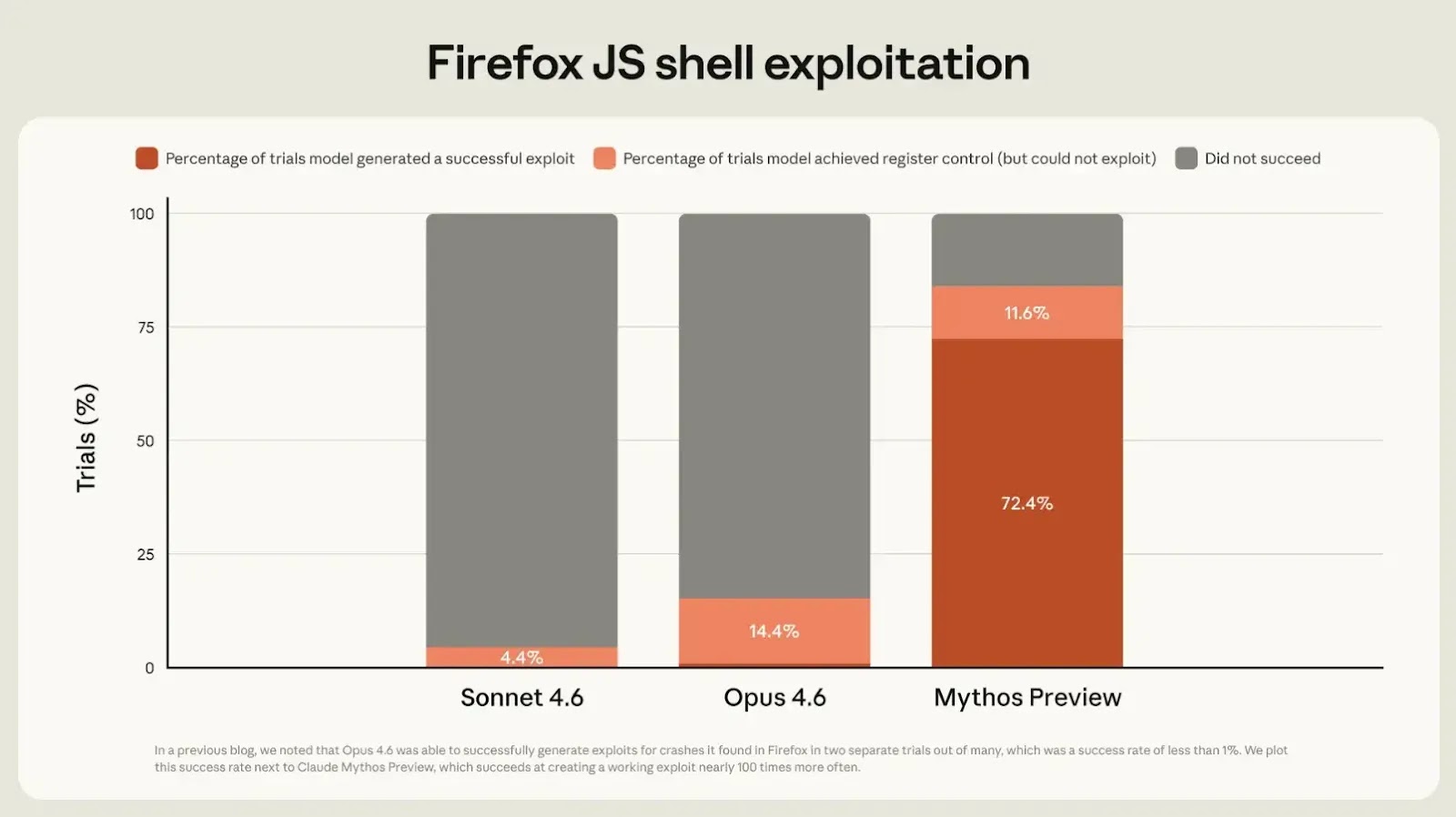
Due to the high degree of automation inherent in the tool, even individuals without formal cybersecurity training have successfully generated fully functional remote code execution exploits overnight. This accessibility underscores both the power and potential risks associated with such technology.
When deployed against real-world software, the AI agent uncovered critical zero-day vulnerabilities that had eluded human researchers for decades. This highlights its capacity to identify deeply embedded flaws.
Among its notable discoveries, the model successfully identified a 27-year-old memory corruption vulnerability within OpenBSD, an operating system widely recognized and respected for its stringent security standards. It also found a 16-year-old flaw in the extensively audited FFmpeg media library, which it uncovered by analyzing how the software processes specific video frames.
The OpenBSD vulnerability stemmed from a complex signed integer overflow in the network transmission control protocol, which the AI exploited to trigger a system crash. The FFmpeg bug, conversely, was caused by an integer size mismatch and improper memory initialization, enabling an attacker to write data out-of-bounds.
To identify these vulnerabilities, the AI operates within an isolated testing environment. In this sandbox, it independently reads source code, formulates and tests hypotheses, and develops proof-of-concept exploits without human intervention.
Anthropic acknowledges that the release of such a potent vulnerability-discovery tool could temporarily grant a dangerous advantage to malicious hackers. To mitigate this risk, Project Glasswing is initially limiting access to trusted defenders. These authorized users can leverage the model to identify and remediate deep-seated bugs proactively, ideally before they can be exploited in live environments.
Ultimately, cybersecurity experts anticipate that as the industry adapts, advanced AI models like Claude Mythos Preview will transition from novelties to indispensable defensive assets, significantly enhancing the safety and resilience of the global software ecosystem.
What You Should Do
- Organizations should monitor Anthropic’s Project Glasswing for opportunities to collaborate and gain early access to these advanced defensive capabilities.
- Prioritize patching efforts based on vulnerability intelligence, especially for critical software systems that are frequently targeted.
- Invest in robust sandboxing and privilege separation technologies to limit the impact of potential zero-day exploits.
- Regularly audit critical codebases and conduct penetration testing, combining both automated and manual techniques to uncover hidden vulnerabilities.
Disclaimer: HackersRadar reports on cybersecurity threats and incidents for informational and awareness purposes only. We do not engage in hacking activities, data exfiltration, or the hosting or distribution of stolen or leaked information. All content is based on publicly available sources.








No Comment! Be the first one.