




Critical Oracle E-Business Suite CVE-2024-21094 exploited, exposing 900+ instances
Key Takeaways Over 900 Oracle E-Business Suite (EBS) instances are publicly exposed online. A critical vulnerability, CVE-2024-21094, is actively being exploited against these exposed EBS servers....

Key Takeaways
- Over 900 Oracle E-Business Suite (EBS) instances are publicly exposed online.
- A critical vulnerability, CVE-2024-21094, is actively being exploited against these exposed EBS servers.
- This flaw allows remote code execution, threatening sensitive ERP data and critical business operations.
- Organizations must immediately secure exposed instances and apply available patches.
Critical Oracle E-Business Suite Vulnerability Exploited, Over 900 Instances Exposed
More than 900 instances of Oracle E-Business Suite (EBS) are currently exposed to the public internet, creating a significant attack surface as threat actors actively exploit a critical vulnerability within the platform. This situation places mission-critical enterprise resource planning (ERP) environments at immediate and severe risk of compromise.
Table Of Content
Recent analysis by cybersecurity researchers indicates that a substantial number of Oracle EBS servers are directly accessible from the internet. Rather than being segmented within private networks or secured behind VPNs, these systems are openly exposed, dramatically increasing their vulnerability to attack.
The Shadowserver Foundation has reported tracking approximately 950 Oracle EBS instances online. This enhanced visibility follows improvements to their fingerprinting methodology, which now incorporates domain-based scanning alongside traditional IP-based probes. This more sophisticated approach allows for a more accurate identification of exposed systems.
The primary threat targeting these exposed instances is a recently disclosed critical vulnerability, identified as CVE-2024-21094. This flaw in Oracle E-Business Suite permits remote attackers to execute arbitrary code, potentially granting them complete control over the compromised application stack and underlying systems.
Security researchers have issued urgent warnings that active exploitation of this vulnerability is already underway in the wild. This means adversaries are not merely scanning for vulnerable systems but are actively attempting to leverage the flaw against internet-facing EBS servers to gain unauthorized access.
Given Oracle E-Business Suite’s widespread use across finance, supply chain management, human resources, and other essential back-office operations, successful exploitation could lead to devastating consequences. Attackers could gain access to highly sensitive transactional data, operational intelligence, and other critical business information.
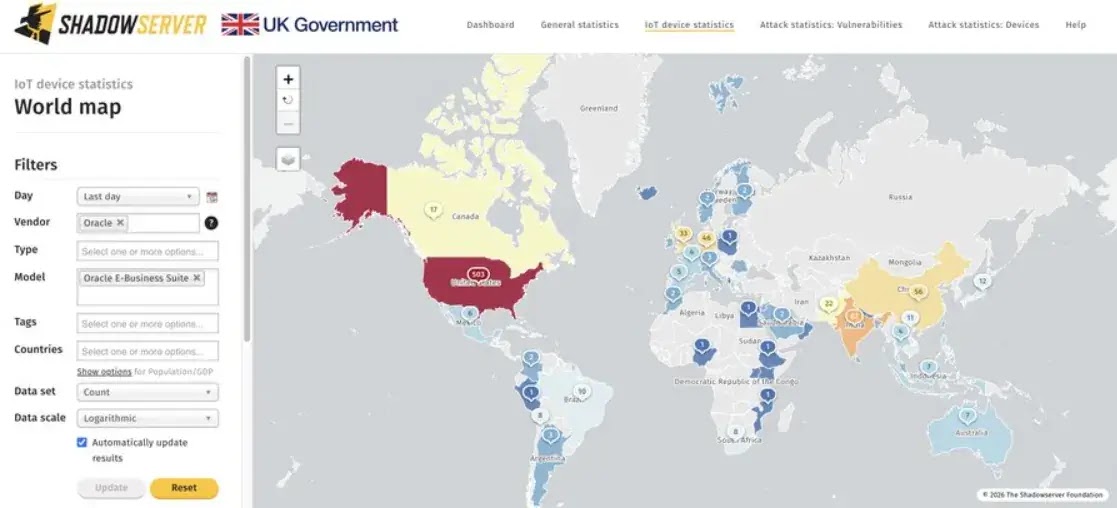
Many of the identified exposed instances belong to large enterprises and critical service providers. A compromise could therefore result in widespread data theft, manipulation of financial records, severe disruption of logistics and supply chains, or serve as a beachhead for lateral movement deeper into corporate networks.
Internet-Exposed Oracle E-Business Instances Under Attack
According to the Shadowserver Foundation, their recent internet scans have confirmed the presence of numerous exposed Oracle EBS instances that are actively being targeted by threat actors. This detection capability was significantly improved through a collaborative effort with Validin LLC.
The enhanced methodology allows Shadowserver to more accurately identify EBS deployments by analyzing domain signatures and specific application fingerprints, moving beyond sole reliance on IP-level banners. This partnership has proven crucial in uncovering the true scope of the exposure.
What You Should Do
- Isolate Exposed Instances: Immediately identify any Oracle E-Business Suite instances directly reachable from the public internet. Move these systems behind secure access controls such as VPNs, zero-trust gateways, or dedicated firewalls.
- Apply Security Patches: Promptly apply the latest security patches released by Oracle that address CVE-2024-21094 and any other critical vulnerabilities. Ensure all middleware components associated with EBS are also fully updated.
- Enhance Monitoring: Implement robust logging and monitoring for all Oracle EBS environments. Look for indicators of compromise (IoCs) or any unusual activity that might suggest probing or exploitation attempts. Integrate relevant detection rules into SIEM and EDR platforms.
- Harden Deployments: Enforce strong authentication mechanisms, disable all unnecessary services, and deploy web application firewalls (WAFs) in front of EBS instances. Conduct regular external exposure assessments to identify and remediate potential attack vectors.
- Prioritize Risk: Treat all internet-exposed Oracle EBS instances as high-priority risk assets. Assume they are being actively probed by malicious actors and prepare for rapid incident response.
Disclaimer: HackersRadar reports on cybersecurity threats and incidents for informational and awareness purposes only. We do not engage in hacking activities, data exfiltration, or the hosting or distribution of stolen or leaked information. All content is based on publicly available sources.








No Comment! Be the first one.