




Top 10 Cloud Detection and Response Solutions for 2026
Key Takeaways Cloud Detection and Response (CDR) is critical for identifying and mitigating active threats within cloud environments, contrasting with Cloud Security Posture Management (CSPM) which...

Key Takeaways
- Cloud Detection and Response (CDR) is critical for identifying and mitigating active threats within cloud environments, contrasting with Cloud Security Posture Management (CSPM) which focuses on configurations.
- The market for CDR solutions in 2026 is seeing strong competition, with leading platforms like Wiz (enhanced by its acquisition of Gem Security) and Sysdig excelling in real-time detection and correlation.
- Specialized vendors such as Stream.Security, Skyhawk Security, and Sweet Security are driving innovation in specific real-time detection capabilities.
- Organizations must prioritize solutions that offer robust real-time control-plane detection, deep telemetry, and effective response automation to counter sophisticated cloud attacks.
Cloud Detection and Response (CDR) represents the dynamic, live operational aspect of cloud security. Unlike Cloud Security Posture Management (CSPM), which assesses static configurations and potential vulnerabilities, CDR actively monitors for ongoing malicious activities. This includes scenarios such as unauthorized use of stolen cloud credentials, anomalous workload behavior, or attempts at privilege escalation by an identity within the cloud infrastructure.
Table Of Content
- Key Takeaways
- One Acquisition to Note
- The 2026 CDR Scorecard
- How We Scored
- What CDR Actually Is (and Isn’t)
- The Ten, Scored
- 1. Wiz (incl. Gem Security) — 8.7/10 · best correlation
- 2. Sysdig — 8.9/10 · best real-time detection
- 3. CrowdStrike — 8.7/10 · best response automation
- 4. Palo Alto Networks — 8.4/10 · best in a platform
- 5. Microsoft Defender for Cloud — 8.1/10 · best Azure economics
- 6. Stream.Security — 8.1/10 · best cloud-model real-time
- 7. Skyhawk Security — 7.9/10 · best purpose-built CDR
- 8. Orca Security — 7.9/10 · best agentless telemetry
- 9. Sweet Security — 7.9/10 · best runtime-sensor CDR
- 10. Uptycs — 7.6/10 · best unified telemetry
- Buyer’s Guide
- Frequently Asked Questions
- What is Cloud Detection and Response (CDR)?
- What is the best CDR solution in 2026?
The CDR landscape is currently dominated by industry leaders like Wiz and Sysdig. A growing cohort of specialized providers, including Stream.Security, Skyhawk Security, and Sweet Security, are pushing the boundaries of real-time detection capabilities. Additionally, open-source options like Falco offer a viable foundation for many organizations. This report provides an in-depth analysis and scoring of the top ten CDR solutions for 2026.
One Acquisition to Note
A significant development in the CDR market is Wiz’s acquisition of Gem Security. This strategic move integrates Gem Security’s specialized real-time cloud detection and response capabilities directly into the Wiz platform. While some older assessments might list Gem as a standalone entity, it is now an integral part of Wiz, specifically enhancing the runtime security layer that Wiz’s core graph-based security model had previously emphasized less.
The 2026 CDR Scorecard
The following table provides an editorial assessment, not benchmark results, of the leading CDR solutions based on key performance indicators for 2026.
| Rank | Solution | Real-time detection (30%) | Cloud telemetry depth (25%) | Response/automation (20%) | Correlation/context (15%) | Value (10%) | Total |
| 1 | Wiz (incl. Gem) | 9 | 9 | 8 | 10 | 6 | 8.7 |
| 2 | Sysdig | 10 | 9 | 9 | 8 | 7 | 8.9 |
| 3 | CrowdStrike | 9 | 8 | 10 | 9 | 6 | 8.7 |
| 4 | Palo Alto Networks | 9 | 9 | 9 | 8 | 6 | 8.4 |
| 5 | Microsoft Defender for Cloud | 8 | 8 | 8 | 8 | 9 | 8.1 |
| 6 | Stream.Security | 9 | 8 | 8 | 8 | 7 | 8.1 |
| 7 | Skyhawk Security | 8 | 8 | 8 | 8 | 7 | 7.9 |
| 8 | Orca Security | 8 | 9 | 7 | 8 | 7 | 7.9 |
| 9 | Uptycs | 8 | 8 | 7 | 7 | 7 | 7.6 |
| 10 | Sweet Security | 9 | 8 | 8 | 7 | 7 | 7.9 |
How We Scored
Our scoring methodology emphasizes the core functions of effective CDR:
- Real-time detection (30%): This metric assesses the speed and precision with which a solution identifies active cloud attacks, distinguishing true CDR from periodic posture scans.
- Cloud telemetry depth (25%): This evaluates the breadth of coverage, including control-plane logs, runtime/workload signals, and identity event monitoring.
- Response/automation (20%): This considers the effectiveness of containment measures, predefined playbooks, and the overall speed of incident resolution.
- Correlation/context (15%): This focuses on the ability to connect disparate events into a coherent security narrative.
- Value (10%): This accounts for the overall economic benefit and efficiency provided by the solution.
What CDR Actually Is (and Isn’t)
CDR meticulously monitors three primary areas within cloud environments: the control plane, which tracks API calls to determine user actions within platforms like AWS, Azure, and GCP; runtime environments, observing the behavior of workloads and containers; and cloud identity, detecting credential misuse and privilege escalation attempts in real-time. It provides a crucial, immediate answer to the question, “Is an attacker currently active in our cloud?” a query that traditional CSPM, with its point-in-time posture assessments, cannot address.
The definition of CDR can often be confused with related security domains. It frequently overlaps with Cloud-Native Application Protection Platforms (CNAPP), which increasingly incorporate runtime capabilities, and with cloud-adjacent XDR/MDR solutions. The essential distinction for CDR lies in its real-time detection capabilities specifically for the cloud control plane and identity events. Our evaluation prioritizes vendors based on their proficiency in these critical areas, rather than on general posture dashboards.
The Ten, Scored
1. Wiz (incl. Gem Security) — 8.7/10 · best correlation

Wiz achieves a leading score for its contextual correlation capabilities. By integrating Gem Security’s real-time CDR into its cloud security and vulnerability graph, Wiz can directly evaluate active runtime alerts against identity entitlements, exposed network pathways, and existing vulnerabilities, providing unparalleled context.
Strengths: Combines real-time detection with robust graph context; offers agentless visibility complemented by Gem’s runtime capabilities; strong cloud-identity detection.
Trade-offs: Ongoing integration of Gem features requires confirmation; premium pricing model.
2. Sysdig — 8.9/10 · best real-time detection
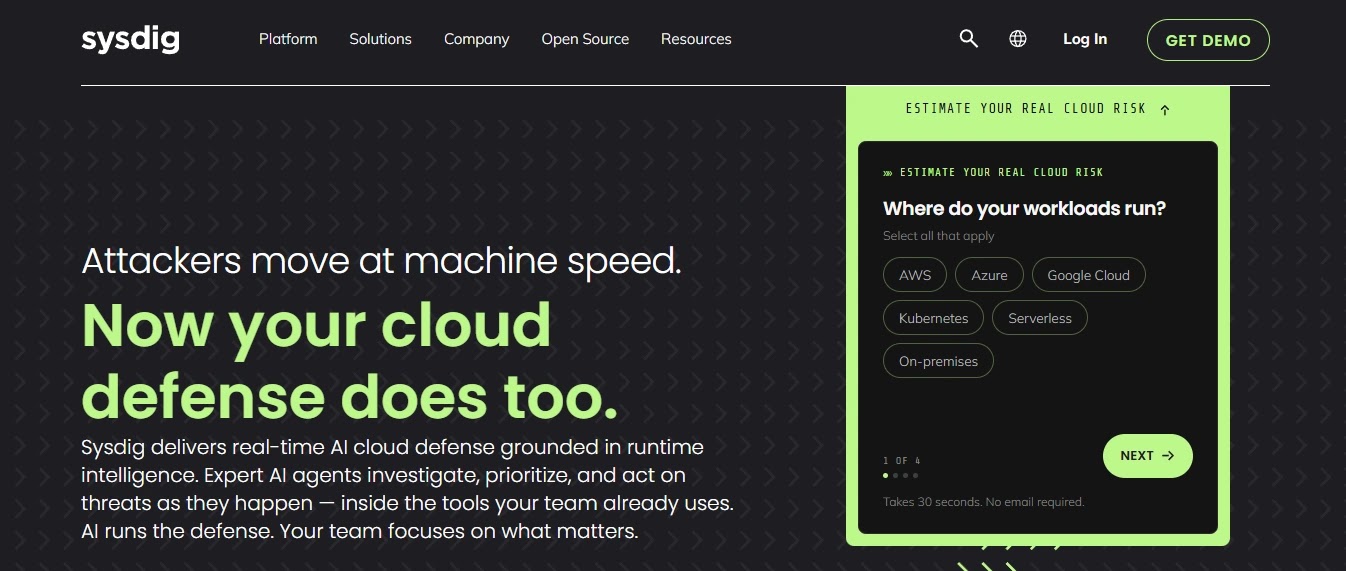
Sysdig earned the highest score for real-time detection due to its Falco-powered runtime protection, which is correlated with cloud control-plane telemetry. Its eBPF-driven threat detection is highly effective at identifying in-progress container escapes and abnormal process executions.
Strengths: Delivers the fastest and deepest cloud runtime detection; strong heritage from Falco; excellent drift and threat detection.
Trade-offs: Coverage for VM/Windows environments may not match that of larger vendors.
3. CrowdStrike — 8.7/10 · best response automation

CrowdStrike stands out with the highest score in response automation. Its Falcon Cloud Security extends proven EDR and threat intelligence capabilities to cloud control-plane events and runtime containers, offering real-time threat detection and automated responses that enable rapid incident containment.
Strengths: Market leader in response automation; robust adversary intelligence; unified console for endpoint, cloud, and identity security.
Trade-offs: Cloud-native breadth might not fully match pure-play specialists in certain areas; uses modular pricing.
4. Palo Alto Networks — 8.4/10 · best in a platform

Palo Alto Networks offers extensive cloud threat detection through its Prisma Cloud and Cortex XDR solutions. This platform unifies control-plane auditing with host runtime telemetry and modern Security Service Edge (SSE) platforms, providing a holistic security view.
Strengths: Broad platform coverage; strong runtime and identity detection; unified response capabilities.
Trade-offs: Complex credit modeling; requires significant commitment to the platform.
5. Microsoft Defender for Cloud — 8.1/10 · best Azure economics
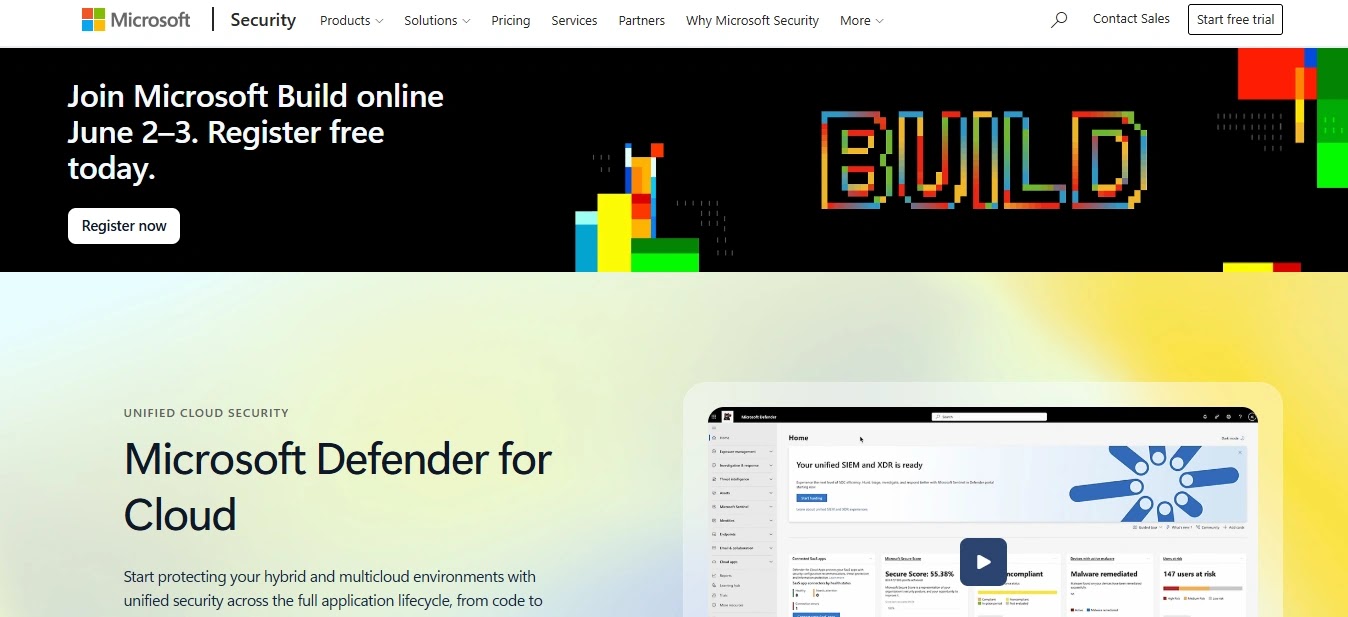
Microsoft Defender for Cloud delivers native control-plane audit log analysis and workload threat detection across Azure environments. Its capabilities extend to AWS and GCP through Azure Arc, all integrated into Microsoft Defender cloud security plans.
Strengths: Cost-effective for Azure-centric organizations; strong Defender XDR correlation; supports multicloud environments via Arc.
Trade-offs: Real-time detection depth outside Azure may not match specialist solutions.
6. Stream.Security — 8.1/10 · best cloud-model real-time
Stream.Security utilizes a dynamic Cloud Twin model to monitor infrastructure changes in real time. This approach allows for rapid identification of cloud misconfigurations and exposures as soon as architectural modifications occur.
Strengths: Exceptional real-time, change-driven detection; innovative cloud-model approach; effective response capabilities.
Trade-offs: Relatively newer vendor; requires due diligence on long-term stability.
7. Skyhawk Security — 7.9/10 · best purpose-built CDR
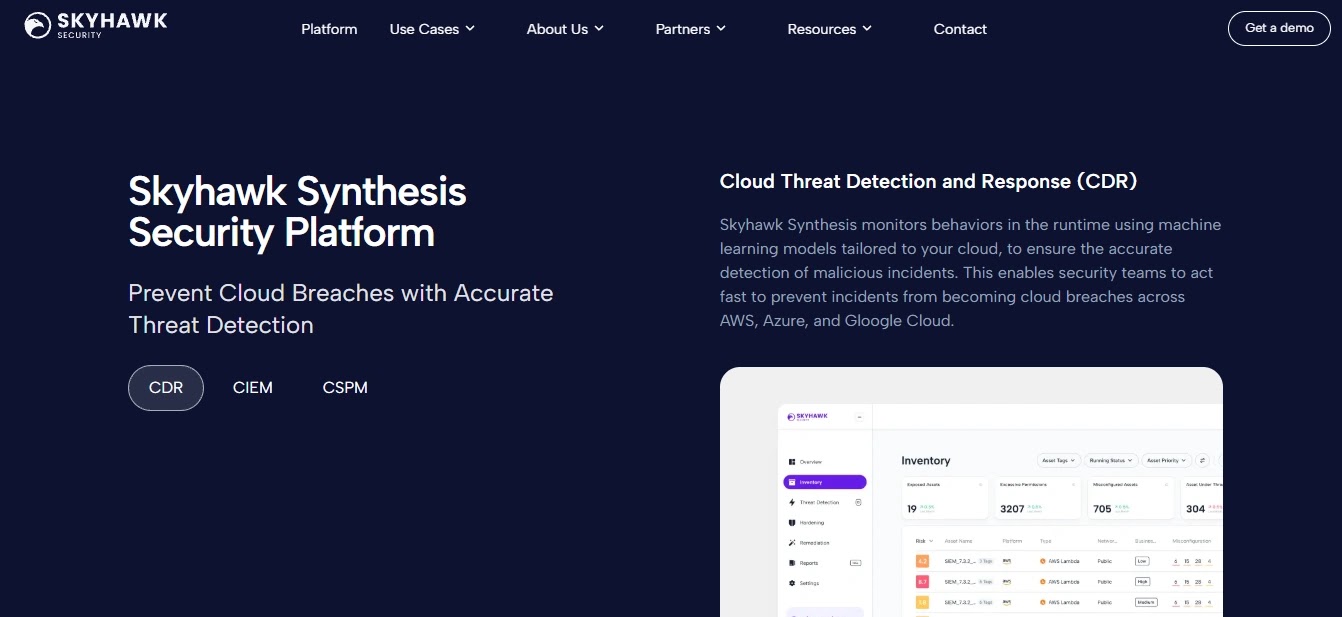
Originating from Radware, Skyhawk Security specializes in cloud threat detection. It employs machine learning to correlate API anomalies into complete attack sequences, coupled with identity threat detection and response (ITDR).
Strengths: Dedicated focus on purpose-built CDR; utilizes ML for attack sequence analysis; strong multicloud support.
Trade-offs: Smaller ecosystem; current status requires validation.
8. Orca Security — 7.9/10 · best agentless telemetry
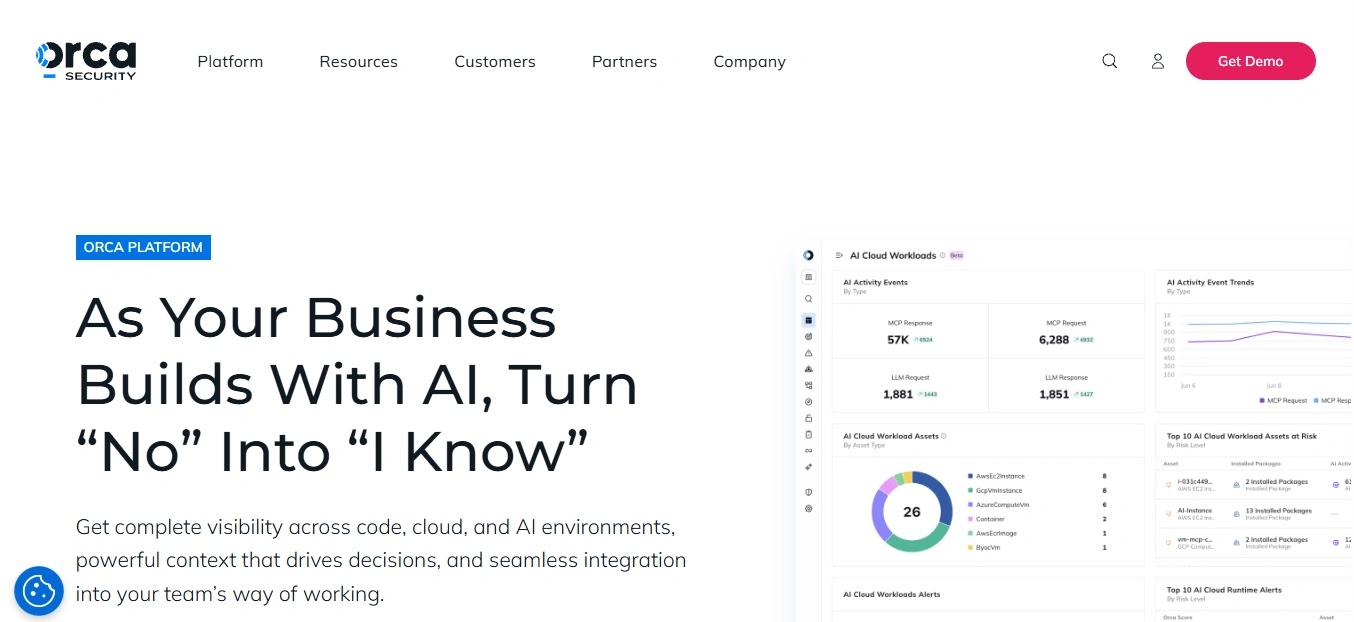
Orca Security earns a high telemetry score due to its agentless side-scanning technology. This approach provides extensive coverage across the cloud estate, enriching detection with valuable data and identity context.
Strengths: Complete agentless visibility for compute and storage; wide multicloud coverage aligning with modern CNAPP and cloud security platforms; comprehensive context regarding data exposure and software vulnerabilities.
Trade-offs: Real-time runtime response may lag behind agent-based leaders; typically requires pairing with other solutions for enforcement.
9. Sweet Security — 7.9/10 · best runtime-sensor CDR

Sweet Security offers deep runtime detection capabilities powered by a lightweight eBPF sensor. Its focus is on managing runtime workload vulnerabilities and threats, effectively filtering out noise to highlight verified security incidents.
Strengths: Provides profound runtime detection; excellent signal-to-noise ratio; strong cloud-native focus.
Trade-offs: Newer vendor; still expanding its feature breadth.
10. Uptycs — 7.6/10 · best unified telemetry
Uptycs unifies osquery and eBPF telemetry across endpoints, Kubernetes clusters, and cloud control planes. It serves teams that manage server security and workload hardening through a coherent SQL data model.
Strengths: Offers unified telemetry; strong visibility into Linux and cloud environments.
Trade-offs: Real-time cloud control-plane depth might not match specialist solutions; requires further refinement in packaging.
Buyer’s Guide
When evaluating CDR solutions, organizations should prioritize specific capabilities to ensure effective real-time threat detection and response:
- Emphasize Real-time Detection Over Posture: Many solutions marketed as “CDR” are merely posture dashboards with an alert feed. Crucially, test detection latency and accuracy against simulated live attacks, such as stolen-credential API abuse, workload compromise, or privilege escalation within your own cloud environment.
- Control-Plane Detection is Key: The most distinct cloud attack vector involves credential misuse within the control plane—an attacker making numerous API calls to enumerate resources, escalate privileges, create new resources, or exfiltrate data. Verify that any tool you consider can ingest and detect events from CloudTrail, Azure Activity, or GCP audit logs in real time, not just through scheduled scans.
- Adopt Zero Trust Cloud Principles: Restrict control-plane permissions and enforce the principle of least privilege, aligning with NIST Zero Trust Architecture guidelines.
- Response Must Be Actionable: Detection alone is insufficient. A robust CDR solution must include automated or guided containment capabilities, such as revoking tokens, isolating workloads, or disabling compromised identities. Explicitly evaluate the speed and effectiveness of the response half of the solution.
- Decide on Standalone vs. Platform Integration: CDR functionality is increasingly being integrated into broader CNAPP (e.g., Wiz+Gem, Prisma, Defender) or XDR platforms. Opt for standalone specialists like Sysdig, Stream.Security, Skyhawk, or Sweet Security for maximum real-time depth. If consolidation is a priority, choose a module from an existing platform.
- Avoid Common Pitfalls: Do not mistake posture management for CDR. Ensure the solution offers genuine control-plane detection and automated response. Avoid deploying a standalone CDR solution if your existing CNAPP already provides adequate capabilities.
Frequently Asked Questions
What is Cloud Detection and Response (CDR)?
CDR delivers real-time threat detection and response across the cloud control plane (API activity), runtime environments (workload and container behavior), and cloud identity (credential misuse, privilege escalation). It answers the critical question of whether an attacker is actively present in your cloud, a capability that point-in-time posture management cannot provide.
What is the best CDR solution in 2026?
Disclaimer: HackersRadar reports on cybersecurity threats and incidents for informational and awareness purposes only. We do not engage in hacking activities, data exfiltration, or the hosting or distribution of stolen or leaked information. All content is based on publicly available sources.








No Comment! Be the first one.