




Best SaaS Security Posture Management (SSPM) Tools
Key Takeaways SaaS Security Posture Management (SSPM) tools are crucial for mitigating misconfigurations, over-permissioned OAuth grants, and shadow IT across complex SaaS environments. The market is...

Key Takeaways
- SaaS Security Posture Management (SSPM) tools are crucial for mitigating misconfigurations, over-permissioned OAuth grants, and shadow IT across complex SaaS environments.
- The market is seeing a shift towards platform consolidation, exemplified by CrowdStrike’s acquisition of Adaptive Shield and Zscaler’s acquisition of Canonic Security.
- Top-performing SSPM solutions excel in application coverage depth, SaaS identity and OAuth risk management, and shadow SaaS discovery.
- Organizations must prioritize SSPM tools that offer deep posture rules for their specific critical applications, rather than simply a high count of “supported” apps.
In today’s interconnected enterprise, the proliferation of SaaS applications—from Microsoft 365 and Salesforce to Workday and hundreds of specialized tools—creates a vast attack surface. This sprawling digital estate is frequently plagued by misconfigurations, overly permissive OAuth grants, and unsanctioned “shadow” applications, posing significant security challenges.
Table Of Content
- Key Takeaways
- Market Consolidation: A Key Trend
- CrowdStrike’s Strategic Acquisition of Adaptive Shield
- The 2026 SSPM Scorecard
- Evaluation Methodology
- The Top Ten SSPM Solutions
- 1. AppOmni — 9.0/10 · best app coverage
- 2. Obsidian Security — 8.9/10 · best SaaS identity and threat
- 3. CrowdStrike (Adaptive Shield) — 8.7/10 · best platform-consolidated
- 4. Nudge Security — 8.2/10 · best SaaS discovery and access governance
- 5. Grip Security — 8.0/10 · best shadow-SaaS discovery
- 6. Palo Alto Networks — 8.0/10 area · best in a Palo Alto estate
- 7. Astrix Security — 7.7/10 · best SaaS-to-SaaS / OAuth security
- 8. Valence Security — 7.7/10 · best SaaS-to-SaaS risk
- 9. Zscaler (Canonic) — 7.6/10 · best in a Zscaler estate
- 10. Microsoft — 7.7/10 · best M365 value
- Buyer’s Guide
- Frequently Asked Questions
- What is SSPM?
- What is the best SSPM tool in 2026?
- SSPM vs CASB — what’s the difference?
- Which SSPM vendors were acquired?
- Why does SaaS identity and OAuth risk matter?
SaaS Security Posture Management (SSPM) solutions provide continuous oversight, meticulously checking SaaS configurations, monitoring identity and third-party application risks, and detecting configuration drift. This proactive approach is essential for maintaining robust application-layer identity security and access control.
While AppOmni and Obsidian Security remain frontrunners among pure-play SSPM vendors, a significant market trend is the integration of SSPM capabilities into broader security platforms. CrowdStrike’s acquisition of Adaptive Shield is a prime example, signaling a shift towards consolidated security offerings. Below, we present an evaluation of the ten leading SSPM tools.
Market Consolidation: A Key Trend
CrowdStrike’s Strategic Acquisition of Adaptive Shield
CrowdStrike’s integration of Adaptive Shield’s SSPM capabilities into its Falcon platform represents a pivotal development in the cybersecurity landscape. This move underscores a broader industry trend where specialized security functions are being absorbed into comprehensive platforms. For existing Falcon customers, this means native SSPM functionality is now available, streamlining their security operations and consolidating visibility. It also suggests that standalone SSPM solutions may increasingly face pressure from integrated offerings.
Another notable acquisition is Zscaler’s purchase of Canonic Security, further demonstrating the drive to embed SaaS and application-centric security into established vendor ecosystems.
The 2026 SSPM Scorecard
| Rank | Tool | App coverage (30%) | Misconfig depth (25%) | SaaS identity/OAuth (20%) | Shadow-SaaS discovery (15%) | Value (10%) | Total |
| 1 | AppOmni | 10 | 9 | 9 | 8 | 7 | 9.0 |
| 2 | Obsidian Security | 9 | 9 | 10 | 8 | 7 | 8.9 |
| 3 | CrowdStrike (Adaptive Shield) | 9 | 9 | 9 | 8 | 7 | 8.7 |
| 4 | Palo Alto Networks | 9 | 8 | 8 | 8 | 6 | 7.9 |
| 5 | Nudge Security | 8 | 7 | 9 | 10 | 8 | 8.2 |
| 6 | Grip Security | 8 | 7 | 8 | 10 | 8 | 8.0 |
| 7 | Zscaler (Canonic) | 8 | 7 | 8 | 8 | 7 | 7.6 |
| 8 | Astrix Security | 7 | 6 | 10 | 9 | 7 | 7.8 |
| 9 | Valence Security | 8 | 8 | 8 | 7 | 7 | 7.7 |
| 10 | Microsoft | 8 | 7 | 8 | 7 | 10 | 7.7 |
Editorial assessments, not benchmark results.
Evaluation Methodology
Our scoring methodology for SSPM tools prioritizes several critical dimensions to provide a comprehensive evaluation:
- App coverage (30%): This metric assesses the breadth and depth of security posture rules across an organization’s actual SaaS applications, distinguishing between robust coverage for critical enterprise suites like M365 and Salesforce versus support for a long tail of niche applications.
- Misconfiguration depth (25%): This evaluates how thoroughly each tool inspects and validates an application’s security settings against established best practices and compliance frameworks.
- SaaS identity/OAuth (20%): This critical component focuses on monitoring third-party application grants, identifying over-permissioned integrations, and assessing overall SaaS user risk, addressing a common attack vector.
- Shadow-SaaS discovery (15%): This measures the tool’s ability to uncover unsanctioned or employee-adopted SaaS applications that operate outside of official IT oversight.
- Value (10%): This considers the overall economic proposition and ease of deployment relative to the capabilities offered.
The Top Ten SSPM Solutions
1. AppOmni — 9.0/10 · best app coverage

AppOmni stands out with a perfect score in application coverage, delivering extensive and normalized posture controls across major enterprise suites and a wide array of long-tail applications. Its capabilities are reinforced by ongoing research, such as the discovery of Salesforce OmniStudio customer data exposure vulnerabilities. AppOmni excels in data-exposure analysis and is a mature solution for large enterprises, though its premium pricing and enterprise focus are considerations.
2. Obsidian Security — 8.9/10 · best SaaS identity and threat

Obsidian Security earns top marks for SaaS identity security, combining robust configuration auditing with advanced threat detection. It effectively identifies account takeovers (ATO), privilege escalation, and suspicious activities, integrating these findings with Identity Threat Detection and Response (ITDR) workflows. Its strengths lie in comprehensive SaaS threat detection, strong identity and OAuth analysis, and solid application coverage. Obsidian is a premium offering, with its advanced threat capabilities being a key differentiator.
3. CrowdStrike (Adaptive Shield) — 8.7/10 · best platform-consolidated
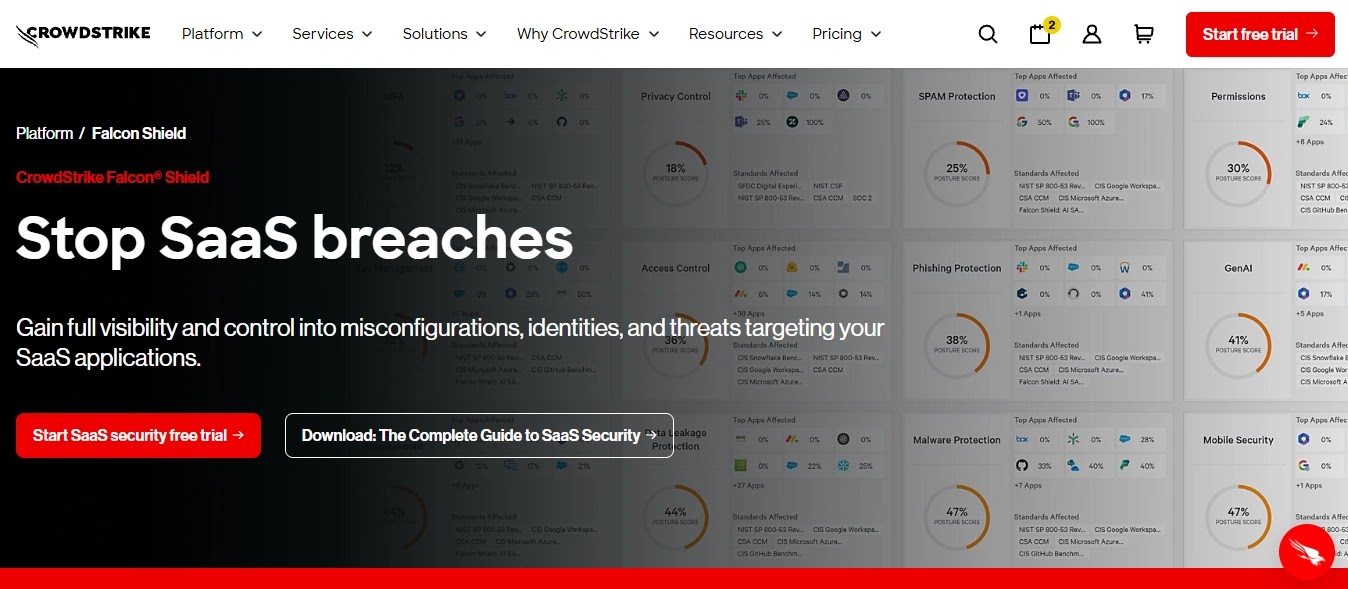
CrowdStrike now delivers Adaptive Shield’s mature SSPM technology natively within its Falcon platform. This integration allows for the correlation of SaaS configurations, non-human identities, and third-party application risks with endpoint and identity data within a unified cloud security architecture. Its key advantages include strong posture and identity coverage, Falcon platform consolidation, and a single management console. Potential users should confirm the current state of integration and be prepared for a platform commitment.
4. Nudge Security — 8.2/10 · best SaaS discovery and access governance

Nudge Security excels in discovering employee-adopted SaaS applications, identifying unmanaged accounts through centralized user access management, and offering continuous visibility into SaaS access across an organization. This helps mitigate insider risks and the adoption of unsanctioned tools. Its strengths include excellent shadow-SaaS discovery, robust SaaS inventory, and rapid deployment. However, it offers less depth in per-application configuration rules compared to dedicated SSPM leaders, with a narrower focus on posture management.
5. Grip Security — 8.0/10 · best shadow-SaaS discovery
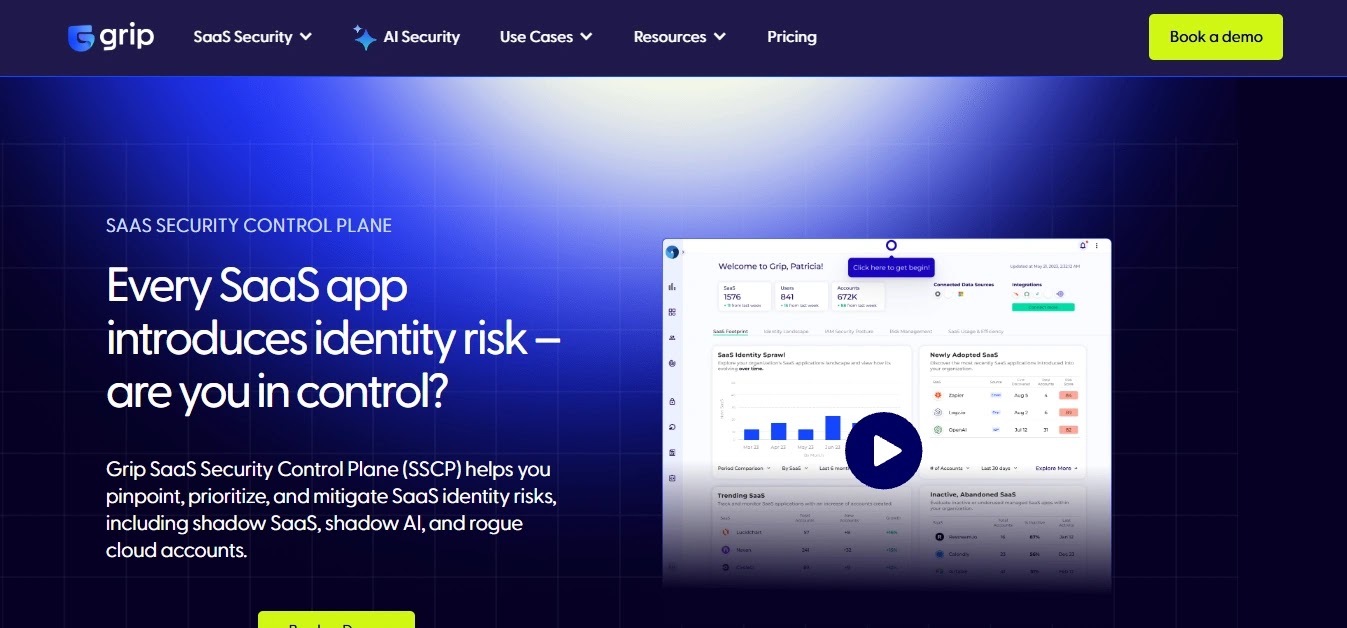
Grip Security achieves a perfect score in discovery, specializing in finding, mapping, and governing unsanctioned SaaS applications and orphaned credentials throughout the enterprise. It serves as a foundational component for modern SaaS security programs. Its primary strengths are exceptional shadow-SaaS discovery and identity governance, alongside strong SaaS access lifecycle management. Deeper per-application misconfiguration rules are not as extensive as those offered by AppOmni.
6. Palo Alto Networks — 8.0/10 area · best in a Palo Alto estate

Palo Alto Networks offers its SSPM module as an integrated part of its comprehensive Prisma SASE and Next-Gen CASB architecture. This provides native SaaS posture checks alongside extensive SASE platforms and edge services. Its main advantages are strong platform integration, particularly for existing Palo Alto customers. However, its dedicated SSPM depth may trail pure-play specialists, and it requires a commitment to the broader Palo Alto platform.
7. Astrix Security — 7.7/10 · best SaaS-to-SaaS / OAuth security
Astrix Security excels in discovering and governing SaaS-to-SaaS integrations, OAuth applications, and non-human identities. It empowers security teams to defend against threat actors leveraging OAuth applications for persistent cloud access and helps reduce excessive third-party permissions. Its strengths include robust OAuth and SaaS-to-SaaS visibility, non-human identity discovery, and effective risk prioritization and remediation. Its focus is more on integration and identity risk than on deep per-application SSPM configuration coverage.
8. Valence Security — 7.7/10 · best SaaS-to-SaaS risk
Valence Security specifically targets the hidden supply chain risks introduced by third-party application connections. It focuses on mitigating threats highlighted by attacks where a single malicious OAuth approval can grant persistent SaaS access. Its strengths lie in deep analysis of SaaS-to-SaaS integration risk and strong remediation capabilities. However, it offers a narrower breadth of overall posture management compared to broader SSPM solutions.
9. Zscaler (Canonic) — 7.6/10 · best in a Zscaler estate
Leveraging technology from its acquisition of Canonic Security, Zscaler provides SaaS application governance and supply chain risk profiling within its extensive Zero Trust security ecosystem. Its primary advantages are strong platform integration and a focus on application-level risk. However, its dedicated SSPM depth may not match that of specialized vendors, and users should confirm the scope of its capabilities for their specific needs.
10. Microsoft — 7.7/10 · best M365 value
Microsoft integrates SaaS posture management through Microsoft Defender for Cloud Apps and Secure Score, offering native capabilities that include automatic isolation of compromised cloud identities and devices. Its strengths include its cost-effectiveness (often included in existing licensing), deep M365 posture management, and seamless Secure Score integration. A trade-off is that its depth for third-party SaaS applications is generally not as comprehensive as that of pure-play SSPM solutions.
Buyer’s Guide
Selecting the right SSPM solution requires strategic consideration of several factors:
- Verify Depth for Critical Applications: Do not rely solely on a vendor’s “supported apps” count. Instead, create a list of your organization’s most critical SaaS applications (e.g., M365, Salesforce, Workday) and thoroughly evaluate the depth of security posture rules each SSPM tool offers for those specific applications. A tool with shallow rules for your core apps is less valuable than one with deep, actionable insights.
- Prioritize SaaS Identity and OAuth Risk: Over-permissioned third-party OAuth grants are a primary vector for SaaS breaches. Focus on tools that excel in OAuth-grant analysis and SaaS-to-SaaS risk assessment, such as Obsidian, Valence, and Grip, to effectively manage this modern attack path.
- Embrace Shadow SaaS Discovery: Employees often adopt new SaaS applications faster than IT can sanction them, creating unmonitored exposure. Solutions strong in discovery, like Nudge Security and Grip, are essential for identifying unsanctioned applications and dormant accounts.
- Evaluate Posture-Only vs. Posture-Plus-Threat: Determine whether your organization requires only configuration checks or if it needs integrated SaaS threat detection capabilities (e.g., account takeover, malicious activity). Regulated industries and high-target organizations often benefit significantly from the added threat layer offered by solutions like Obsidian and CrowdStrike.
- Avoid Common Pitfalls: Be wary of purchasing based on a high count of “supported” applications without confirming the depth of coverage for your actual critical apps. Do not overlook OAuth-grant risks, and understand that SSPM is distinct from CASB, though they can complement each other. Finally, consider integrated platform offerings from vendors like CrowdStrike and Microsoft before opting for standalone solutions.
Frequently Asked Questions
What is SSPM?
SaaS Security Posture Management (SSPM) is a cybersecurity discipline focused on continuously monitoring and managing the security configurations of SaaS applications (e.g., M365, Salesforce). It ensures adherence to best practices, oversees SaaS identities and third-party OAuth application grants, discovers shadow SaaS, and detects configuration drift and exposure risks.
What is the best SSPM tool in 2026?
In 2026, AppOmni leads for comprehensive application coverage depth, Obsidian Security excels in SaaS identity and threat detection, and CrowdStrike (Adaptive Shield) is notable for platform consolidation. Nudge Security and Grip Security are strong contenders for value and shadow-SaaS discovery, respectively, while Microsoft offers excellent integrated value for M365 environments.
SSPM vs CASB — what’s the difference?
CASB (Cloud Access Security Broker) primarily governs access to and data flows within cloud applications, operating inline or via API to enforce policies. SSPM, conversely, focuses on managing the security configuration and identity posture of sanctioned SaaS applications, addressing misconfigurations, OAuth grants, and configuration drift. While they share some API-based visibility, they address distinct security concerns, and many organizations deploy both.
Which SSPM vendors were acquired?
CrowdStrike acquired Adaptive Shield, integrating its capabilities into the Falcon platform. Similarly, Zscaler acquired Canonic Security. Organizations should ensure they purchase from the current owner and verify the integration status, as older comparison lists may still show these products as standalone.
Why does SaaS identity and OAuth risk matter?
SaaS identity and OAuth risks are critical because third-party applications granted
Disclaimer: HackersRadar reports on cybersecurity threats and incidents for informational and awareness purposes only. We do not engage in hacking activities, data exfiltration, or the hosting or distribution of stolen or leaked information. All content is based on publicly available sources.









No Comment! Be the first one.