




Mozilla Unveils Kill Switch to Disable All Firefox AI Features
Mozilla’s latest release, Firefox 148, introduces comprehensive AI controls, empowering users with greater command over built-in artificial intelligence features. A new security-focused setting...

Mozilla’s latest release, Firefox 148, introduces comprehensive AI controls, empowering users with greater command over built-in artificial intelligence features. A new security-focused setting centralizes this capability, offering a single toggle to block both current and future generative AI functionalities within the browser.
Addressing growing privacy and security concerns among users who reject AI integration in their browsing environment.
The “Block AI enhancements” toggle represents a significant shift in browser security architecture.
When activated, this kill switch disables all AI-powered features across Firefox and prevents notifications or prompts encouraging the adoption of AI features.
This granular control mechanism addresses cybersecurity best practices by allowing organizations. Privacy-conscious users need to eliminate potential attack vectors introduced through AI-driven features.
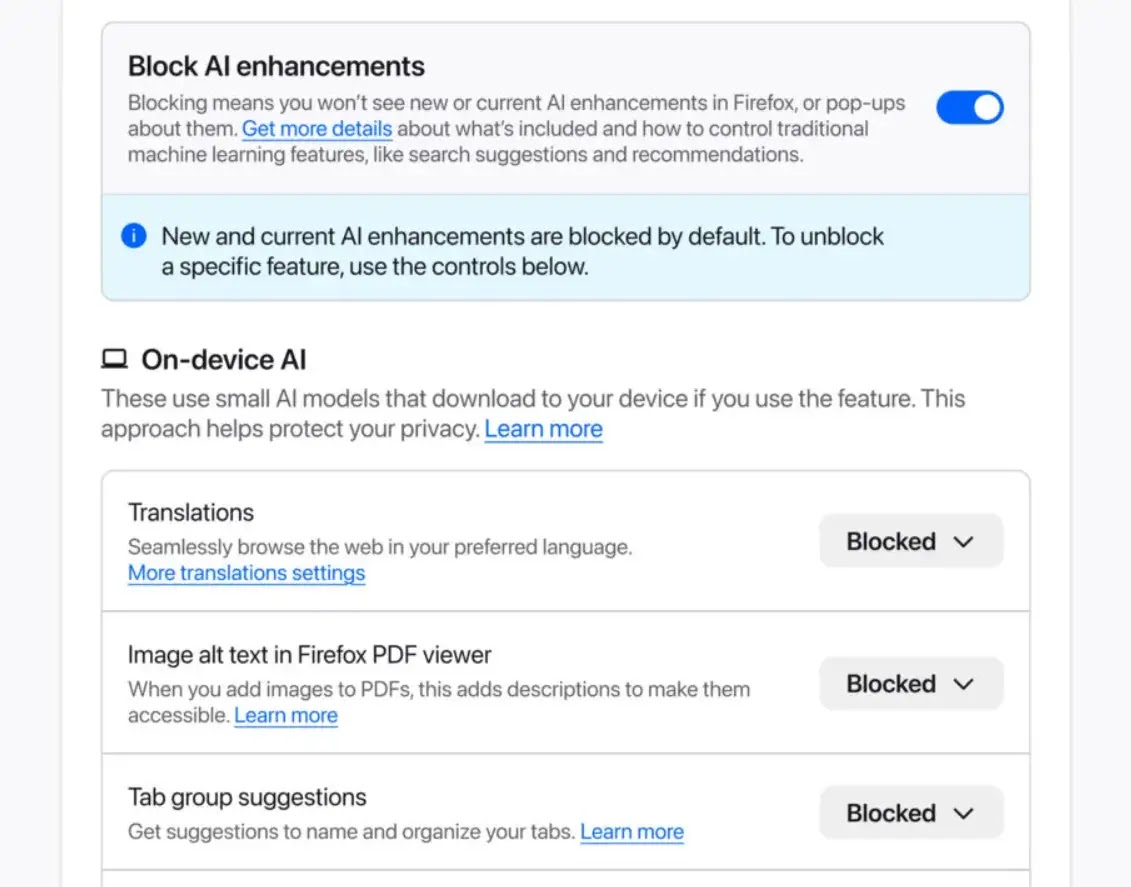
Individual AI Feature Management
Firefox’s AI controls section in desktop settings lets users selectively manage five distinct AI functionalities. The first feature is intelligent translation, enabling multilingual browsing without third-party translation services.
The second enhancement adds accessibility-focused alt text generation for PDF documents, using AI to describe images automatically.
Third, AI-enhanced tab grouping suggests related browsing contexts and assigns descriptive group names based on content analysis.
The fourth feature implements link preview functionality, extracting and displaying summarized content before users navigate to external URLs.
Finally, the integrated AI chatbot sidebar supports multiple AI models, including Anthropic Claude, ChatGPT, Microsoft Copilot, Google Gemini, and Le Chat Mistral, enabling conversational assistance during browsing sessions.
This update reflects Mozilla’s recognition of growing user apprehension regarding AI-driven data processing and potential security risks.
The persistent preference storage mechanism ensures user settings remain stable across Firefox updates.
Preventing automatic re-enablement of disabled features during system refreshes is a critical security consideration for enterprise deployments.
Early access to these AI controls is available through Firefox Nightly, enabling security researchers and technical users to conduct vulnerability assessments and evaluate potential AI-related threat vectors before widespread deployment.
Mozilla’s approach contrasts sharply with other browsers that implement AI features by default.
By prioritizing user agency and security-first design, Firefox sets a precedent for responsible AI integration in internet infrastructure.
This development demonstrates the browser vendor’s commitment to privacy preservation while acknowledging legitimate use cases for AI-assisted functionality.
The launch of Firefox 148, with comprehensive AI controls, signals industry-wide movement toward user-controlled AI deployment.
Particularly addressing cybersecurity professionals’ demand for transparent, manageable implementations of artificial intelligence within critical browsing infrastructure.
Disclaimer: HackersRadar reports on cybersecurity threats and incidents for informational and awareness purposes only. We do not engage in hacking activities, data exfiltration, or the hosting or distribution of stolen or leaked information. All content is based on publicly available sources.








No Comment! Be the first one.