




Top 10 Identity Threat Detection and Response (ITDR) Solutions for 2026
Key Takeaways Identity Threat Detection and Response (ITDR) is crucial for securing modern enterprises, as attackers increasingly exploit compromised credentials and identity system...

Key Takeaways
- Identity Threat Detection and Response (ITDR) is crucial for securing modern enterprises, as attackers increasingly exploit compromised credentials and identity system misconfigurations.
- ITDR solutions continuously monitor identity activity across Active Directory, cloud platforms, SaaS, and non-human identities to detect and respond to threats like credential theft, privilege escalation, and lateral movement.
- The market for ITDR is rapidly evolving, with significant mergers and acquisitions (M&A) indicating growing investment and consolidation, such as CrowdStrike’s acquisition of SGNL and Silverfort’s absorption of Rezonate.
- Top solutions for 2026 include CrowdStrike Falcon Identity Protection for overall real-time defense, Microsoft Defender for Identity for hybrid Microsoft environments, and Silverfort for unified protection of challenging legacy and non-human identities.
The cybersecurity landscape has fundamentally shifted, with enterprise identity now serving as the primary battleground. Adversaries are routinely circumventing traditional perimeter defenses by compromising credentials, hijacking sessions, abusing privileged accounts, and exploiting misconfigurations within critical identity infrastructure such as Active Directory, cloud platforms, SaaS applications, and non-human identities.
Table Of Content
- Key Takeaways
- Quick Verdict
- How We Evaluated
- The 10 Best ITDR Solutions in 2026
- 1. CrowdStrike Falcon Identity Protection — Best Overall ITDR
- 2. Microsoft Defender for Identity — Best for Microsoft Estates
- 3. Silverfort — Best Unified Identity Security Platform
- 4. SentinelOne Singularity Identity — Best Deception-Augmented ITDR
- 5. Semperis — Best AD Protection and Recovery
- 6. Okta Identity Threat Protection — Best IdP-Native ITDR
- 7. Proofpoint Identity Threat Defense — Best Attack-Path Cleanup
- 8. Cisco Identity Intelligence — Best Cross-IdP Analytics
- 9. Netwrix — Best Hybrid AD Value Tier
- 10. Huntress — Best ITDR for SMB and MSP
- Full Comparison Table
- How to Choose an ITDR Solution
- FAQ
- What is identity threat detection and response (ITDR)?
- How is ITDR different from IAM or PAM?
- Why did ITDR become critical in 2026?
- Does Microsoft Defender for Identity make third-party ITDR unnecessary?
- Can ITDR stop ransomware?
- How much do ITDR solutions cost?
- What You Should Do
In 2024, Microsoft reported an astonishing rate of over 7,000 password attacks per second. Moreover, compromised credentials continue to be a prevalent entry point for breaches, often remaining undetected for extended periods.
Identity Threat Detection and Response (ITDR) solutions have emerged to counteract this escalating risk. These platforms provide continuous monitoring of identity-related activities, identify dangerous exposures, detect suspicious behaviors, and empower security teams to contain compromised accounts swiftly, preventing attackers from executing lateral movement or escalating privileges.
Unlike conventional identity and access management (IAM) tools, ITDR platforms specifically focus on detecting and responding to scenarios where legitimate credentials, permissions, or authentication systems are misused. The most advanced ITDR solutions by 2026 offer comprehensive protection across hybrid identity environments, integrate and correlate signals from diverse security systems, visualize potential attack paths, prioritize high-risk exposures, and automate critical response actions. Many now also extend their protective capabilities to service accounts, workloads, API keys, and AI agents – identities that frequently possess extensive privileges but often receive insufficient oversight compared to human users.
This analysis provides a comprehensive comparison of ten leading ITDR solutions for 2026, evaluated based on their detection capabilities, breadth of identity coverage, integration options, automated response mechanisms, deployment complexity, and overall suitability for various organizational needs. Whether an organization seeks a dedicated identity protection solution or integrated ITDR functionalities within a broader security platform, this guide aims to assist in identifying the optimal choice.
The modern attacker no longer “hacks in” but “logs in,” and ITDR is designed precisely to intercept them at this critical juncture. For 2026, CrowdStrike Falcon Identity Protection stands out as the top overall recommendation. Microsoft Defender for Identity remains the default choice for organizations with hybrid Active Directory environments, while Silverfort is recognized as the most robust unified identity-security platform.
Quick Verdict
- Best overall: CrowdStrike Falcon Identity Protection – Delivers real-time identity defense seamlessly integrated with the Falcon platform.
- Best for Microsoft estates: Microsoft Defender for Identity – Offers unparalleled native AD/Entra coverage within the Defender XDR ecosystem.
- Best unified identity platform: Silverfort – Provides in-line protection for all identity types, including challenging legacy systems.
- Best AD resilience: Semperis – Combines advanced detection with unmatched Active Directory recovery capabilities.
- Best for SMB/MSP: Huntress – Offers managed ITDR services with transparent, published pricing.
How We Evaluated
Our ranking is based on extensive research, not vendor lab claims, and utilizes six key criteria:
- Identity coverage breadth: Assesses support for Active Directory, Entra ID, Okta, other cloud Identity Providers (IdPs), SaaS sessions, and service accounts.
- Detection quality: Evaluates efficacy against real-world attack techniques, including Kerberoasting, DCSync, pass-the-hash, MFA fatigue, and token theft, mapped to MITRE ATT&CK credential access and lateral movement tactics.
- Response capability: Examines in-line blocking, session revocation, and orchestrated containment features.
- Recovery depth: Specifically for scenarios where directories are the primary target.
- Ecosystem integration: Evaluates compatibility and synergy with existing security tools.
- Vendor trajectory: Considers the vendor’s market position and strategic direction within a consolidating market.
Pricing is only referenced where publicly disclosed.
Market Context: The period between 2025 and 2026 saw significant M&A activity focused on identity security. CrowdStrike acquired access orchestration firm SGNL for $627.9 million in January 2026. Silverfort integrated cloud-identity specialist Rezonate in November 2024. Cisco’s acquisition of Astrix for approximately $400 million extended identity security to non-human entities. Organizations should anticipate further consolidation during their contract terms and negotiate appropriate protections.
The 10 Best ITDR Solutions in 2026
1. CrowdStrike Falcon Identity Protection — Best Overall ITDR

Best for: Enterprises aiming to consolidate identity and endpoint defense within a single Security Operations Center (SOC) workflow.
Falcon Identity Protection provides real-time monitoring of authentication traffic across on-premises Active Directory and Entra ID. It correlates identity signals with endpoint telemetry collected by the Falcon agent. This capability allows risky authentications to trigger immediate, in-line responses, such as step-up MFA or outright blocking, rather than merely generating post-facto alerts. The January 2026 acquisition of SGNL further enhances its roadmap with dynamic, policy-driven access orchestration.
Key features: Real-time analysis of AD/Entra authentication; risk-conditional access enforcement (e.g., forcing MFA, denying access); unified correlation of identity, endpoint, and cloud data in one console; visibility into attack paths and stale accounts; available as a managed option via Falcon Complete.
Pros: Exceptional speed from detection to response; cost-effective single-agent deployment for existing Falcon users; highly effective against lateral movement and the identity-centric phases of ransomware attacks.
Cons: Full value is realized within the broader Falcon ecosystem; module-based pricing can accumulate, necessitating careful negotiation for bundles.
Pricing: Quote-based Falcon module.
Standout differentiator: Treats identity threats akin to endpoint threats, detecting, correlating, and blocking them within the same real-time pipeline.
2. Microsoft Defender for Identity — Best for Microsoft Estates

Best for: Organizations whose primary identity infrastructure consists of Active Directory and Entra ID, which encompasses a significant majority of enterprises.
Defender for Identity directly integrates with domain controllers (and AD CS/ADFS) using sensors, providing unparalleled telemetry depth that only the platform owner can achieve. It detects reconnaissance activities, credential theft techniques (such as DCSync, Kerberoasting, and pass-the-ticket), and domain dominance methods. This rich telemetry feeds into Defender XDR, where identity, endpoint, and email signals converge to form cohesive incident alerts.
Key features: Sensor-based monitoring of domain controllers; comprehensive detection across the AD kill chain; identity security posture recommendations (ISPM); automatic attack disruption capabilities within Defender XDR; synergistic integration with Entra ID Protection for cloud risk management.
Pros: Unrivaled access to Active Directory telemetry; cost-effective bundling within Microsoft 365 E5 licenses; continuous detection updates driven by Microsoft’s extensive threat research.
Cons: Inherently Microsoft-centric, requiring supplementary solutions for third-party IdPs and non-Microsoft SaaS applications; the true cost can be obscured by E5 licensing structures.
Pricing: Included in M365 E5; standalone/add-on licensing is also available.
Standout differentiator: The directory’s creator directly observing the directory, offering a depth of insight that competitors must reverse-engineer.
3. Silverfort — Best Unified Identity Security Platform

Best for: Enterprises with critical assets that are notoriously difficult to protect, such as legacy applications, service accounts, and Operational Technology (OT) systems.
Silverfort integrates directly into the authentication flow, enabling the extension of Multi-Factor Authentication (MFA) and risk-based policies to systems that traditionally lack such support, including legacy applications, command-line tools, and service accounts. It also enforces virtual fencing for non-human identities. Following the acquisition of cloud identity security specialist Rezonate in November 2024, Silverfort now offers comprehensive identity coverage, spanning on-premises Active Directory to cloud IdPs and non-human identities (NHIs) within a single platform.
Key features: In-line enforcement at the authentication layer; MFA capabilities for systems previously unable to support it; discovery and fencing of service accounts; ITDR detections with real-time blocking; cloud identity posture management via Rezonate integration.
Pros: Protects assets that competitors can only observe; provides enforcement (not just alerts) directly at the authentication layer; strong capabilities for non-human identities.
Cons: Represents a platform purchase rather than a point solution; the in-line architecture necessitates careful planning during rollout.
Pricing: Quote-based.
Standout differentiator: Transforms every authentication event, even from outdated legacy applications, into an enforcement point.
4. SentinelOne Singularity Identity — Best Deception-Augmented ITDR
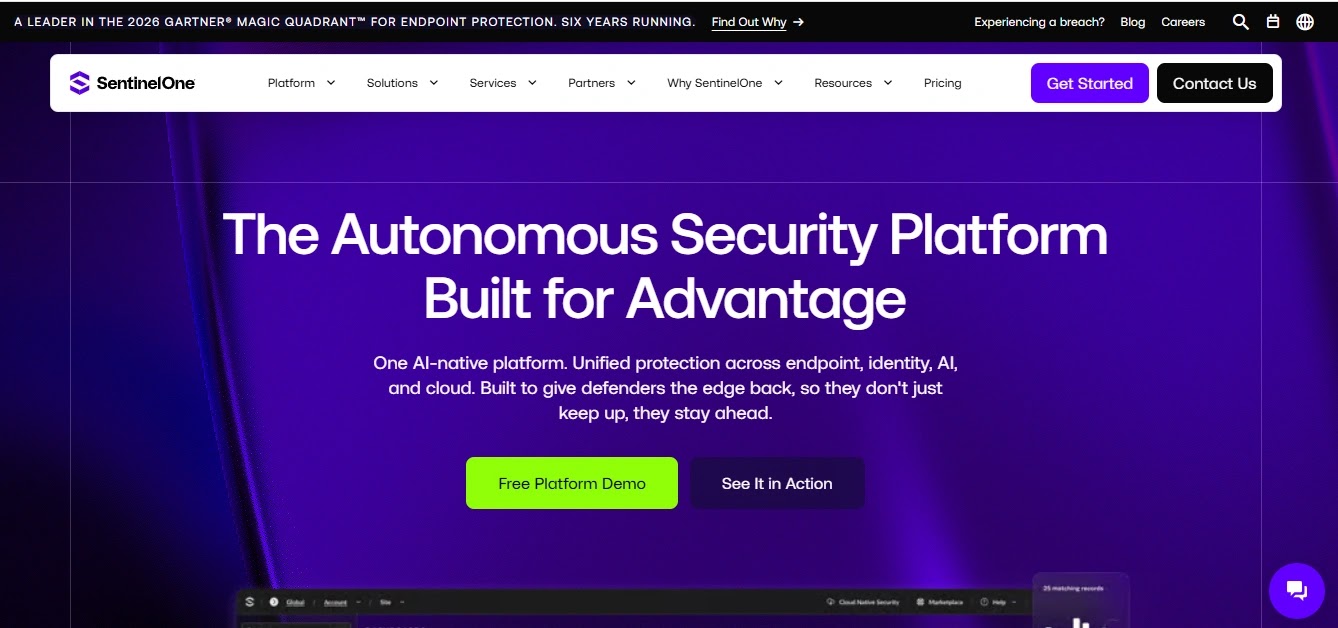
Best for: Security teams prioritizing attacker detection through the use of deception technologies.
Built upon the Attivo Networks acquisition, Singularity Identity employs deception as its core defense mechanism for Active Directory and endpoint credential stores. It deploys fake credentials, decoy objects, and misdirection to convert attacker tradecraft into high-fidelity alarms. Additionally, it provides endpoint-side protection against credential harvesting, all integrated within SentinelOne’s XDR platform.
Key features: Active Directory deception objects and decoys; endpoint credential-theft protection; AD posture assessment via Ranger AD lineage; real-time attack detection with XDR correlation; automated response capabilities.
Pros: Deception-based detection yields extremely low false positives; highly effective against hands-on-keyboard intrusions; offers combined endpoint and identity protection from a single vendor.
Cons: Deception requires meticulous deployment to maintain believability; ecosystem benefits are strongest for existing SentinelOne customers.
Pricing: Quote-based module.
Standout differentiator: Attackers expose themselves by interacting with elements that should not exist within the environment.
5. Semperis — Best AD Protection and Recovery
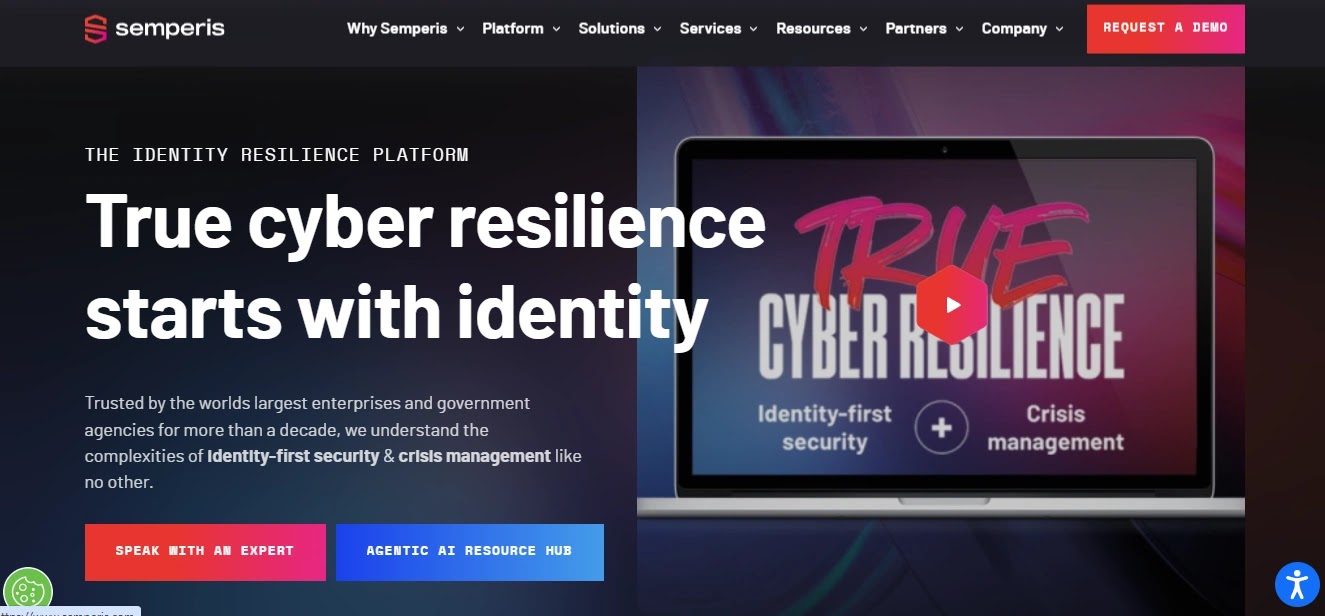
Best for: Organizations for whom an Active Directory outage would equate to a business-crippling event.
Semperis uniquely covers the entire lifecycle of Active Directory defense and recovery. Its Directory Services Protector detects and automatically remediates malicious changes to AD/Entra, offering rollback capabilities. Free tools like Purple Knight and Forest Druid expose posture weaknesses and attack paths. Crucially, Active Directory Forest Recovery provides automated, clean restoration of the forest after a ransomware attack, a capability unmatched in the market.
Key features: Continuous monitoring of AD/Entra changes with automatic rollback; comprehensive attack-path analysis; automated, malware-free forest recovery; incident response services (for breach preparedness and response); hybrid environment coverage.
Pros: Offers the deepest Active Directory-specific defense available; unparalleled recovery capabilities; free community tools foster trust and demonstrate value.
Cons: Primarily directory-focused, requiring pairing with other solutions for broader SaaS/IdP coverage; positioned at a premium enterprise price point.
Pricing: Quote-based.
Standout differentiator: Embraces an “assume breach” mentality by providing the only solution stack that can detect, contain, and fully rebuild the directory.
6. Okta Identity Threat Protection — Best IdP-Native ITDR
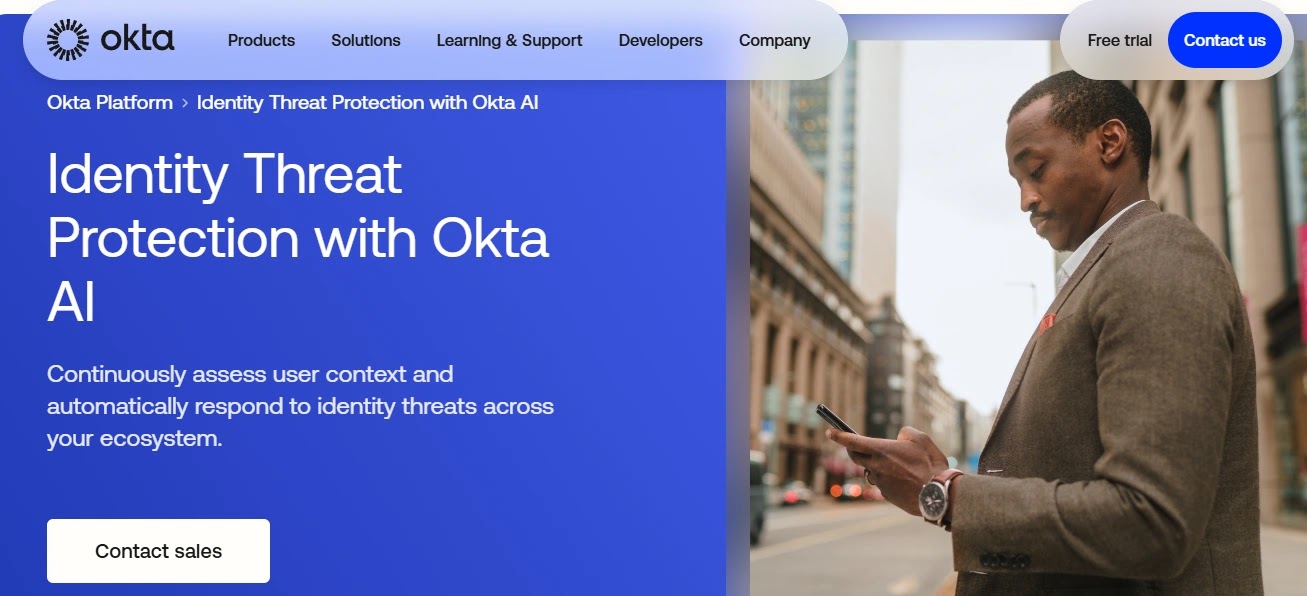
Best for: Okta-centric workforces seeking continuous risk evaluation throughout the entire user session, not just at login.
Identity Threat Protection, powered by Okta AI, extends risk assessment beyond initial authentication to cover the entire session duration. It ingests risk signals from Okta and third-party security tools (via Shared Signals/CAEP), triggering mid-session responses such as universal logout, step-up authentication, or application revocation, effectively turning the IdP itself into a response enforcement point.
Key features: Continuous evaluation of session risk; ingestion of shared signals from EDR and other security stacks; universal logout and adaptive response capabilities; identity posture insights; ecosystem policy actions.
Pros: Responses are enacted precisely where sessions reside; leverages standards-based signal sharing; provides rapid value for existing Okta environments.
Cons: Inherently Okta-first in its design; requires supplementary coverage for deep Active Directory attacks; premium SKU stacking can increase costs.
Pricing: Okta subscription SKU, quote via sales.
Standout differentiator: Incorporates a direct “kill switch” functionality within the identity provider itself.
7. Proofpoint Identity Threat Defense — Best Attack-Path Cleanup

Best for: Organizations committed to actively removing identity attack surface vulnerabilities, rather than just monitoring them.
Leveraging its acquisition of Illusive in 2023, Proofpoint Identity Threat Defense offers a unique dual approach. Spotlight continuously discovers exploitable identity risks—including cached credentials, shadow administrators, and exposed sessions—and actively remediates the lateral movement paths attackers exploit. Concurrently, Shadow’s deception technology detects adversaries who attempt to traverse these paths. This functionality is now seamlessly integrated into Proofpoint’s human-centric security suite.
Key features: Continuous discovery of identity vulnerabilities across endpoints, servers, and Active Directory; visualization and remediation of attack paths; deception-based detection; integration with Proofpoint threat intelligence; managed service options available.
Pros: Achieves prevention through attack surface reduction, leaving fewer paths for detection; benefits from a proven deception heritage; complements defenses against email-borne credential attacks.
Cons: Roadmap development is influenced by the broader Proofpoint portfolio; offers less in-line authentication enforcement compared to solutions like Silverfort or CrowdStrike.
Pricing: Quote-based.
Standout differentiator: Eliminates the lateral movement map before attackers can exploit it.
8. Cisco Identity Intelligence — Best Cross-IdP Analytics
.webp)
Best for: Enterprises managing multiple identity providers that require a unified analytical view of their identity posture.
Built on the Oort acquisition in 2023, Cisco Identity Intelligence provides an overlay across various IdPs including Okta, Entra, and Duo. It identifies dormant accounts, MFA gaps, impossible travel scenarios, and session anomalies that individual IdP tools might miss. Cisco’s identity graph enhances Duo policy enforcement and XDR response. The Astrix acquisition further extends this ambition to non-human identities.
Key features: Agentless visibility across multiple IdPs; identity posture analytics (identifying dormant, over-privileged, or MFA-weak accounts); behavior-based threat detections; integration with Duo and XDR for response; non-human identity (NHI) trajectory via Astrix.
Pros: Offers the fastest path to a truthful, cross-IdP hygiene assessment; low deployment friction; backed by Cisco’s substantial roadmap investment.
Cons: Primarily analytics-focused, with enforcement relying on companion tools; packaging within Cisco security suites is subject to evolution.
Pricing: Available via Cisco security suites, quote-based.
Standout differentiator: Provides a single, accurate inventory of every identity across all accumulated IdPs.
9. Netwrix — Best Hybrid AD Value Tier

Best for: Mid-market teams seeking robust Active Directory threat prevention without incurring top-tier vendor pricing.
Netwrix’s identity security portfolio, encompassing Threat Prevention (real-time AD event interception), Auditor (change visibility), PingCastle-lineage posture assessment, and Recovery for AD, delivers a significant portion of enterprise-grade ITDR outcomes at mid-market economics. Its published entry points are a rarity in this category.
Key features: Real-time interception of AD changes and authentication events at the source; threat detections and alerting; posture assessment; AD rollback/recovery options; broad auditing ecosystem.
Pros: Offers value pricing with transparently published components; supports modular adoption; strong focus on hybrid-AD environments.
Cons: Represents an assembled portfolio rather than a single unified platform; cloud IdP/SaaS depth is not as extensive as leading solutions.
Pricing: Published entry pricing per module, plus custom quotes.
Standout differentiator: Delivers enterprise-grade Active Directory defense capabilities at a mid-market price point.
10. Huntress — Best ITDR for SMB and MSP
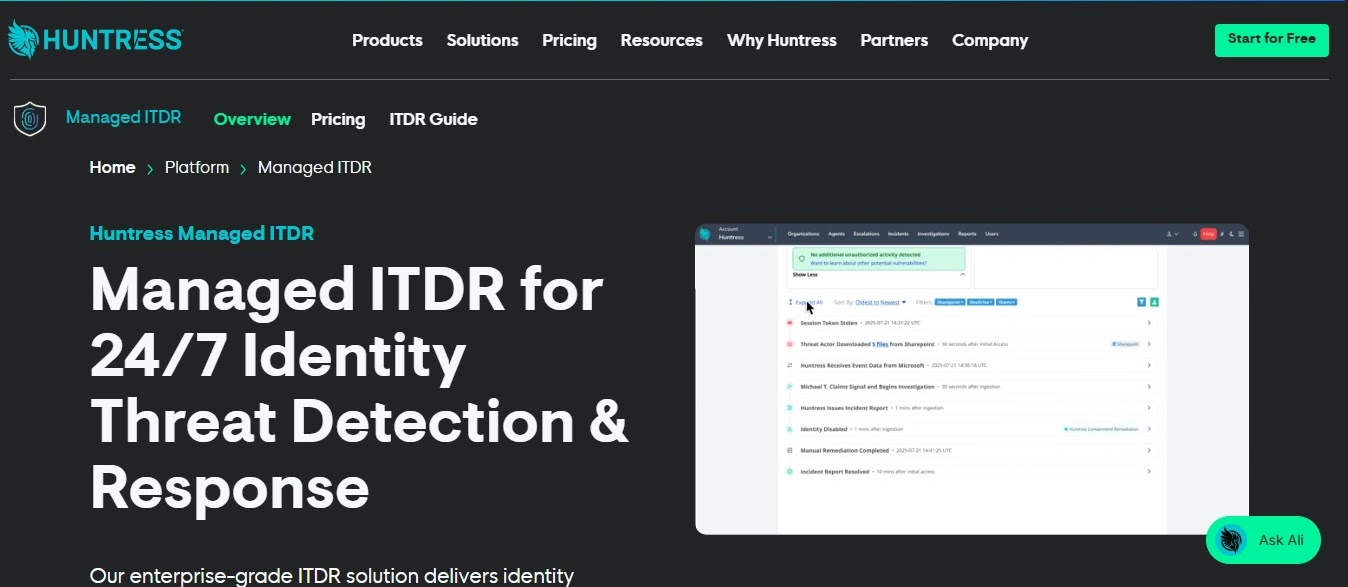
Best for: Small businesses and Managed Service Providers (MSPs) responsible for defending multiple Microsoft 365 tenants.
Huntress Managed ITDR specifically monitors Microsoft 365 identities for attacks commonly targeting SMBs, such as session hijacking, token theft, rogue inbox rules, and improbable VPN logins. A 24/7 SOC investigates and contains these threats (e.g., disabling users, revoking sessions) rather than merely forwarding alerts. Its published per-user pricing model simplifies procurement for smaller organizations.
Key features: Managed detection for M365/Entra identities; detection of session token theft and Business Email Compromise (BEC) precursors; SOC-driven response actions; monitoring for rogue applications and inbox rules; multi-tenant management capabilities for MSPs.
Pros: Truly managed service with human responders; transparent, published pricing; designed for organizations without dedicated SOC teams.
Cons: M365-centric scope; enterprises with deep hybrid AD requirements may find it insufficient.
Pricing: Published per-user/month rates.
Standout differentiator: Delivers enterprise-grade identity defense as a service that SMBs can realistically afford and implement.
Full Comparison Table
| Solution | AD depth | Cloud IdP/SaaS | In-line response | Recovery | Managed option |
| CrowdStrike | Strong | Strong | Yes | No | Yes (Complete) |
| Microsoft DfI | Deepest | Entra-strong | Via XDR disruption | No | Via partners |
| Silverfort | Strong | Strong (Rezonate) | Yes (in-line) | No | Partners |
| SentinelOne | Strong (deception) | Moderate | Endpoint-side | No | Yes (Vigilance) |
| Semperis | Deepest | Entra | Auto-rollback | Yes (forest) | IR services |
| Okta ITP | Light | Okta-native | Yes (session) | No | — |
| Proofpoint ITD | Strong (paths) | Moderate | Path removal | No | Yes |
| Cisco II | Moderate | Multi-IdP strong | Via Duo/XDR | No | — |
| Netwrix | Strong | Light | Interception | AD rollback | Partners |
| Huntress | Light | M365-strong | SOC actions | No | Core model |
How to Choose an ITDR Solution
Begin by thoroughly mapping your organization’s identity attack surface. Hybrid Active Directory environments necessitate solutions with deep directory telemetry, such as those offered by Microsoft, Semperis, Netwrix, or CrowdStrike. For workforces primarily relying on Okta or multiple IdPs, session-layer response capabilities are crucial, provided by solutions like Okta ITP or Cisco Identity Intelligence. Legacy systems and service accounts demand in-line enforcement, a strength of Silverfort. If Active Directory is business-critical, a robust recovery solution like Semperis can be the decisive factor between a mere incident and a catastrophic outage.
Demand concrete evidence of detection capabilities against specific attack techniques—such as Kerberoasting, DCSync, token theft, or MFA fatigue—rather than relying on vague “AI-powered” descriptors. Critically, test the response mechanisms: can the solution actively block an attack in progress, or does it merely generate alerts? Small to medium-sized businesses (SMBs) should prioritize the delivered outcome, opting for managed services akin to Huntress. ITDR serves as a vital complement to your existing IAM foundation, PAM controls, and, as machine identities proliferate, Non-Human Identity (NHI) management strategies.
FAQ
What is identity threat detection and response (ITDR)?
ITDR is a cybersecurity discipline and associated toolset designed to continuously monitor identity infrastructure, including directories, IdPs, credentials, and sessions. Its purpose is to detect attacks such as credential theft, privilege escalation, and lateral movement, and then respond through actions like blocking, session revocation, or automated containment. ITDR recognizes and addresses identity as the critical attack surface it has become.
How is ITDR different from IAM or PAM?
IAM (Identity and Access Management) focuses on granting and governing user access, while PAM (Privileged Access Management) is concerned with securing and controlling privileged credentials. ITDR, however, operates on the assumption that these preventive controls may be compromised. It actively monitors for the misuse of legitimate access—such as a compromised session, a forged ticket, or a service account behaving anomalously—providing detection and response capabilities specifically for the identity layer.
Why did ITDR become critical in 2026?
ITDR became critical in 2026 because attackers have industrialized methods of “logging in” rather than “hacking in.” Stolen credentials and session tokens now precede the majority of significant intrusions. Techniques like MFA fatigue and token theft effectively bypass many first-generation defenses, and Active Directory remains a prime target for ransomware operators seeking privilege escalation. The substantial M&A activity—including CrowdStrike’s acquisition of SGNL, Silverfort’s absorption of Rezonate, and Cisco’s Astrix deal—reflects the shift in defender budgets towards robust identity security.
Does Microsoft Defender for Identity make third-party ITDR unnecessary?
For organizations operating exclusively within a Microsoft ecosystem, Microsoft Defender for Identity provides extensive coverage, particularly with its unmatched domain controller-level telemetry. However, gaps emerge when dealing with third-party IdPs, managing SaaS session risks, enforcing policies on legacy or service accounts (Silverfort’s specialty), cleaning up attack surfaces (Proofpoint), or requiring advanced Active Directory recovery (Semperis). Most enterprises find it beneficial to pair Defender for Identity with specialized third-party ITDR solutions rather than relying on it exclusively.
Can ITDR stop ransomware?
ITDR is instrumental in intercepting the identity-centric phases that ransomware campaigns heavily rely on, such as credential theft, privilege escalation, and domain dominance, all of which typically precede data encryption. Real-time responses, including CrowdStrike’s blocking, Silverfort’s step-up authentication, or Semperis’s rollback capabilities, can effectively break the ransomware kill chain. Furthermore, solutions like Semperis provide critical recovery capabilities to rebuild Active Directory if containment efforts fail. While not a silver bullet, ITDR is a critical layer in an effective anti-ransomware strategy.
How much do ITDR solutions cost?
The majority of ITDR solutions are priced annually per user or per identity, typically requiring a custom quote. Huntress offers published per-user rates for SMBs, and Netwrix provides published entry points for its value-tier offerings. Microsoft bundles some ITDR capabilities into its M365 E5 license. Enterprise deployments generally range from five to six figures annually. It is important to be aware of module stacking by platform vendors and to negotiate M&A protections in this rapidly consolidating market.
What You Should Do
- Assess Your Identity Landscape: Understand where your critical identities reside (on-prem AD, Entra ID, Okta, other IdPs, SaaS, non-human accounts) to determine the necessary breadth of coverage.
- Prioritize Real-Time Response: Look for solutions that offer in-line blocking, session revocation, or automated containment, not just alerts, to stop attacks in progress.
- Demand Proven Detection: Insist on demonstrations of detection capabilities against specific, known attack techniques relevant to your environment (e.
Disclaimer: HackersRadar reports on cybersecurity threats and incidents for informational and awareness purposes only. We do not engage in hacking activities, data exfiltration, or the hosting or distribution of stolen or leaked information. All content is based on publicly available sources.









No Comment! Be the first one.