




PentesterFlow AI Tool Automates Workflows for Pen Testers
Key Takeaways PentesterFlow is a new open-source, AI-powered command-line interface (CLI) tool designed for penetration testers and bug bounty hunters. It automates the entire penetration testing...

Key Takeaways
- PentesterFlow is a new open-source, AI-powered command-line interface (CLI) tool designed for penetration testers and bug bounty hunters.
- It automates the entire penetration testing workflow, from reconnaissance to reporting, while maintaining human oversight.
- The tool addresses common AI limitations like hallucinations and poor context retention through built-in “skills,” evidence-based finding confirmation, and continuous local learning.
- PentesterFlow supports various local and hosted large language models (LLMs) and integrates with existing security tools like Burp Suite.
- It is intended for authorized security work only, requiring explicit analyst approval for sensitive commands, although a “YOLO mode” is available for isolated lab environments.
A new open-source command-line interface (CLI) tool, PentesterFlow, has emerged, specifically tailored for penetration testers and bug bounty hunters. This agentic AI solution aims to streamline the entire pen-testing process, from initial reconnaissance through to final reporting, without compromising the critical role of human expertise.
Table Of Content
Many existing agentic AI security tools struggle with issues such as generating erroneous findings (hallucinations), failing to retain context across tasks, and lacking robust integration with other tools. PentesterFlow addresses these fundamental challenges by incorporating specialized penetration testing “skills,” demanding evidence-based validation for all findings, and implementing a continuous local learning system.
The tool can connect to either local or cloud-hosted large language models (LLMs). It formulates action plans against a specified target, executes genuine offensive security tools, and critically, requires explicit approval from the analyst before initiating any sensitive commands. This “human-in-the-loop” design is paramount, ensuring that the AI never operates autonomously on production systems without a security engineer’s direct authorization, thereby bridging a significant trust gap often associated with automated penetration testing solutions.
PentesterFlow: Comprehensive Workflow Automation
PentesterFlow is engineered to support every phase of the penetration testing lifecycle, encompassing scoping, reconnaissance, enumeration, vulnerability validation, coverage tracking, reporting, and knowledge acquisition.
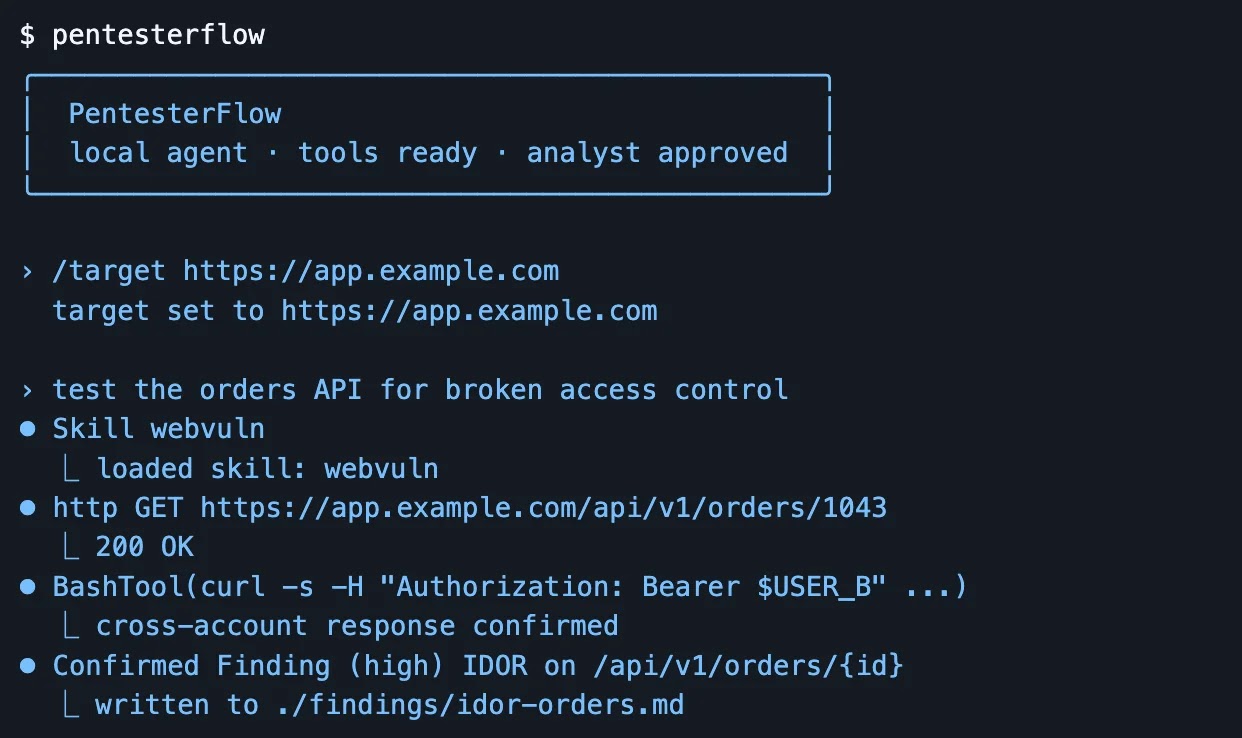
A demonstration illustrates the tool’s capabilities: loading a “webvuln” skill, dispatching HTTP requests to scrutinize an orders API, and automatically confirming a high-severity Insecure Direct Object Reference (IDOR) vulnerability. The tool then generates evidence-backed findings directly into a Markdown file, complete with proof-of-concept, impact assessment, and remediation recommendations.
| Feature | Description |
|---|---|
| Model backends | Ollama, LM Studio, Kimi, Groq, Gemini, DeepSeek, OpenRouter, and OpenAI-compatible APIs |
| Built-in skills | Recon, webvuln, SSRF, SSTI, JWT, GraphQL, race conditions, subdomain takeover, Supabase, deserialization |
| Tooling | Shell/Bash, HTTP, Burp Suite bridge, browser capture, MCP support, file read/write, grep/glob |
| Reporting | Confirmed findings saved with PoC, impact, remediation, and copy-pasteable curl commands |
| Memory | Session resume, context snapshots, and a continuous local intelligence system |
Continuous Learning and Security Features
A standout feature of PentesterFlow is its local Continuous Learning System. This system discreetly records user preferences, successful workflows, identified coverage gaps, and insights derived from failed assumptions. This data is stored in project-specific and personal intelligence files, enhancing the tool’s performance in subsequent sessions without requiring retraining of the underlying LLM.
To maintain security and efficiency, sensitive information (secrets) is automatically redacted before being written to disk, and redundant memories are deduplicated before being processed by the model. This ensures a streamlined workflow that becomes more intelligent over time.
PentesterFlow available from GitHub incorporates several critical security measures, including permission-gated tool execution, blocking of potentially catastrophic shell command patterns, and redaction of credentials during memory compaction and snapshotting. For controlled lab environments, a “YOLO mode” is available, which automatically approves actions.
The tool seamlessly integrates with Burp Suite through a dedicated bridge. This allows testers to feed captured traffic into the CLI for analysis and subsequently import confirmed findings back into Burp as issues, creating a fluid workflow between manual and AI-assisted testing.
Installation and Usage
Installation of PentesterFlow is straightforward, using a shell script for macOS/Linux systems or a PowerShell command for Windows. The process automatically fetches the latest standalone binary and verifies its SHA-256 checksum to ensure integrity.
Users have the flexibility to pin specific versions, opt for local LLMs such as Ollama’s qwen2.5-coder model, or connect to hosted providers like Gemini and Groq. Once configured, a simple /target command sets the target URL, after which the agent can be instructed in natural language, for example, “test the orders API for broken access control.”
It is crucial for analysts working with sensitive targets to understand that PentesterFlow is explicitly designed for authorized security work only. Its capability to execute shell commands and make live HTTP requests, once approvals are granted, underscores the necessity for responsible and ethical use.
As agentic AI tools continue to proliferate within the offensive security landscape, alongside projects like PentAGI and PentestGPT, PentesterFlow’s strong emphasis on transparent, reproducible evidence and analyst-approved actions positions it as a significant contender for teams who prioritize human oversight over fully autonomous penetration testing agents.
Disclaimer: HackersRadar reports on cybersecurity threats and incidents for informational and awareness purposes only. We do not engage in hacking activities, data exfiltration, or the hosting or distribution of stolen or leaked information. All content is based on publicly available sources.







No Comment! Be the first one.