




Okta AuthN Bypass Vulnerability Lets Attackers Impersonate Users
Key Takeaways Cyberattackers are increasingly abandoning traditional email phishing in favor of vishing, or voice-based social engineering, to gain initial access to corporate networks. This shift...

Key Takeaways
- Cyberattackers are increasingly abandoning traditional email phishing in favor of vishing, or voice-based social engineering, to gain initial access to corporate networks.
- This shift primarily targets identity providers like Okta, which serve as central authentication hubs for numerous enterprise applications.
- Successful vishing attacks against Okta allow threat actors to bypass multi-factor authentication (MFA) and gain broad access to connected cloud services such as Microsoft 365, SharePoint, OneDrive, Salesforce, Google Workspace, and Slack.
- The attacks require minimal technical skill, relying instead on sophisticated social engineering tactics to manipulate help desk personnel into resetting MFA or enrolling new devices for the attackers.
- Organizations are urged to enhance identity verification protocols, train staff on vishing recognition, adopt phishing-resistant MFA, and improve logging and incident response capabilities.
A significant evolution in cyberattack methodology is underway, with threat actors increasingly sidestepping traditional email-based phishing for direct phone calls to infiltrate corporate systems. This strategic pivot, often dubbed “vishing,” or voice phishing, is proving highly effective, catching many organizations off guard.
Table Of Content
For years, malicious emails were the primary conduit for unauthorized network access. Attackers meticulously crafted convincing messages, embedding deceptive links or attachments, banking on unsuspecting employees to initiate the compromise. However, as email security defenses matured, cybercriminals sought more direct routes, finding considerable success by targeting identity providers like Okta through social engineering over the phone.
LevelBlue analysts and researchers have identified this growing trend, noting that Okta vishing has rapidly become one of the most prevalent initial access techniques observed in active incident investigations. The findings, published on April 13, 2026, by LevelBlue’s SpiderLabs team, highlight Okta as a prime target due to its critical role as a centralized authentication gateway for numerous enterprises.
Once an Okta instance is compromised, attackers inherit trusted access across all applications connected via Single Sign-On (SSO), including critical platforms like Microsoft 365, SharePoint, OneDrive, Salesforce, Google Workspace, Slack, and VPN portals. This broad access is achieved without the need for deploying any malicious code or exploits.
The ramifications of such an attack extend far beyond a single account compromise. Gaining control of an Okta identity grants immediate access to an entire ecosystem of SSO-connected applications. This often precipitates large-scale cloud data theft, where attackers download extensive document libraries from SharePoint, export email archives, access OneDrive storage, and register unauthorized OAuth applications. What might initially appear as a routine help desk inquiry can quickly escalate into a severe corporate data breach.
A key characteristic of this threat is its low technical barrier to entry. Attackers require no sophisticated malware or exploit kits; a credible narrative and a phone number are frequently sufficient to unlock an organization’s complete cloud environment.
Inside the Okta Vishing Attack Chain
The vishing attack sequence is meticulously planned, commencing well before any direct phone contact is made. During the reconnaissance phase, threat actors compile comprehensive profiles of their target organizations. They leverage publicly available resources such as LinkedIn, corporate websites, and data enrichment services like ZoomInfo, often supplementing this with previously compromised credentials. This data collection includes employee names, job titles, help desk contact information, and specific Okta tenant naming conventions. Such thorough preparation enables attackers to present a highly believable persona during the subsequent phone call.
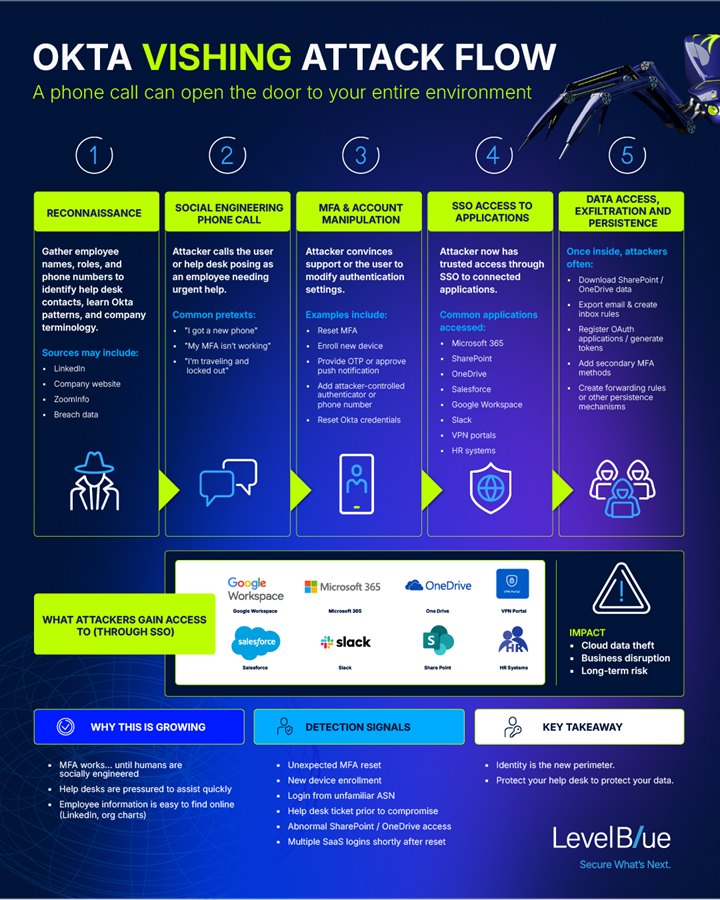
The attacker then contacts either the target employee directly or the IT help desk, impersonating a legitimate employee or executive. They typically fabricate an urgent scenario, such as being locked out of an account, requiring VPN access while traveling, or needing to set up a new phone. This manufactured urgency is a deliberate psychological tactic designed to pressure help desk staff into bypassing standard verification procedures and acting swiftly to restore access.
Once the help desk is manipulated into resetting Multi-Factor Authentication (MFA) or enrolling a new authenticator device, the attacker gains unauthorized entry to Okta. From there, they pivot rapidly across all integrated SaaS platforms. Post-compromise activities commonly include downloading files from SharePoint, exporting email content, establishing inbox forwarding rules, generating API tokens, and adding secondary MFA methods to lock out the legitimate user. This culminates in a significant cloud data exfiltration event, distinct from traditional malware infections.
What You Should Do
- Strengthen Identity Verification: Implement stringent identity verification protocols for all MFA resets or new device enrollments, requiring secondary approvals (e.g., manager sign-off, validated support tickets).
- Provide Vishing Training: Equip help desk and IT support staff with specialized training to recognize vishing tactics, including common pretexts and psychological manipulation techniques. Empower them to challenge urgent requests and follow established verification processes rigorously.
- Adopt Phishing-Resistant MFA: Migrate away from less secure MFA methods like SMS and voice calls. Prioritize the deployment of phishing-resistant alternatives such as FIDO2 security keys or passkeys across the organization.
- Enhance Logging and Monitoring: Ensure Okta logs are integrated with Security Information and Event Management (SIEM) platforms. Correlate Okta authentication events with activity across SaaS applications and endpoint data to detect and flag suspicious login sequences or privilege escalations.
- Develop Incident Response Playbooks: Create dedicated incident response playbooks specifically for identity-related compromises. These playbooks should include clear procedures for rapidly revoking active sessions, isolating compromised accounts, and removing any unauthorized MFA methods or registered devices immediately upon detection.
Disclaimer: HackersRadar reports on cybersecurity threats and incidents for informational and awareness purposes only. We do not engage in hacking activities, data exfiltration, or the hosting or distribution of stolen or leaked information. All content is based on publicly available sources.








No Comment! Be the first one.