




North Korean Hackers Employ Modular Malware to Evade Detection
Key Takeaways North Korea’s cyber operations have evolved to use a modular malware strategy, moving away from monolithic tools towards specialized, disposable components. This sophisticated...

Key Takeaways
- North Korea’s cyber operations have evolved to use a modular malware strategy, moving away from monolithic tools towards specialized, disposable components.
- This sophisticated approach, driven by over a decade of international pressure, enables the regime to conduct simultaneous espionage, financial theft, and disruptive attacks with enhanced resilience.
- The program operates across three distinct tracks—espionage (Kimsuky), financial (Lazarus), and disruptive (Andariel)—each with unique operational tempos and tactics, yet all relying on social engineering for initial access.
- Targets include government entities, defense contractors, cryptocurrency platforms, and software supply chains, resulting in significant intelligence loss and financial drain.
- Effective defense requires a shift from signature-based detection to behavioral analytics, identity monitoring, and comprehensive supply chain visibility.
North Korea’s state-sponsored cyber program has undergone a significant transformation, adopting a sophisticated modular approach to malware development and deployment. Instead of relying on single, multi-purpose hacking tools, the regime now employs a diverse ecosystem of specialized malware families, each designed for specific objectives.
Table Of Content
This strategic evolution is a direct response to over a decade of persistent international sanctions, heightened law enforcement scrutiny, and advancements in global cybersecurity defenses. These pressures have compelled DPRK operators to re-engineer their methods to ensure operational continuity and resilience.
The core of this strategy involves compartmentalizing tools, infrastructure, and operations based on mission requirements. Should one malware family be exposed and neutralized, the impact remains localized, allowing other parallel operations to continue unimpeded.
Malware toolchains are treated as ephemeral assets, designed for rapid deployment, use, and subsequent abandonment. This “loss-tolerant” architecture facilitates simultaneous operations by multiple teams, who can pursue objectives such as espionage, financial illicit gains, and network disruption without sharing infrastructure or increasing the risk of wider exposure across the entire cyber program.
Analysts at DomainTools identified this deliberate architectural shift, interpreting it as a clear indicator of program maturity rather than internal disorganization. Their research, published on April 1, 2026, synthesized data from government advisories, vendor intelligence, and academic reports. It conclusively demonstrated that what might appear to be a fragmented program from an external perspective is, in reality, a highly disciplined, mission-aligned portfolio engineered to withstand pressure and survive repeated takedowns.
The targets of these operations are broad, encompassing government ministries, defense contractors, policy think tanks, cryptocurrency exchanges, and various software supply chains. The consequences of these attacks are substantial, ranging from the theft of state secrets and the siphoning of billions from crypto platforms to destructive attacks strategically timed to coincide with geopolitical events.
By maintaining three distinct operational tracks, DPRK actors can conduct covert intelligence gathering in one environment while aggressively deploying destructive tools in another, crucially avoiding cross-contamination of their separate access points.
Although the specific attack vectors vary depending on the mission type, a common thread unites all three tracks: the exploitation of human trust. Social engineering serves as the primary initial access vector across every operation. This includes weaponized documents, highly personalized phishing lures, deceptive fake trading platforms, and trojanized software updates.
Once inside a target network, operators adjust their pace and toolset to align with the objective. This can involve maintaining stealth for months or even years in some cases, or moving with extreme speed to inflict immediate damage in others.
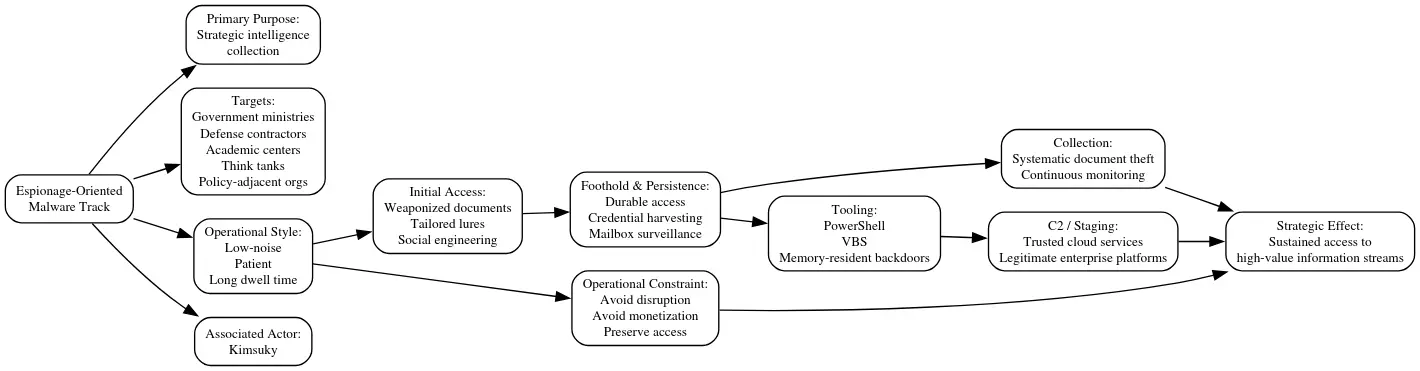
Three Tracks, One Program
Espionage Track
The espionage track represents the oldest and most patient component of North Korea’s cyber operations. Primarily linked to the Kimsuky threat group, this track focuses on government ministries, think tanks, and defense organizations. Its priority is establishing long-term access rather than achieving quick results. Initial compromise typically occurs through weaponized documents or highly customized lures delivered to specific individuals. Once a foothold is established, operators deploy memory-resident backdoors that leave minimal forensic traces on disk. Command-and-control (C2) traffic is often routed through legitimate cloud platforms, allowing malicious activity to blend seamlessly with normal enterprise network flows. The objective is prolonged, quiet observation—harvesting credentials, monitoring email communications, and exfiltrating sensitive documents over extended periods, often for months or years, without detection.
Financial Track
In stark contrast to the espionage track, the financial track operates with a significantly faster tempo. Largely attributed to actors associated with the Lazarus Group, this segment targets cryptocurrency exchanges, decentralized finance (DeFi) platforms, and developer ecosystems. Attack tools, such as AppleJeus, are often disguised as legitimate crypto wallets or trading applications. Attackers also employ clipboard hijackers to silently redirect cryptocurrency transfers to their own wallets. Malicious code is frequently embedded into trusted open-source software packages, transforming widely used development tools into scalable vectors for compromise. Infrastructure is rapidly rotated to preempt takedowns, with all illicit proceeds directly financing North Korea’s weapons programs and efforts to circumvent international sanctions.
Disruptive Track
The disruptive track constitutes the most visible arm of the DPRK cyber program, predominantly associated with the Andariel group. These operations involve the deployment of wipers and ransomware-style payloads designed to cause immediate and widespread damage across enterprise environments. Upon gaining access, operators move swiftly to achieve lateral movement and maximize impact before defenders can respond effectively. These attacks are deliberately timed to coincide with significant political or military events, ensuring that the disruption serves as a clear state-sponsored message rather than mere opportunistic cybercrime. Despite their operational isolation, each of these three tracks ultimately contributes to a singular overarching goal: sustaining the regime’s capabilities and resilience amidst ongoing international pressure.
What You Should Do
- Implement advanced behavioral analytics solutions to detect anomalous activities that bypass traditional signature-based detection.
- Strengthen identity and access management (IAM) protocols, including multi-factor authentication (MFA) for all critical systems and accounts, and regularly review access privileges.
- Enhance supply chain visibility by scrutinizing third-party software, open-source components, and developer environments for embedded malicious code or vulnerabilities.
- Leverage cloud telemetry correlation to identify suspicious C2 traffic blending with legitimate cloud services.
- Conduct regular security awareness training for all employees, focusing on recognizing sophisticated social engineering tactics, phishing attempts, and weaponized documents.
- Adopt a comprehensive, behavior-based security posture rather than focusing narrowly on specific threat categories, as North Korea’s modular approach is designed to evade targeted defenses.
Disclaimer: HackersRadar reports on cybersecurity threats and incidents for informational and awareness purposes only. We do not engage in hacking activities, data exfiltration, or the hosting or distribution of stolen or leaked information. All content is based on publicly available sources.








No Comment! Be the first one.