




AIRecon: AI Penetration Testing Tool Integrates Kali Linux Sandbox
Key Takeaways AIRecon is a new, autonomous penetration testing tool that integrates a self-hosted Ollama Large Language Model (LLM) with a Kali Linux Docker sandbox. It performs end-to-end security...

Key Takeaways
- AIRecon is a new, autonomous penetration testing tool that integrates a self-hosted Ollama Large Language Model (LLM) with a Kali Linux Docker sandbox.
- It performs end-to-end security assessments offline, ensuring sensitive data remains on the operator’s machine and is not exposed to cloud services.
- Developed by researcher pikpikcu, AIRecon offers a cost-effective alternative to commercial API-based AI security tools, which typically incur high subscription fees for extensive LLM calls.
- The tool is designed for bug bounty hunters and red teamers, providing features like native Caido proxy integration, automated engagement phases, and an optional offline security dataset.
AIRecon: Revolutionizing Offline AI-Powered Penetration Testing
A novel autonomous penetration testing agent, AIRecon, has emerged, offering a robust solution for offline security assessments. This innovative tool combines a self-hosted Ollama Large Language Model (LLM) with a Kali Linux Docker sandbox, enabling comprehensive, end-to-end security evaluations without relying on external cloud services. This architecture is critical for maintaining data privacy and operational security, as all reconnaissance data, vulnerability reports, and session information remain local to the operator’s machine.
Table Of Content
Developed by researcher pikpikcu, AIRecon addresses a significant cost barrier associated with commercial AI-driven security platforms. Unlike tools that depend on expensive API calls to models like GPT-4 or Claude for recursive reconnaissance workflows—which can involve thousands of LLM interactions per session—AIRecon operates entirely offline. This eliminates the prohibitive subscription costs, making advanced AI-powered testing more accessible.
Core Functionality and Data Security
Traditional AI-powered security tools often transmit target intelligence to external servers and necessitate ongoing API subscriptions. AIRecon fundamentally alters this paradigm by ensuring that all generated output, vulnerability findings, and session data are confined to the operator’s local environment. This design prioritizes data sovereignty and operational independence.
The tool seamlessly integrates with the Caido proxy and offers five core functionalities: listing, replaying, automating tasks using §FUZZ§ markers, managing findings, and defining scope. These features make AIRecon particularly valuable for bug bounty hunters and red team operators who must adhere to stringent data-handling policies and operate in environments where cloud data exposure is unacceptable.
Automated Engagement Phases and Advanced Features
AIRecon structures each penetration testing engagement into four automated phases, each with distinct objectives, recommended tools, and automated transition criteria. While the phase enforcement is flexible, guiding the agent without blocking its progress, checkpoints are implemented at key intervals: every 5 iterations for phase evaluation, every 10 for self-evaluation, and every 15 for context compression.
The comprehensive technology stack underlying AIRecon includes the Kali sandbox, browser automation capabilities, a custom fuzzer, Schemathesis for API fuzzing, and Semgrep for static application security testing (SAST) of source code.
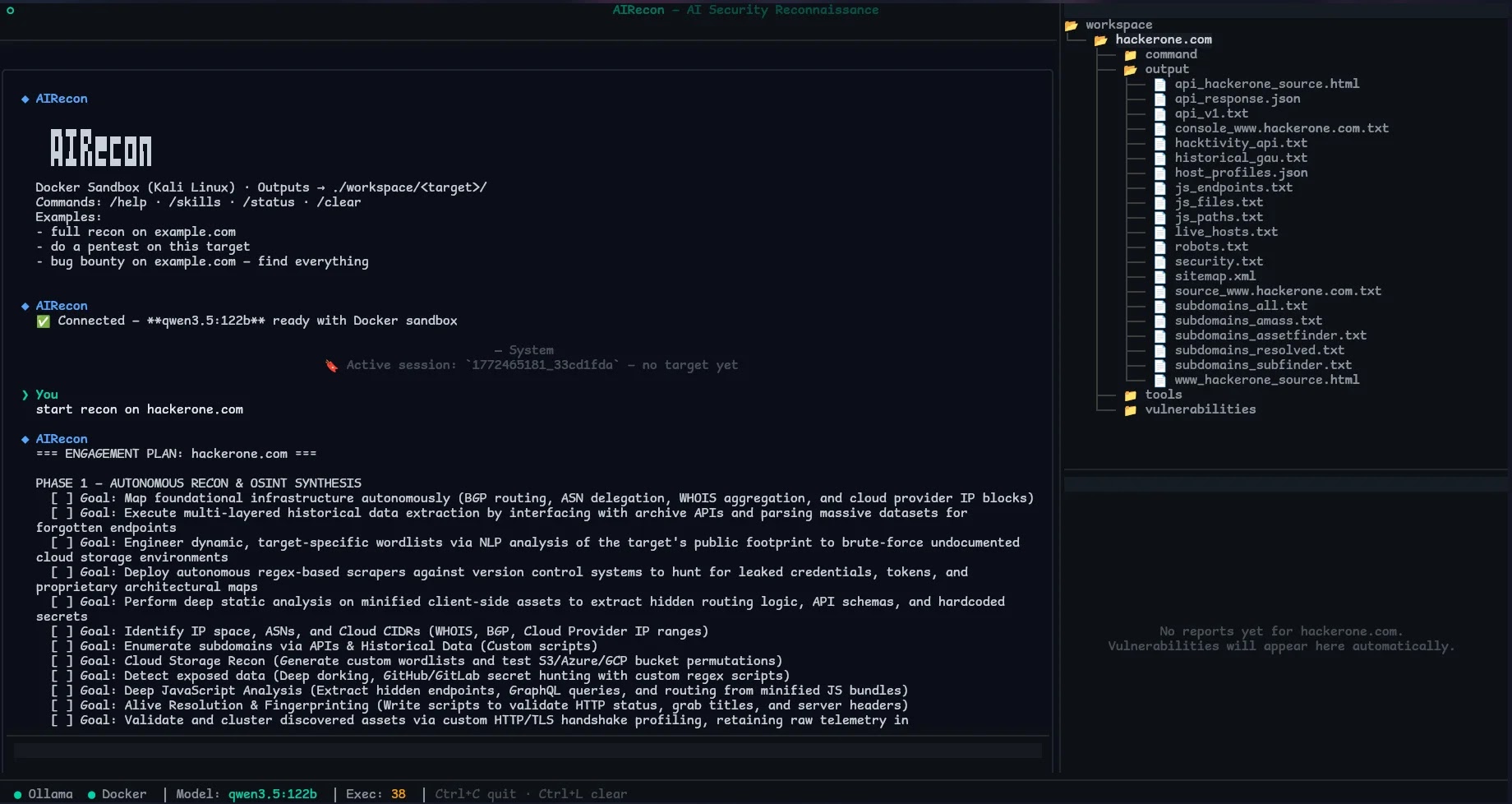
A notable companion feature is the optional airecon-dataset, which comprises approximately 1.09 million security records indexed into local SQLite FTS5 databases. This extensive offline repository includes CVEs, red team techniques, CTF writeups, Nuclei templates, and bug bounty payloads. This allows the LLM to autonomously invoke dataset_search before attempting unfamiliar techniques, grounding its decisions in real, indexed data rather than relying on potentially erroneous “hallucinations.” Session memory is persistently stored in ~/.airecon/memory/airecon.db, recording findings, WAF bypass patterns, tool reliability scores, and per-target attack chain discoveries, which collectively inform and shape future agent behavior.
LLM Model Requirements and Configuration
AIRecon necessitates an LLM with native tool-calling support and advanced reasoning capabilities, specifically those that utilize <think> blocks. Models with fewer than 8 billion parameters are strongly discouraged due to their propensity for frequent hallucinations, fabrication of CVEs, and unreliable tool calls. Recommended configurations for optimal performance include:
| Model | VRAM | Use Case |
|---|---|---|
| Qwen3.5 122B | 48+ GB | Best quality, most reliable |
| Qwen3.5 35B | 20 GB | Recommended for most users |
| Qwen3.5 35B (MoE) | 16 GB | Lower VRAM footprint |
| Qwen3.5 9B | 6 GB | Minimum viable setup |
The tool comes equipped with 57 built-in skill files and 289 keyword-to-skill auto-mappings, covering a wide array of common offensive techniques. Furthermore, the community-driven airecon-skills repository provides an additional 57 CLI-based playbooks tailored for CTF, bug bounty, and penetration testing engagements.
AIRecon also supports MCP server integration via ~/.airecon/mcp.json, enabling the agent to dynamically incorporate external tools such as custom XSS generators or proprietary API scanners as first-class functionalities.
Installation & Google Colab Support
Installation from GitHub requires Python 3.12+, Docker 20.10+, and a running Ollama instance. The setup process can be completed with a single command:
curl -fsSL https://raw.githubusercontent.com/pikpikcu/airecon/refs/heads/main/scripts/install.sh | bashFor users lacking sufficient local VRAM, AIRecon offers support for a Google Colab T4 GPU tunnel setup through Cloudflare. This allows a free-tier Colab session to host the LLM model while AIRecon’s Text User Interface (TUI) operates locally. Although the free T4 GPU provides 15 GB VRAM, sufficient for qwen3.5:9b, Colab sessions are capped at 12 hours, which may limit deep autonomous reconnaissance efforts extending beyond this duration.
Disclaimer: HackersRadar reports on cybersecurity threats and incidents for informational and awareness purposes only. We do not engage in hacking activities, data exfiltration, or the hosting or distribution of stolen or leaked information. All content is based on publicly available sources.








No Comment! Be the first one.