




Aikido Security Launches Altar-1 AI for Cybersecurity Defense
Key Takeaways Aikido Security has launched Altar-1, an open-weight AI model designed for autonomous cybersecurity defense. Altar-1 operates entirely within an organization’s infrastructure,...

Key Takeaways
- Aikido Security has launched Altar-1, an open-weight AI model designed for autonomous cybersecurity defense.
- Altar-1 operates entirely within an organization’s infrastructure, ensuring data privacy and compliance for sensitive environments.
- The model specializes in vulnerability discovery and penetration testing, processing sensitive data locally without external cloud exposure.
- Developed from Z.AI’s GLM-5.3, Altar-1 significantly reduces storage footprint while maintaining strong vulnerability detection capabilities.
Aikido Security has unveiled Altar-1, a new open-weight artificial intelligence model engineered to perform defensive cybersecurity operations directly within an organization’s existing infrastructure. This innovation aims to provide advanced AI capabilities for security teams while strictly adhering to data privacy and regulatory requirements.
The core objective of Altar-1 is to empower security professionals with sophisticated AI tools for tasks like vulnerability identification and penetration testing. Crucially, it achieves this without necessitating the transmission of sensitive data — such as source code, internal documentation, or security findings — to external, cloud-based AI inference services.
Altar-1 is specifically tailored for entities operating under stringent privacy, regulatory, or operational mandates. This includes financial institutions bound by data-residency laws, healthcare providers managing protected patient information, and industrial organizations with isolated or air-gapped operational technology (OT) environments.
By ensuring that both the AI model and the processed data remain under the customer’s direct control, Aikido positions Altar-1 as a sovereign security intelligence solution. This model is integral to the functionality of Aikido Machine, the company’s proprietary autonomous penetration testing appliance, which is designed to continuously identify, exploit, and validate security weaknesses across an attack surface directly within customer environments. Altar-1 enhances this process by providing local AI reasoning, enabling comprehensive security testing that respects data sovereignty.
Engineering Altar-1 for Sovereign Security
Aikido developed Altar-1 by adapting Z.AI’s open-weight GLM-5.3 model. A primary focus during this process was to drastically reduce the model’s storage footprint, shrinking it from an initial 1.51 TB down to 328 GB. This reduction was achieved through a multi-stage optimization process.
Initially, Aikido applied AWQ INT4 quantization, which brought the model size down to 488.2 GB. Following this, the company employed expert pruning, a technique that systematically removed components of the model deemed less critical for specific security workloads.
Mixture-of-experts (MoE) models, like GLM-5.3, are characterized by numerous specialized neural-network components, or “experts.” During inference, only a subset of these experts is activated for each token. However, the overall size of the expert pool typically still demands substantial memory resources.
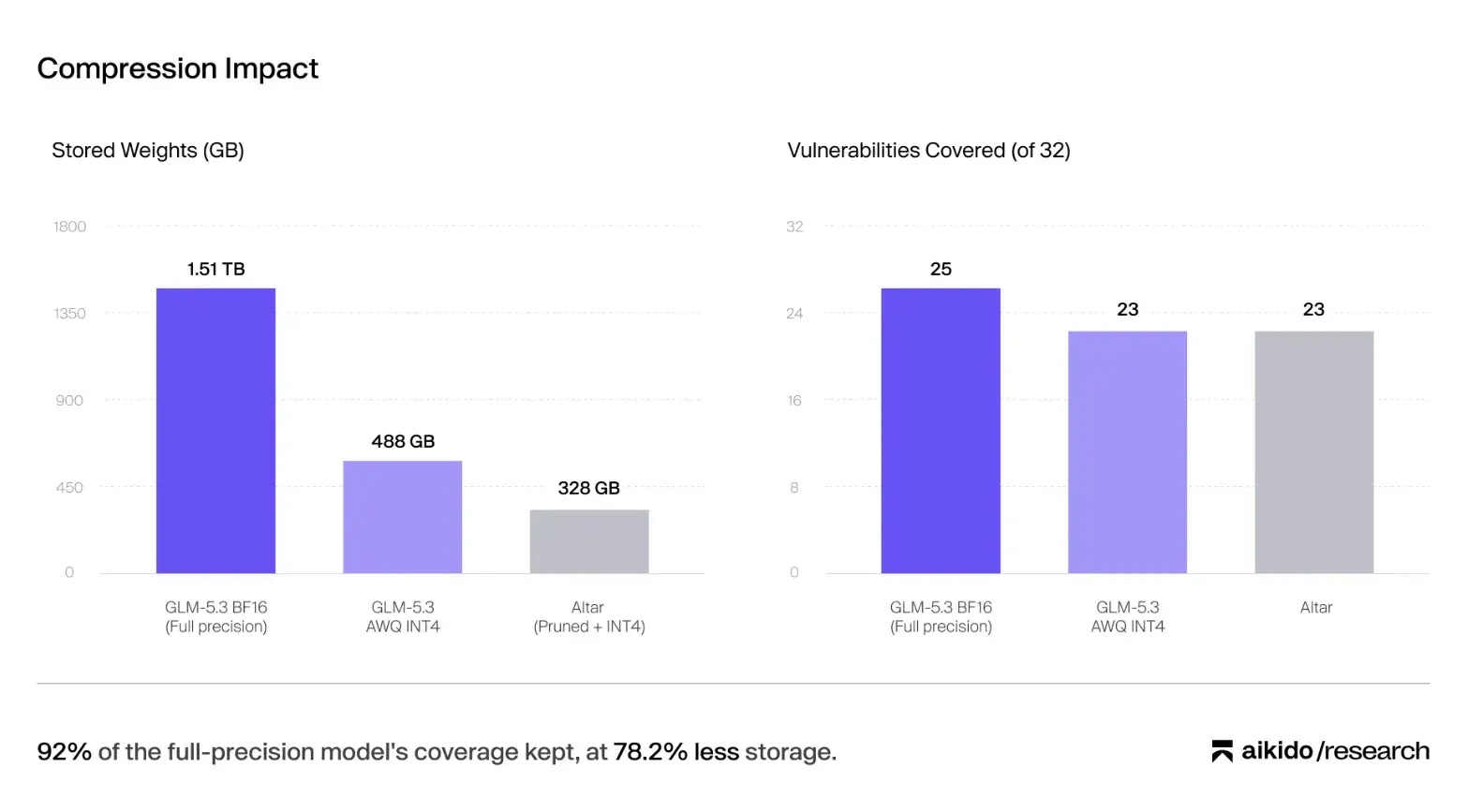
As Aikido said, it strategically retained 168 of the original 256 routed experts within each backbone layer, removing 88 experts. This targeted pruning resulted in a 78.2 percent reduction compared to the original full-precision model and a 32.8 percent reduction from the already quantized checkpoint.
To determine which experts to preserve, Aikido utilized traces derived from its internal penetration testing benchmarks, rather than relying on customer data. These traces encompassed representative code, tool calls, and agent responses generated during actual security testing workflows, ensuring relevance to the model’s intended use.
Furthermore, the company incorporated multilingual text during the calibration phase. This step was crucial for Altar-1 to maintain the necessary language comprehension abilities for reviewing diverse documentation, business rules, application behaviors, and user interfaces across different languages.
Aikido leveraged Cerebras REAP (Router-weighted Expert Activation Pruning) for expert selection. This method prioritizes experts based on their router weights and output magnitude, effectively preserving the model’s critical capabilities in coding, cybersecurity, and natural-language reasoning.
Performance Benchmarks
In internal benchmarks, Altar-1 demonstrated robust performance in vulnerability detection. Across 30 repositories containing 32 known vulnerabilities, Altar-1 achieved an average recall rate of 60.4 percent per run. Over three runs, the model successfully rediscovered 23 of the 32 vulnerabilities at least once.
For comparison, the quantized but unpruned GLM-5.3 model achieved a slightly higher 61.5 percent recall and also identified the same 23 vulnerabilities. The full-precision parent model, without any size optimizations, delivered the highest performance with a 65.6 percent recall, identifying 25 vulnerabilities.

Aikido stated that Altar-1 effectively retained 92 percent of the full model’s vulnerability coverage, while significantly reducing the computational infrastructure required for its deployment and operation.
Altar-1 is now accessible through Aikido’s Hugging Face organization. It can be deployed on a node equipped with four NVIDIA H200 GPUs using vLLM, a high-throughput inference engine.
Looking ahead, the company plans to further optimize the model. Future developments include exploring even lower-bit formats and fine-tuning subsequent versions of Altar-1 for enhanced code analysis, automated remediation, sophisticated tool utilization, and extended security workflows.
Disclaimer: HackersRadar reports on cybersecurity threats and incidents for informational and awareness purposes only. We do not engage in hacking activities, data exfiltration, or the hosting or distribution of stolen or leaked information. All content is based on publicly available sources.






No Comment! Be the first one.