




New Modular RAT Steals Credentials and Captures Screenshots
Key Takeaways A sophisticated, modular Remote Access Trojan (RAT) is actively targeting high-profile individuals in Southeast Asia. The campaign, dubbed “Operation GriefLure,” is...

Key Takeaways
- A sophisticated, modular Remote Access Trojan (RAT) is actively targeting high-profile individuals in Southeast Asia.
- The campaign, dubbed “Operation GriefLure,” is simultaneously attacking Vietnam’s military-linked telecom sector and the Philippine healthcare industry.
- The threat actors employ highly convincing spear-phishing tactics, using legitimate legal and financial documents as lures.
- The RAT is designed for deep system persistence, extensive credential theft, and stealthy screenshot capture, bypassing conventional security measures.
- Security researchers attribute the campaign with moderate-to-high confidence to a China-nexus threat cluster.
Operation GriefLure: Advanced Modular RAT Targets Southeast Asian Executives
A recent and alarming malware campaign, designated “Operation GriefLure” by researchers, is actively compromising senior executives and government investigators across Southeast Asia. This advanced operation leverages a modular Remote Access Trojan (RAT) to exfiltrate credentials, capture sensitive screenshots, and establish robust persistence on victim systems. For a comprehensive technical deep dive into this evolving threat, a detailed analysis is available from Seqrite Labs.
Table Of Content
A particularly concerning aspect of this campaign is the attackers’ method of initial compromise. Rather than relying on generic phishing attempts, the threat actors are leveraging highly authentic, legally binding documents. In one instance, they utilized actual legal records from an ongoing data breach lawsuit, including signed police reports, official corporate admissions, and personal medical information. Victims who opened these archives saw what appeared to be perfectly legitimate documents, completely unaware of the malicious activity unfolding in the background.
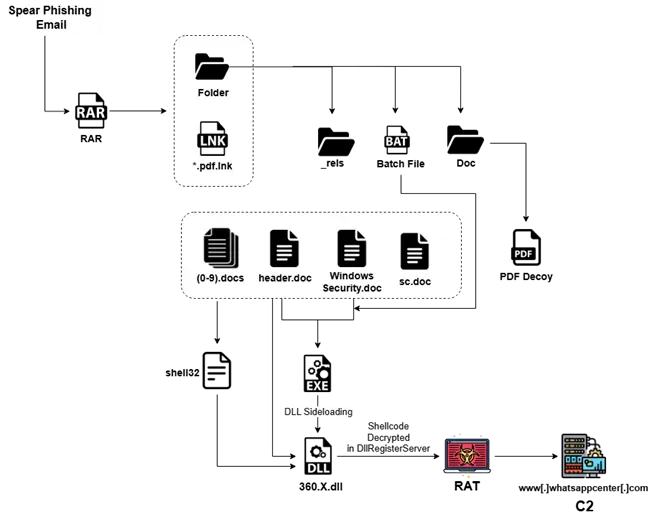
Researchers at Seqrite Labs, who identified and named the campaign, highlighted that the entire system compromise typically concludes in under ten seconds, leaving no visible indicators for the victim. The malware is delivered via targeted spear-phishing emails containing nested compressed archives. Its meticulously crafted infection chain is designed to circumvent most conventional security solutions. Operation GriefLure encompasses two parallel campaigns.
Dual Campaign Targets
The first campaign primarily targets senior executives within Viettel Group, Vietnam’s largest telecommunications provider, which operates under the Ministry of National Defence. It also targets cybercrime investigators from the Thanh Hoa Provincial Police. The second campaign focuses on compliance and audit personnel at St. Luke’s Medical Center in the Philippines, utilizing a fabricated whistleblower complaint alleging financial fraud and accreditation violations exceeding PHP 1.5 million.
Crucially, both campaigns share the same underlying infrastructure and malicious payload, indicating a single threat actor orchestrating a coordinated, multi-country attack operation. A detailed technical analysis of the threat is available from Seqrite Labs.
Modular RAT Capabilities: Credential Theft and Stealthy Screenshot Capture
At the heart of this sophisticated campaign lies a modular RAT, functioning as a versatile implant. Once it successfully loads into memory through a multi-layered execution chain, the RAT initiates extensive data harvesting. It targets credentials stored in web browsers, including Chrome’s saved login data, cookies, and browsing history. Beyond browsers, it also extracts configurations from FTP clients, remote access tools such as Sunlogin and ToDesk, and SSH session files from Xshell, posing a significant risk to individuals managing privileged system access.
The RAT’s screenshot capture module is equally advanced. It can determine full screen dimensions, accurately account for multi-monitor setups, and dynamically adjust image resolution based on prevailing network conditions. These reconstructed BMP images are then covertly transmitted to the attacker’s command-and-control (C2) server. Furthermore, the malware actively scans for and profiles installed security products, allowing it to adapt its behavior to minimize detection.
The payload itself is never stored as a complete file on the disk. Instead, it is broken into binary chunks disguised as ordinary document files, which are then reassembled at runtime using native Windows copy commands. A time-based mechanism randomizes the payload hash with each execution, effectively thwarting signature-based detection. The final executable is subsequently injected into a trusted Windows process, making its activity indistinguishable from legitimate system operations to many forensic tools.
Infrastructure, Attribution, and Defensive Measures
The malware establishes communication with a hardcoded command-and-control domain, whatsappcenter[.]com, hosted on the IP address 38[.]54[.]122[.]188. This server is located within KAOPU-HK, a Hong Kong-based network known for providing abuse-resistant hosting services to various threat actors across the Asia-Pacific region. Passive intelligence classifies this host as “bulletproof infrastructure,” strongly indicating deliberate operational security measures by the attackers.
Based on multiple converging indicators, Seqrite researchers assess with moderate-to-high confidence that this campaign is linked to a China-nexus threat cluster. Supporting evidence includes the use of bulletproof Chinese hosting, an embedded security detection list that specifically enumerates vendors such as 360Safe, Qianxin, and Sangfor, direct targeting of WeChat data within the credential harvesting module, and the broader geographical footprint targeting military-linked telecom and healthcare sectors in Southeast Asia.
What You Should Do
- Block Known Indicators: Immediately block the C2 domain
whatsappcenter[.]comand IP address38[.]54[.]122[.]188at network perimeter defenses (firewalls, proxies, DNS filters). - Monitor for Anomalous Activity: Implement robust monitoring for LNK file executions that invoke
ftp.exe, and any processes dropping chunked document files into the Public directory. - Audit Process Behavior: Regularly audit systems for instances of
explorer.exebeing respawned under a restricted security context, as this is a known evasion technique. - Enhance Endpoint Detection: Ensure Endpoint Detection and Response (EDR) solutions are configured for behavioral analysis and anomaly detection, as signature-based methods may be insufficient due to payload randomization.
- Review Privileged Access: Conduct an urgent review of all privileged access credentials, especially those for remote access tools (Sunlogin, ToDesk) and SSH clients (Xshell), and enforce multi-factor authentication (MFA) rigorously.
- Advanced User Training: While standard user awareness is crucial, recognize that this attack weaponizes genuine documents. Augment training with simulations that expose users to highly convincing, context-specific phishing lures.
- Threat Intelligence Integration: Integrate the provided Indicators of Compromise (IoCs) into your Security Information and Event Management (SIEM) and threat intelligence platforms for proactive detection.
Indicators of Compromise (IoCs):-
| Type | Indicator | Description |
|---|---|---|
| File Hash (SHA256) | 35af2cf5494181920b8624c7b719d39590e2a5ff5eaa1a2fa1ba86b2b5aa9b43 | LNK dropper — Viettel-themed lure (Campaign 1) |
| File Hash (SHA256) | bc090d75f51c293d916c40d4b21094faaec191a42d97448c92d264875
Disclaimer: HackersRadar reports on cybersecurity threats and incidents for informational and awareness purposes only. We do not engage in hacking activities, data exfiltration, or the hosting or distribution of stolen or leaked information. All content is based on publicly available sources.
|









No Comment! Be the first one.