




Best Network Detection and Response (NDR) Solutions of 2024
Key Takeaways Network Detection and Response (NDR) solutions are crucial for modern cybersecurity, providing real-time threat detection beyond traditional perimeter defenses. These platforms leverage...

Key Takeaways
- Network Detection and Response (NDR) solutions are crucial for modern cybersecurity, providing real-time threat detection beyond traditional perimeter defenses.
- These platforms leverage advanced behavioral analytics and machine learning to identify sophisticated threats like lateral movement, C2 communication, and data exfiltration.
- Key features of top NDR solutions include advanced decryption, behavioral machine learning, MITRE ATT&CK mapping, and automated response capabilities.
- Leading vendors like Darktrace, ExtraHop, Vectra AI, and Cisco offer diverse approaches, from autonomous AI to deep packet inspection and integrated XDR platforms.
In today’s complex digital landscape, the network remains the definitive source of truth for understanding an organization’s security posture. The rapid pace of digital transformation, coupled with the widespread adoption of cloud-native architectures, has effectively dismantled the conventional security perimeter.
Table Of Content
- Key Takeaways
- How We Evaluated Leading NDR Platforms
- Essential Capabilities of Modern NDR Solutions
- NDR Solutions Feature Comparison
- Top 10 Best NDR (Network Detection and Response) Solutions
- 1. Darktrace NDR
- Why We Picked It
- Pros
- Cons
- 2. ExtraHop Reveal(x)
- Why We Picked It
- Pros
- Cons
- 3. Vectra AI
- Why We Picked It
- Pros
- Cons
- 4. Cisco Secure Network Analytics (Formerly Stealthwatch)
- Why We Picked It
- Pros
- Cons
- 5. Palo Alto Networks Cortex NDR
- Why We Picked It
- Pros
- Cons
- 6. Arista NDR (Formerly Awake Security)
- Why We Picked It
- Pros
- Cons
- 7. Corelight
- Why We Picked It
- Pros
- Cons
- 8. Fortinet FortiNDR
- Why We Picked It
- Pros
- Cons
- 9. Gigamon ThreatINSIGHT
- Why We Picked It
- Pros
- Cons
- 10. Rapid7 NDR
- Why We Picked It
- Pros
- Cons
- What You Should Do
Adversaries have become increasingly adept at circumventing traditional endpoint defenses. They frequently employ stolen credentials, utilize legitimate system tools (“living-off-the-land” techniques), and leverage highly evasive, encrypted communication channels to mask their malicious activities.
To combat these evolving threats, modern Security Operations Centers (SOCs) are increasingly integrating Network Detection and Response (NDR) solutions. These platforms are becoming an indispensable component of their Zero Trust security frameworks.
NDR platforms function by continuously analyzing raw network traffic in real-time. They employ sophisticated behavioral machine learning algorithms to pinpoint anomalous activities that often bypass firewalls and Endpoint Detection and Response (EDR) systems.
From detecting unauthorized lateral movement and covert command-and-control (C2) beaconing to identifying large-scale data exfiltration attempts, NDR provides persistent, agentless visibility across diverse environments, including on-premises, hybrid, and multi-cloud infrastructures.
By correlating disparate network events into actionable alerts and initiating automated containment playbooks, these solutions significantly reduce the time attackers dwell within a network. This empowers enterprise defenders to neutralize advanced cyberattacks proactively, preventing irreversible damage.
How We Evaluated Leading NDR Platforms
Our assessment of the top NDR platforms was based on a rigorous, practitioner-focused methodology, aligning with Google’s EEAT (Experience, Expertise, Authoritativeness, and Trustworthiness) principles. Our goal was to provide enterprise security architects and SOC leadership with truly actionable insights.
To achieve this, we simulated high-stress incident response scenarios across various network topologies. We deliberately bypassed standard vendor marketing materials, prioritizing how each tool performed under the demanding operational requirements of different SOC tiers.
Each platform’s ingestion engine was fed a carefully curated dataset of evasive network traffic. This included heavily encrypted reverse shells, sophisticated domain generation algorithms (DGAs), and stealthy data exfiltration attempts. Our evaluation focused on the quality of their behavioral analytics, their capacity to decrypt traffic at line rate without introducing latency, and the seamlessness of their API integrations with existing SOAR workflows.
Platforms that effectively minimized alert fatigue and provided clear, automated tactical context were ranked highest in our assessment.
Essential Capabilities of Modern NDR Solutions
Before investing in any network security platform, organizations must differentiate between legacy Network Traffic Analysis (NTA) and the advanced capabilities of true next-generation NDR.
A premier NDR solution must feature Advanced Decryption Capabilities, ideally capable of analyzing TLS 1.3 traffic without compromising enterprise privacy or creating network bottlenecks. This is critical, as attackers heavily leverage encrypted channels to hide their activities. Behavioral Machine Learning is equally vital; the system must establish a baseline of normal network operations and intelligently flag deviations, moving beyond outdated static signatures.
Furthermore, seamless MITRE ATT&CK Mapping is essential for translating raw packet data into understandable adversary tactics, techniques, and procedures. Finally, the “Response” component of NDR is non-negotiable—the platform must natively integrate with firewalls, Network Access Controls (NACs), and endpoints to automatically quarantine compromised assets the moment a threat is verified.
NDR Solutions Feature Comparison
Below is a quick-reference guide evaluating the core capabilities and integration features of our top enterprise NDR selections.
| Platform | Cloud-Native Capabilities | Encrypted Traffic Analysis | Automated SOC Response | MITRE ATT&CK Mapping |
| Darktrace NDR | Yes | Yes | Yes | Yes |
| ExtraHop Reveal(x) | Yes | Yes | Yes | Yes |
| Vectra AI | Yes | Yes | Yes | Yes |
| Cisco Secure Network Analytics | Yes | Limited (ETA) | Yes | Yes |
| Palo Alto Networks Cortex NDR | Yes | Yes | Yes | Yes |
| Arista NDR | Yes | Yes | Yes | Yes |
| Corelight | Yes | Yes | Limited (Via SIEM) | Yes |
| Fortinet FortiNDR | Yes | Yes | Yes | Yes |
| Gigamon ThreatINSIGHT | Yes | Yes | No (Hunting Focus) | Yes |
| Rapid7 NDR | Yes | Yes | Yes | Yes |
Top 10 Best NDR (Network Detection and Response) Solutions
1. Darktrace NDR
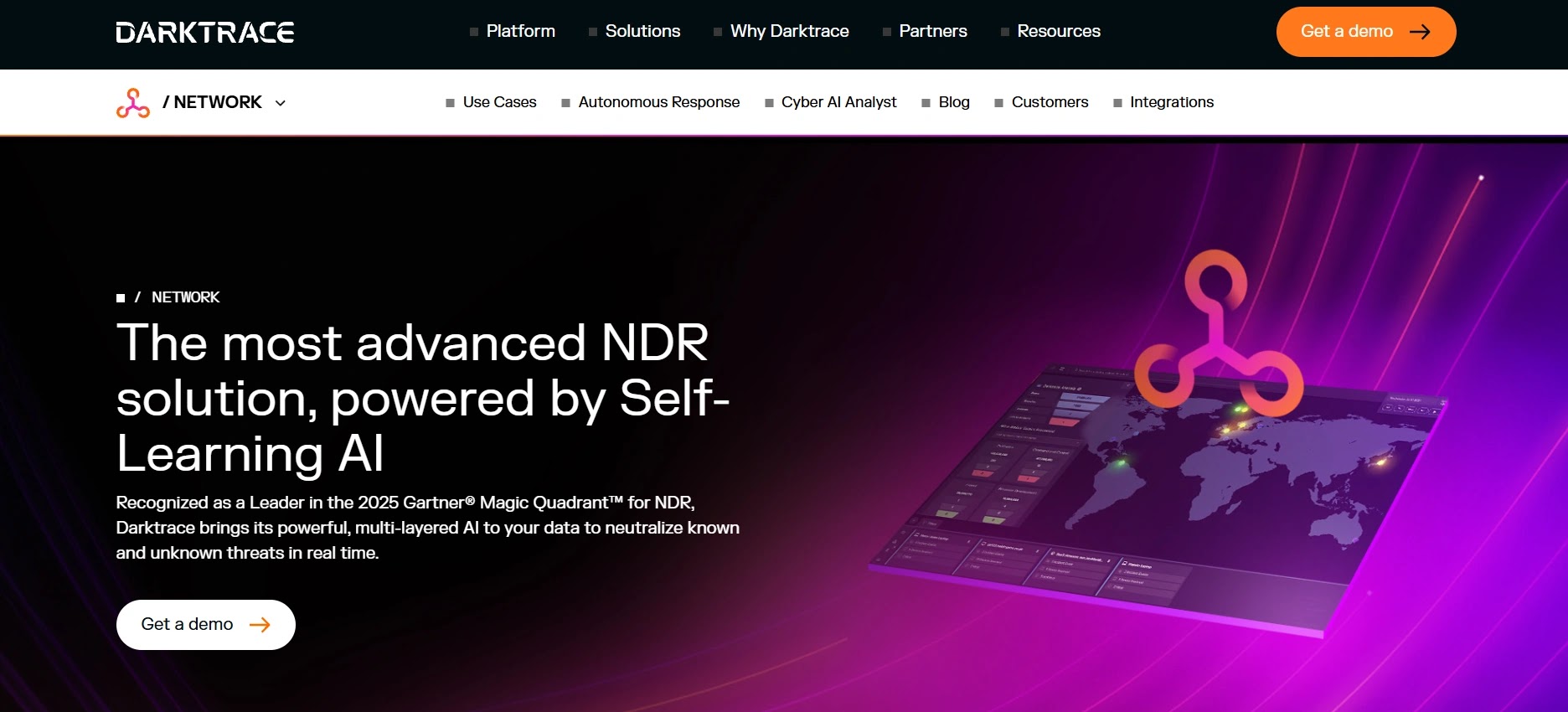
Darktrace stands as a pioneer in applying unsupervised machine learning to network security. Functioning as an “Enterprise Immune System,” its methodology eschews reliance on predefined threat intelligence or static rules. Instead, it meticulously learns the unique “pattern of life” for every user, device, and network segment within an organization.
When even a subtle deviation from this established norm occurs—such as a printer suddenly initiating network scans or an executive’s laptop transmitting unusual data volumes in the early hours—Darktrace’s AI promptly flags the anomalous behavior. Its autonomous response capability, known as Antigena, can automatically interrupt active attacks within seconds by surgically disrupting malicious connections.
- Specifications: Available as physical or virtual appliances, offers full support for AWS, Azure, and GCP, and integrates with major SIEM platforms.
- Features: Unsupervised machine learning, autonomous response (Antigena), self-learning behavioral baselining, real-time threat visualization (Threat Visualizer).
- Reason to Buy: Ideal for organizations seeking a highly autonomous, self-learning system that significantly reduces the manual configuration and tuning typically associated with traditional security tools.
Why We Picked It
Darktrace’s unsupervised learning model proved exceptionally effective at detecting entirely novel, zero-day threats that lack existing signatures. By establishing a comprehensive understanding of “normal” behavior, it effortlessly identifies the subtle anomalies indicative of sophisticated insider threats or compromised credentials.
Furthermore, its Antigena autonomous response technology functions as an automated Tier-1 analyst. By surgically interrupting malicious connections without taking entire systems offline, it effectively halts the spread of ransomware while preserving business continuity.
Pros:
- Does not rely on external signatures or threat feeds.
- Autonomous response capability interrupts attacks at machine speed.
- Offers a highly engaging and visually intuitive threat mapping interface.
Cons:
- The underlying “AI” logic can sometimes appear opaque to experienced analysts.
- Requires a dedicated learning period before reaching full operational effectiveness.
Try Darktrace NDR: Explore the Darktrace Platform2. ExtraHop Reveal(x)

ExtraHop Reveal(x) is widely recognized as a benchmark for cloud-native network visibility and high-speed decryption. It meticulously captures and processes network packets at line rate, reaching speeds up to 100 Gbps, extracting over 5,000 distinct behavioral features to deliver unparalleled situational awareness.
Its standout capability is the real-time decryption of TLS 1.3 traffic. Given that over 80% of contemporary malware leverages encrypted channels to obscure its operations, Reveal(x) ensures that SOC teams maintain continuous visibility, providing pristine, decrypted payloads for analysis without introducing latency.
- Specifications: Available with SaaS-based or on-premises management, offers massive horizontal scalability, and supports out-of-band passive deployment.
- Features: Line-rate TLS 1.3 decryption, extraction of 5,000+ L7 features, automated threat investigation, continuous packet capture (PCAP).
- Reason to Buy: Provides the industry’s most robust high-speed decryption and deep packet inspection, making it an essential tool for enforcing a stringent Zero Trust architecture.
Why We Picked It
ExtraHop Reveal(x) earned its selection due to its unparalleled ability to cleanly decrypt and analyze vast volumes of encrypted traffic at scale. In an era where attackers routinely conceal themselves within standard SSL/TLS tunnels, this capability is the sole effective means of detecting deeply hidden data exfiltration or C2 beaconing.
Furthermore, its interface is purpose-built to accelerate the workflow of incident responders. With a single click, analysts can seamlessly transition from a high-level behavioral alert directly into the raw, decrypted PCAP file to immediately verify the nature of the threat.
Pros:
- Offers unrivaled high-speed, passive decryption capabilities.
- Features an incredibly intuitive, investigator-focused user interface.
- Retains continuous packet capture for in-depth forensic lookbacks.
Cons:
- Premium throughput licensing can be costly for mid-sized organizations.
- Storage requirements for extended PCAP retention are substantial.
Try ExtraHop Reveal(x): Explore the ExtraHop Reveal(x) Platform3. Vectra AI
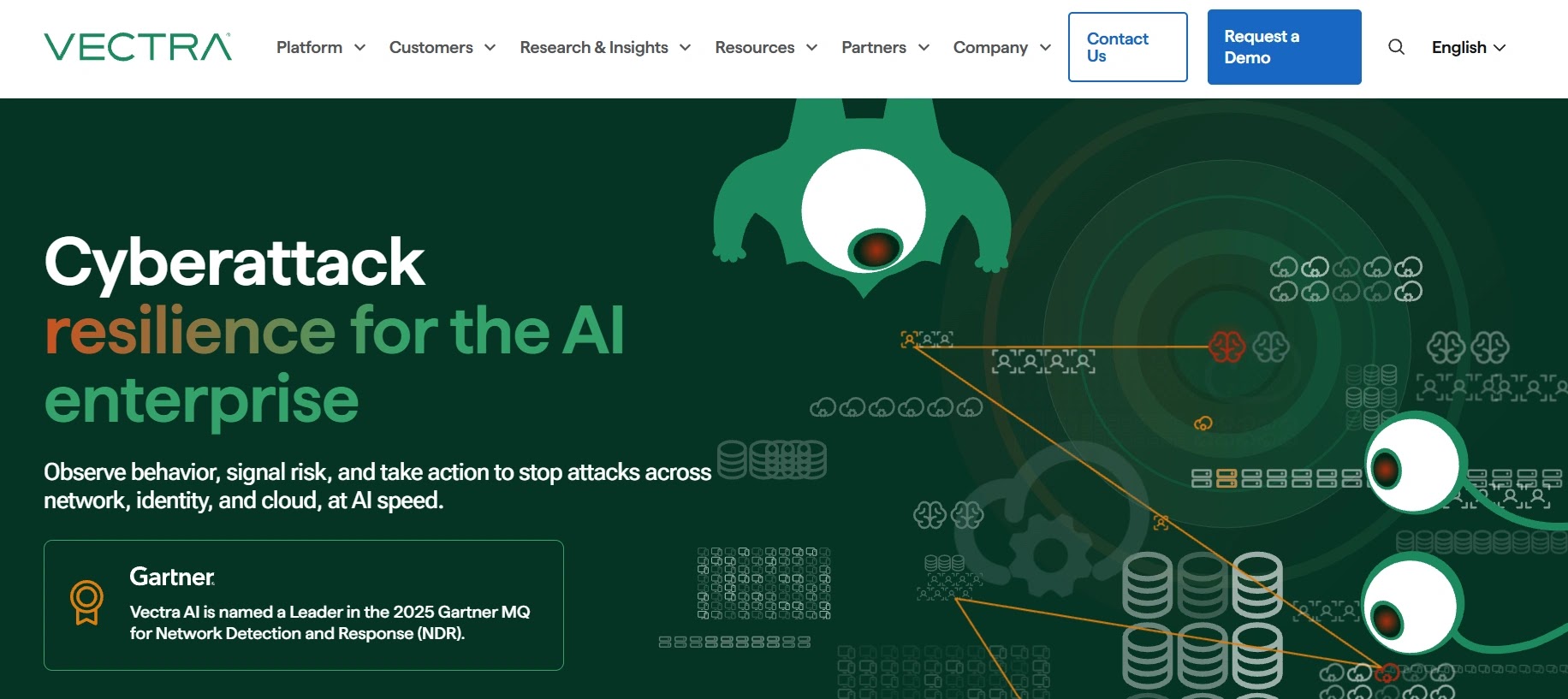
Vectra AI is specifically engineered to alleviate the pervasive alert fatigue that overwhelms modern SOC operational tiers. Rather than inundating analysts with thousands of low-level network anomalies, its “Attack Signal Intelligence” engine correlates multiple behaviors into a prioritized, entity-centric risk score.
The platform particularly excels at identifying post-compromise attacker behaviors, with a strong focus on lateral movement, privilege escalation, and reconnaissance within complex cloud-native security environments. By prioritizing threats based on severity and certainty, Vectra ensures security teams concentrate their efforts solely on critical incidents.
- Specifications: Cloud-native platform, deep integrations with Microsoft 365, Azure AD, and AWS, and a robust REST API.
- Features: Attack Signal Intelligence, AI-driven alert prioritization, strong focus on identity and credential abuse, seamless EDR integration.
- Reason to Buy: The optimal solution for understaffed SOCs requiring AI to prioritize critical, actionable alerts over raw, noisy network anomalies.
Why We Picked It
Vectra AI was chosen because its prioritization engine fundamentally transforms the daily workflow of a security analyst. By organizing alerts around compromised identities and hosts rather than isolated packets, it constructs a comprehensive narrative of an attack in progress.
Moreover, its tight integration with EDR tools (such as CrowdStrike and SentinelOne) establishes a cohesive, cross-layered defense. When Vectra detects lateral movement on the network, it can automatically trigger the EDR to isolate the offending host, instantly closing the response loop.
Pros:
- Exceptional at filtering noise and prioritizing genuine threats.
- Provides deep visibility into cloud identity and SaaS abuse (e.g., M365).
- Offers actionable, prioritized scoring based on severity and certainty.
Cons:
- Less emphasis on deep, manual packet-level forensics.
- Customizing the underlying detection logic is somewhat rigid.
Try Vectra AI: Explore the Vectra AI Platform4. Cisco Secure Network Analytics (Formerly Stealthwatch)

Cisco Secure Network Analytics, previously known as Stealthwatch, serves as a robust workhorse in the NDR domain, specifically designed for monitoring vast, globally dispersed enterprise networks. It leverages NetFlow, IPFIX, and telemetry from existing routing infrastructure, effectively transforming the entire network into an extensive sensor array.
Rather than solely relying on intensive deep packet inspection probes, it employs advanced behavioral modeling to analyze traffic flow patterns. This, combined with the immense global intelligence feed from Cisco Talos, enables it to identify malware, insider threats, and policy violations across millions of endpoints.
- Specifications: Highly scalable architecture (on-premises, cloud, or hybrid), capable of ingesting billions of NetFlow records daily.
- Features: Encrypted Traffic Analytics (ETA), massive scalability without dedicated hardware probes, deep Cisco identity integration (ISE), global Talos threat intelligence.
- Reason to Buy: Represents the most cost-effective and scalable method for achieving visibility across enormous, decentralized networks without the need for ubiquitous physical tap deployments.
Why We Picked It
Cisco Secure Network Analytics was chosen for its ingenious utilization of an enterprise’s existing network infrastructure. By ingesting NetFlow directly from routers and switches, it delivers 100% visibility across massive architectures where deploying traditional hardware taps would be financially prohibitive.
Additionally, its Encrypted Traffic Analytics (ETA) technology is highly innovative. It can infer the presence of malware within encrypted traffic based on characteristics like packet lengths and arrival times, without requiring actual decryption of the payload, thus respecting compliance policies.
Pros:
- Offers infinite scalability across sprawling global networks.
- Leverages existing infrastructure, significantly reducing hardware deployment costs.
- Talos integration provides world-class threat intelligence context.
Cons:
- NetFlow analysis lacks the granular Layer 7 payload detail available through deep packet inspection.
- Configuration and tuning in large environments demand considerable expertise.
Try Cisco Secure Network Analytics: Explore the Cisco Secure Network Analytics Solution5. Palo Alto Networks Cortex NDR

Cortex NDR is deeply integrated into Palo Alto Networks’ comprehensive XDR strategy, seamlessly incorporating powerful network analytics into a unified security operations platform. It employs precision machine learning to profile devices, identify anomalies, and detect sophisticated command-and-control infrastructure.
By natively ingesting rich metadata from Palo Alto Next-Generation Firewalls (NGFWs), it eliminates the necessity of deploying dedicated network sensors. This telemetry is analyzed to automatically discover unmanaged devices and detect advanced adversarial tactics operating beneath the radar.
- Specifications: Cloud-delivered architecture, leverages existing Palo Alto NGFW deployments, and is deeply integrated into Cortex XDR.
- Features: Native NGFW telemetry ingestion, advanced ML-driven behavioral profiling, automated device discovery, integrated cross-layer threat hunting.
- Reason to Buy: The most logical choice for organizations already heavily invested in the Palo Alto Networks ecosystem, providing seamless NDR capabilities without requiring new sensors.
Why We Picked It
Cortex NDR was selected due to its integration with Palo Alto firewalls, which creates an exceptionally frictionless deployment model. Instead of installing new network taps, enterprises can simply activate the NDR module and immediately begin analyzing the rich telemetry already generated by their gateways.
Furthermore, when used in conjunction with Cortex XDR, network alerts are instantly correlated with endpoint data. This provides Tier-3 analysts with an unparalleled, unified timeline of an attack, linking the initial network beacon directly to the exact process executing on the endpoint.
Pros:
- Offers zero-hardware deployment for existing Palo Alto customers.
- Provides flawless correlation with endpoint and cloud data via Cortex XDR.
- Excels at automated profiling of unmanaged IoT devices.
Cons:
- Its true value is only fully realized within the Palo Alto ecosystem.
- Standalone deployment without Cortex XDR significantly diminishes contextual information.
Try Palo Alto Networks Cortex NDR: Explore the Cortex NDR Platform6. Arista NDR (Formerly Awake Security)

Arista NDR, built upon the Awake Security platform, adopts a distinctive approach by heavily emphasizing AI-driven entity tracking and human-led threat hunting. It acknowledges the dynamic nature of IP addresses, choosing instead to track the actual entity—whether a user, device, or application—as it traverses the network.
Its deep packet inspection engine meticulously analyzes full packet payloads, while its automated Ava AI system furnishes security analysts with pre-computed investigative answers rather than merely raw alerts. The platform specializes in identifying non-malware, living-off-the-land attacks.
- Specifications: Supports cloud, on-premises, and hybrid sensor deployments, highly integrated with Arista’s broader zero trust networking fabric.
- Features: EntityIQ tracking technology, Ava AI investigative assistant, deep packet inspection, automated hunting of LotL techniques.
- Reason to Buy: The premier platform for proactive threat hunting, automatically tracking entities across complex network boundaries irrespective of IP changes.
Why We Picked It
Arista NDR was chosen because its EntityIQ technology resolves a significant challenge for network analysts. In modern networks, IP addresses are often ephemeral, making tracking an attacker difficult. Arista’s system tracks the underlying identity of the device, ensuring the threat is followed seamlessly across subnets and VPNs.
Furthermore, the Ava AI system dramatically accelerates the investigative process. When an alert is triggered, Ava has already queried related domains, analyzed the packet payload, and mapped the behavior to MITRE ATT&CK, presenting the analyst with a nearly complete case file.
Pros:
- Entity-centric tracking eliminates confusion caused by DHCP/NAT.
- Ava AI assistant significantly speeds up manual threat hunting.
- Provides deep visibility into encrypted and non-malware-based attacks.
Cons:
- The hunting interface can be complex for junior analysts.
- Requires strategic sensor placement to maximize entity tracking effectiveness.
Try Arista NDR: Explore the Arista NDR Platform7. Corelight
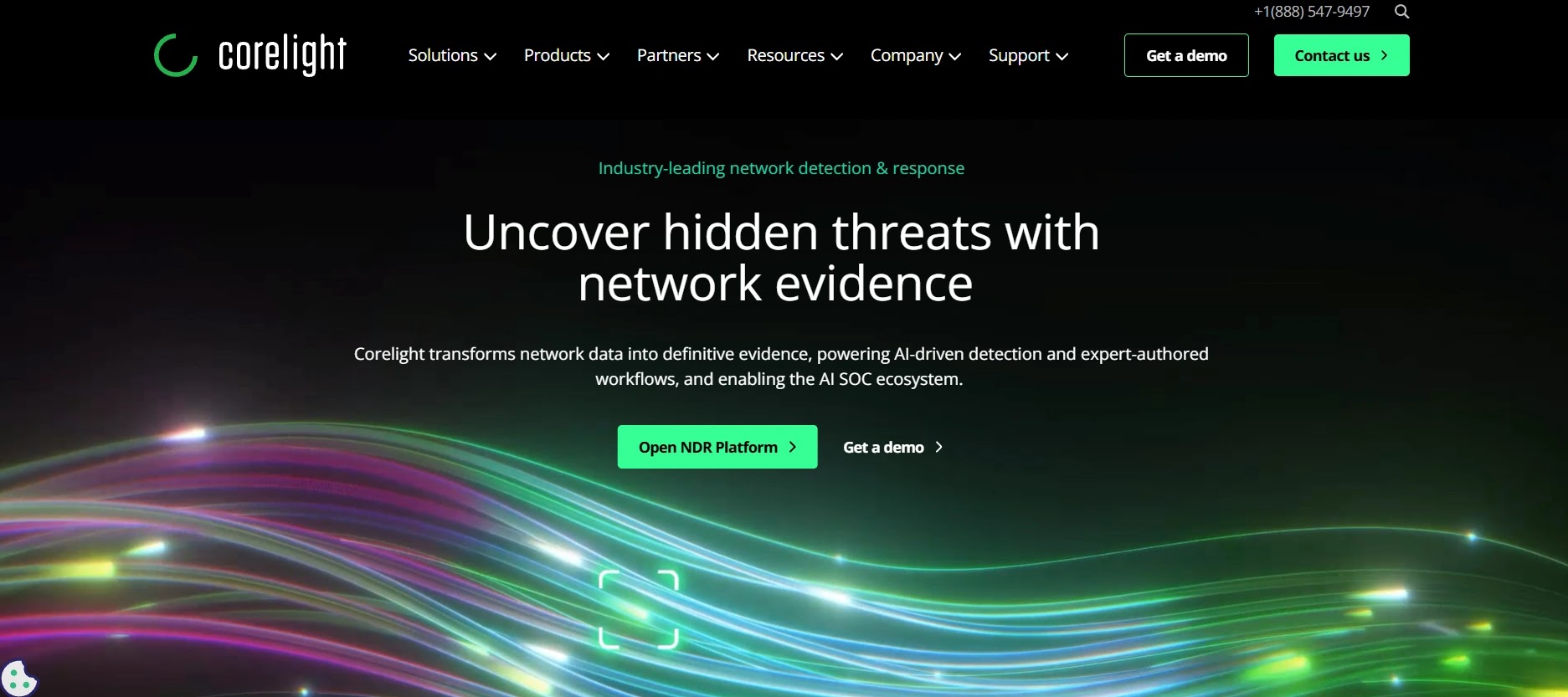
Corelight excels at transforming raw network traffic into highly structured, actionable data. Founded by the creators of the open-source Zeek (formerly Bro) and Suricata projects, Corelight appliances function as enterprise-grade, high-performance sensors that generate the most detailed network logs available in the industry.
While fundamentally an NDR platform, its philosophy is distinctly data-driven. It avoids trapping analysts within a proprietary dashboard; instead, it streams impeccably structured, heavily enriched Zeek logs directly into an enterprise SIEM or data lake for advanced threat hunting and long-term forensics.
- Specifications: Offers high-performance hardware, virtual, and cloud sensors; integrates tightly with Splunk, Elastic, and other advanced SIEMs.
- Features: Enterprise-grade Zeek and Suricata engine, Open NDR architecture, encrypted traffic inference, automated file extraction.
- Reason to Buy: The ultimate tool for mature, engineering-heavy SOCs that require ingesting raw, high-fidelity network data directly into their customized analytical pipelines.
Why We Picked It
Corelight was selected because Zeek data is widely considered the industry standard for network threat hunting. Corelight takes the complex, open-source Zeek engine and makes it highly scalable and manageable for enterprise deployment, ensuring no packets are dropped even during periods of high traffic.
Furthermore, its Open NDR approach prevents vendor lock-in. By providing the richest, most structured network metadata available, it empowers threat researchers to develop their own custom detection algorithms and correlation rules within their preferred data lake environment.
Pros:
- Generates the highest-fidelity, most structured network logs available.
- Built upon the trusted, open-source Zeek and Suricata engines.
- Offers seamless integration into massive SIEM and data lake architectures.
Cons:
- Requires a powerful SIEM to effectively process and make sense of the massive data volume.
- Lacks the out-of-the-box, “black box” automated response capabilities of some competitors.
Try Corelight: Explore the Corelight Platform8. Fortinet FortiNDR

FortiNDR serves as the AI-powered network detection component within the extensive Fortinet Security Fabric. It employs a Virtual Security Analyst (VSA), driven by Deep Neural Networks, to meticulously inspect network traffic, identify malicious files, and detect anomalous network activity.
The platform demonstrates particular strength in identifying the nascent stages of malware infections and botnet activity. By natively sharing intelligence with FortiGate firewalls and FortiNAC, it facilitates automated, closed-loop mitigation across the entire enterprise network.
- Specifications: Available as hardware appliances, VMs, and cloud instances; deeply integrated with the Fortinet Fabric architecture.
- Features: Deep Neural Network (DNN) AI engine, Virtual Security Analyst (VSA), automated file analysis, native Fortinet Fabric automated response.
- Reason to Buy: Delivers cost-effective, AI-driven network analytics that integrate perfectly into an existing Fortinet-centric enterprise environment.
Why We Picked It
FortiNDR was selected due to its exceptional synergy with the broader Fortinet ecosystem. In a Zero Trust architecture, the ability to instantly revoke access is paramount. When FortiNDR detects a compromised host, it seamlessly orchestrates the FortiGate firewall to quarantine the device immediately.
Additionally, its integration of deep neural networks enables highly accurate, signature-less detection of sophisticated malware moving laterally across the network, serving as an automated backstop for endpoint security failures.
Pros:
- Provides flawless automated response capabilities within the Fortinet Fabric.
- Virtual Security Analyst automates complex triage workflows.
- Offers strong capabilities for offline, air-gapped network analysis.
Cons:
- The interface can appear dense and highly technical.
- Maximum ROI is achieved with broad adoption of other Fortinet solutions.
Try Fortinet FortiNDR: Explore the FortiNDR Platform9. Gigamon ThreatINSIGHT

Gigamon ThreatINSIGHT is a SaaS-based NDR solution specifically engineered by incident responders, for incident responders. Gigamon is already a leader in network visibility and traffic brokering; ThreatINSIGHT builds on this foundation by offering a highly intuitive platform for guided threat hunting.
While it provides high-fidelity behavioral analytics, its true strength lies in its extensive retention of network metadata—often up to 365 days. This capability empowers analysts to conduct deep, historical threat hunting to uncover when a newly identified APT group might have first breached the network months prior.
- Specifications: SaaS-based platform utilizing lightweight sensors; integrates perfectly with Gigamon’s underlying network visibility fabric.
- Features: Guided threat hunting interface, massive historical metadata retention, parallel threat detection, native PCAP generation.
- Reason to Buy: Unbeatable for proactive, historical threat hunting and retroactive compromise assessments due to its extended data retention capabilities.
Why We Picked It
Gigamon ThreatINSIGHT was chosen because its interface is meticulously designed around the actual workflow of a threat hunter. It goes beyond merely presenting an alert; it provides a cohesive, guided path to investigate the alert, making it highly accessible for analysts of all skill levels.
Furthermore, in contemporary incident response, attackers frequently reside in networks for months before launching ransomware or other destructive attacks. ThreatINSIGHT’s unparalleled retention of rich network metadata ensures that researchers always possess the historical evidence necessary to trace an attack back to its origin.
Pros:
- Specifically built to streamline and guide the threat hunting process.
- Offers industry-leading retention times for historical network metadata.
- Provides seamless integration with existing Gigamon tapping infrastructure.
Cons:
- Places less emphasis on automated, non-human remediation workflows.
- Operates most effectively when deployed alongside the Gigamon visibility fabric.
Try Gigamon ThreatINSIGHT: Explore the Gigamon ThreatINSIGHT Solution10. Rapid7 NDR
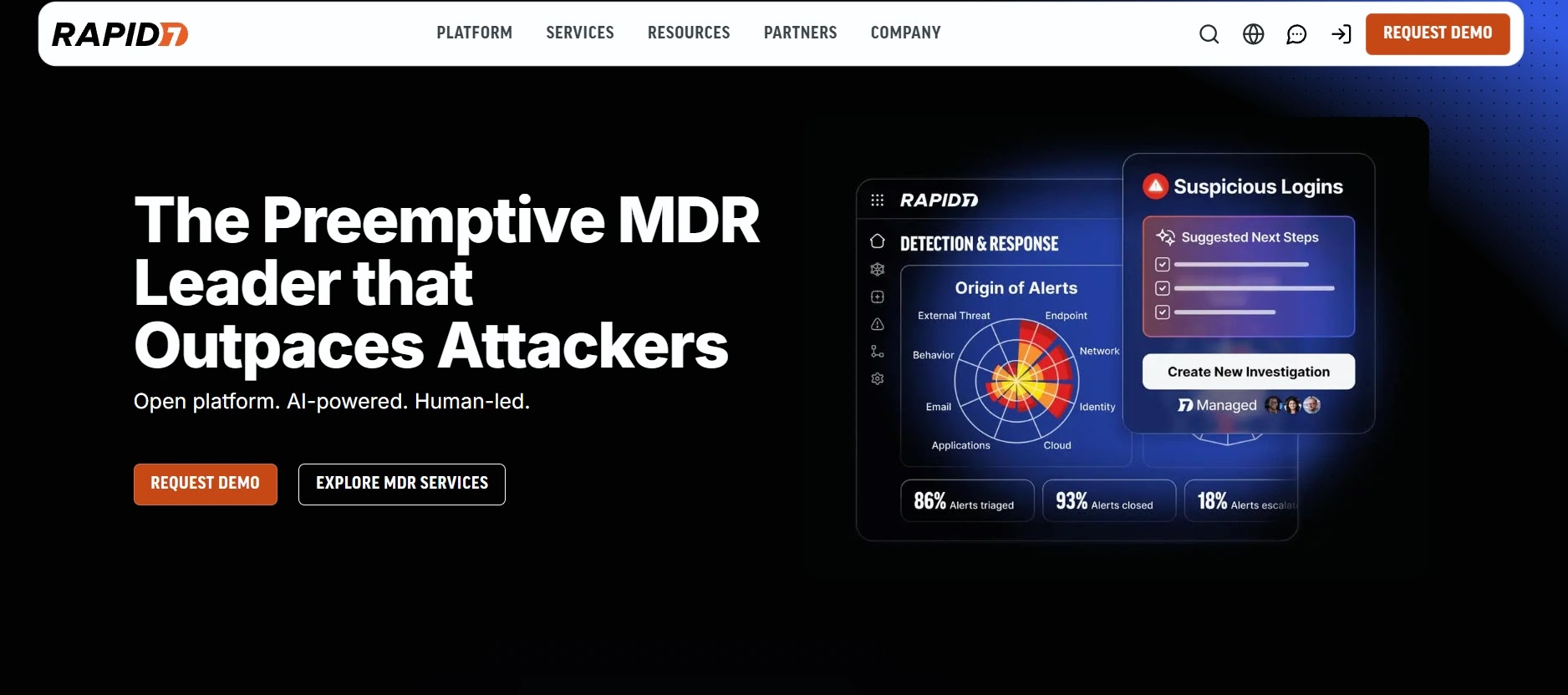
Rapid7 NDR is natively integrated into InsightIDR, the company’s powerful cloud SIEM and XDR platform. By converging network traffic analysis with user behavior analytics (UBA) and endpoint telemetry, it delivers a highly unified perspective of the enterprise attack surface.
It leverages Rapid7’s extensive proprietary threat intelligence network to identify malicious connections and lateral movement. The platform is designed to prioritize rapid time-to-value, enabling SOC teams to quickly get up and running with actionable alerts without prolonged configuration periods.
- Specifications: Cloud-native architecture, integrated directly as a core component of the Rapid7 InsightIDR platform.
- Features: Deep SIEM/XDR integration, User Behavior Analytics (UBA) correlation, automated deception technology (honeypots), streamlined deployment.
- Reason to Buy: The ideal choice for organizations seeking a highly unified, single-pane-of-glass solution that combines SIEM, UBA, and NDR into one rapidly deployable platform.
Why We Picked It
Rapid7 NDR was included because it intelligently recognizes that network data is most impactful when immediately contextualized alongside user and endpoint behavior. By integrating NDR directly into InsightIDR, analysts eliminate the need to pivot between multiple tools to fully comprehend a security event.
Furthermore, its deployment model is exceptionally streamlined. It focuses on providing out-of-the-box, high-fidelity detections that deliver immediate ROI for under-resourced security teams, significantly reducing the complexity often associated with network analytics.
Pros:
- Unified seamlessly with InsightIDR for a true single-pane-of-glass experience.
- Offers excellent correlation between network traffic and anomalous user behavior.
- Ensures extremely fast deployment and rapid time-to-value.
Cons:
- NDR functions as a feature of InsightIDR, rather than a standalone, specialized network tool.
- Deep packet inspection capabilities are less granular compared to dedicated NDR pure-play solutions.
Try Rapid7 NDR: Explore the Rapid7 InsightIDR PlatformWhat You Should Do
- Assess Your Needs: Evaluate your organization’s specific network size, complexity (on-prem, hybrid, multi-cloud), existing security stack, and SOC maturity to determine which NDR features are most critical.
- Prioritize Key Features: Focus on solutions offering strong encrypted traffic analysis, advanced behavioral machine learning, seamless integration with your current SIEM/SOAR/EDR, and robust automated response capabilities.
- Consider Ecosystem Integration: If you are heavily invested in a particular vendor (e.g., Cisco, Palo Alto, Fortinet, Rapid7), prioritize their native NDR offerings for simplified deployment and enhanced correlation.
- Plan for Data Retention and Storage: Be aware of the storage requirements for network metadata and PCAP, especially for solutions emphasizing long-term historical analysis.
- Pilot and Test: Conduct a proof-of-concept (POC) with shortlisted solutions, feeding them real or simulated evasive traffic to assess their effectiveness in your unique environment.
Disclaimer: HackersRadar reports on cybersecurity threats and incidents for informational and awareness purposes only. We do not engage in hacking activities, data exfiltration, or the hosting or distribution of stolen or leaked information. All content is based on publicly available sources.








No Comment! Be the first one.