




Top 10 DNS Security Solutions for 2026
Key Takeaways DNS forms a critical cybersecurity layer, with nearly all attack chains touching it at some point, making it a cost-effective point for disruption. The market for DNS security solutions...

Key Takeaways
- DNS forms a critical cybersecurity layer, with nearly all attack chains touching it at some point, making it a cost-effective point for disruption.
- The market for DNS security solutions is mature and diverse, offering specialized options for enterprises, SMBs, MSPs, and specific regional requirements.
- Top solutions for 2026 include Cisco Umbrella for overall enterprise excellence, Infoblox for DDI integration, and Akamai for large-scale edge protection.
- Key evaluation criteria include threat intelligence quality, advanced detection capabilities (beyond simple blocklists), deployment flexibility, and handling of encrypted DNS protocols like DoH/DoT.
The Critical Role of DNS Security in 2026
The Domain Name System (DNS) remains an indispensable yet frequently overlooked component of enterprise security architecture. From initial phishing attempts and malware callbacks to data exfiltration tunnels, almost every cyberattack leverages DNS at some stage. This pervasive involvement positions the DNS layer as one of the most strategic and cost-effective points to interrupt attack kill chains.
Table Of Content
- Key Takeaways
- The Critical Role of DNS Security in 2026
- Our Top Picks at a Glance
- Evaluation Methodology
- The 10 Best DNS Security Solutions in 2026
- 1. Cisco Umbrella — Best Overall
- Key features
- Pros
- Cons
- 2. Infoblox — Best DDI-Integrated Security
- Key features
- Pros
- Cons
- 3. Akamai — Best Edge-Scale Enterprise/Carrier
- Key features
- Pros
- Cons
- 4. Cloudflare Gateway — Best Value at Any Scale
- Key features
- Pros
- Cons
- 5. DNSFilter — Best for SMBs and MSPs
- Key features
- Pros
- Cons
- 6. Palo Alto Networks DNS Security — Best for PA Estates
- Key features
- Pros
- Cons
- 7. BlueCat — Best for Enterprise DDI Owners
- Key features
- Pros
- Cons
- 8. EfficientIP — Best European DDI Security
- Key features
- Pros
- Cons
- 9. Vercara (DigiCert) — Best Authoritative + Protective Pairing
- Key features
- Pros
- Cons
- 10. Whalebone — Best EU-Sovereign Protective DNS
- Key features
- Pros
- Cons
- How to Choose a DNS Security Solution
- What You Should Do
DNS security solutions operate by proactively blocking access to malicious domains, identifying sophisticated threats like tunneling and Domain Generation Algorithms (DGAs), and fortifying the underlying DNS infrastructure against compromise. Our comprehensive analysis for 2026 highlights the ten leading solutions in this critical cybersecurity domain.
Our Top Picks at a Glance
- Best overall: Cisco Umbrella – Renowned for its intelligence, scalability, and seamless enterprise integrations.
- Best DDI-integrated: Infoblox – Delivers robust DNS security deeply integrated with infrastructure context.
- Best edge-scale: Akamai – Offers carrier-grade resolution combined with extensive threat data for large-scale deployments.
- Best value / SMB & MSP: Cloudflare Gateway and DNSFilter – Provide fast service with transparent pricing, ideal for smaller organizations and managed service providers.
- Best for Palo Alto Networks estates: Palo Alto DNS Security – Integrates inline analytics directly into existing firewall infrastructure.
Evaluation Methodology
Our ranking is based on rigorous research, not unsubstantiated lab claims. We assessed solutions across several key criteria:
- Threat Intelligence: Quality and real-time freshness of threat feeds.
- Detection Capabilities: Efficacy beyond simple blocklists, including detection of tunneling, DGAs, and lookalike domains.
- Deployment Models: Flexibility across cloud resolvers, on-premise DDI, and firewall-integrated solutions.
- Encrypted DNS Handling: Ability to maintain visibility and control over DoH/DoT traffic.
- Operational Fit: Suitability for environments ranging from small businesses to national-scale deployments.
- Pricing: Transparency and structure, with published pricing noted where available.
The 10 Best DNS Security Solutions in 2026
1. Cisco Umbrella — Best Overall

Ideal for: Enterprises seeking a highly proven, scalable DNS-layer security solution with a clear path to Secure Access Service Edge (SASE).
Cisco Umbrella, originating from OpenDNS, pioneered commercial DNS-layer security. It features globally scaled recursive resolvers, threat intelligence powered by Cisco Talos, and advanced detection for tunneling and DGAs. Policies can be applied from roaming laptops to entire branch networks. Umbrella is increasingly integrated into Cisco Secure Access and Secure Web Gateway (SWG) platforms, aligning with modern Security Service Edge (SSE) strategies.
Key features:
- Threat intelligence from Cisco Talos.
- Detection of DNS tunneling and DGAs.
- Virtual appliances for internal IP attribution.
- Extensive coverage for roaming clients and network-wide protection.
- Gradual integration path into Cisco SSE.
Pros:
- Profound threat intelligence.
- Proven capability at massive scale.
- Strong enterprise integrations (e.g., Active Directory, Cisco ISE, SD-WAN).
Cons:
- Pricing escalates with feature packages.
- Some advanced capabilities are bundled within Secure Access.
Pricing: Package quote.
Standout differentiator: Unmatched maturity across resolver reliability, intelligence quality, and administrative user experience.
2. Infoblox — Best DDI-Integrated Security

Ideal for: Enterprises requiring DNS security, threat intelligence, and automated response capabilities tightly integrated with a leading DDI platform.
Infoblox Threat Defense embeds detection directly where DNS resolution occurs. It leverages specialized DNS threat intelligence (including research into lookalike domains and DNS-based malware infrastructure), advanced tunneling/DGA analytics, and automated response mechanisms. This is all built on the BloxOne/Universal DDI platform, which many enterprises already utilize, aligning perfectly with modern Zero Trust Data Access (ZTDA) frameworks.
Key features:
- Specialized DNS threat intelligence.
- Advanced tunneling and DGA analytics.
- Comprehensive coverage for on-premise and cloud environments.
- IP Address Management (IPAM) context enhances security event data.
- Extensive integrations with Security Operations Center (SOC) tools.
Pros:
- DNS-first threat research.
- Enforcement at the infrastructure level.
- Enriched asset context via IPAM.
Cons:
- Premium platform economics.
- Full value is realized with existing Infoblox DDI adoption.
Pricing: Platform quote.
Standout differentiator: Leveraging the DDI leader’s data advantage to provide actionable detections, informed by IPAM data.
3. Akamai — Best Edge-Scale Enterprise/Carrier

Ideal for: Enterprises already utilizing Akamai’s edge platform and seeking DNS-layer security at comparable scale.
Akamai’s Secure Internet Access, building on the legacy of Enterprise Threat Protector, delivers DNS-layer security via one of the internet’s most extensive platforms. It benefits from Akamai’s unparalleled visibility into global web traffic and proactive threat intelligence, offering a unified security approach for both application protection and outbound DNS resolution.
Key features:
- Massive resolver scale and reliability.
- Robust threat research capabilities.
- Seamless integration with Akamai’s application security offerings.
- Specialized offerings for carriers and ISPs.
- Comprehensive coverage for roaming users and network environments.
Pros:
- Significant platform and data gravity.
- Consolidated edge security from a single vendor.
- Carrier-grade performance and resilience.
Cons:
- Primarily packaged for enterprise clients.
- Deepest value is achieved with broader Akamai solution adoption.
Pricing: Quote-based contracts.
Standout differentiator: Akamai’s unique position allows it to detect attack infrastructure early due to the vast volume of internet traffic it handles.
4. Cloudflare Gateway — Best Value at Any Scale

Ideal for: Any organization seeking credible DNS security, with options starting from a free tier.
Cloudflare Gateway provides DNS validation and filtering across one of the internet’s largest anycast networks. It offers free entry tiers, transitions to per-user pricing, natively supports DoH/DoT, and boasts national-scale credibility, facilitating a smooth progression into enterprise Zero Trust models.
Key features:
- DNS filtering powered by a massive anycast network.
- Native support for DoH/DoT.
- Available free tier with published Zero Trust plans.
- Roaming client support via WARP.
- Comprehensive SSE growth path.
Pros:
- Zero-cost entry point.
- Exceptional performance.
- Clear upgrade path to a full SSE solution.
Cons:
- Achieving deep enterprise attribution (especially in AD-heavy environments) can require more effort than with solutions like Umbrella.
- Advanced analytics are typically reserved for higher tiers.
Pricing: Free tier, published plans, enterprise quote.
Standout differentiator: Provides a seamless solution from free-tier entry to national-scale deployment on a single platform.
5. DNSFilter — Best for SMBs and MSPs
Ideal for: Small to mid-sized organizations and Managed Service Providers (MSPs) protecting multiple client fleets.
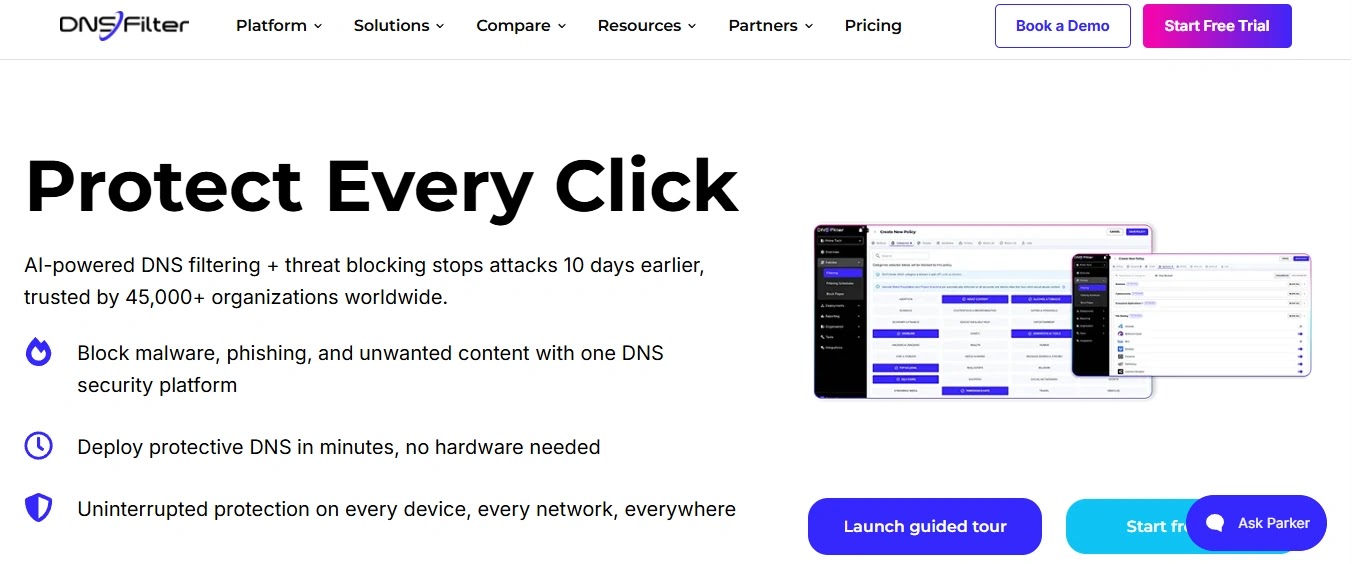
DNSFilter simplifies DNS protection through AI-driven categorization, rapidly identifying and blocking new threats. It integrates with real-time credential monitoring, offers transparent per-user pricing, provides robust multi-tenant tooling for MSPs, and enables roaming client deployment within an hour of signup.
Key features:
- Real-time AI-powered domain categorization.
- Published per-user pricing model.
- Excellent multi-tenancy capabilities for MSPs.
- Roaming client coverage.
- Integrated threat and content filtering.
Pros:
- Low friction deployment and management.
- Transparent pricing.
- Native MSP support.
Cons:
- Enterprise-level integrations may not be as deep as Cisco or Infoblox.
- DDI-layer security is not its primary focus.
Pricing: Published per-user tiers.
Standout differentiator: Sets the benchmark for transparent value in the DNS security category.
6. Palo Alto Networks DNS Security — Best for PA Estates
Ideal for: Organizations leveraging Palo Alto Networks Next-Generation Firewalls (NGFWs) that require inline DNS threat prevention.
Palo Alto Networks DNS Security operates as a subscription that analyzes DNS queries directly on the firewall. It utilizes cloud-scale analytics (powered by Unit 42) to detect DGAs, tunneling, and newly weaponized domains. Enforcement occurs inline, using the same policy objects as other firewall rules, thereby reinforcing strict Zero Trust Architecture principles.
Key features:
- Inline enforcement integrated into existing firewall policies.
- Strong DGA/tunneling analytics from Unit 42.
- Requires no additional infrastructure.
- Covers all ports and protocols traversing the firewall.
- Receives cloud-scale threat intelligence updates.
Pros:
- Security controls are applied where network policy is already managed.
- Protects against east-west traffic and non-web protocols.
- No new DNS resolvers are required.
Cons:
- Adds to existing Palo Alto licensing subscriptions.
- Roaming protection requires Prisma Access.
- Not a standalone solution.
Pricing: NGFW subscription.
Standout differentiator: Provides the most effective way to close DNS security gaps within an existing Palo Alto Networks environment.
7. BlueCat — Best for Enterprise DDI Owners

Ideal for: Enterprises already using BlueCat DDI that want integrated security at the same layer.
BlueCat integrates its enterprise DDI platform with security capabilities derived from its DNS Edge lineage. This offers resolution-point policy enforcement, integration with threat feeds, and granular query-level visibility—unique advantages only available to the DNS infrastructure owner. This extends endpoint and access control security across core networks.
Key features:
- First-party query visibility.
- Policy enforcement at the resolution point.
- Deep DDI operational capabilities.
- Threat-feed enforcement.
- Strong presence in enterprise and federal sectors.
Pros:
- Attributable query visibility.
- Policy application directly at the point of resolution.
- Comprehensive DDI depth.
Cons:
- Primarily a DDI purchase; security features are dependent on the platform.
Pricing: Platform quote.
Standout differentiator: Transforms core DNS infrastructure into a powerful enforcement and telemetry layer.
8. EfficientIP — Best European DDI Security
Ideal for: European enterprises seeking DDI-integrated DNS security with a strong emphasis on data sovereignty.
EfficientIP’s DNS Guardian provides behavioral protection through real-time DNS transaction analytics. It effectively detects tunneling and data exfiltration at the resolver, mirroring the capabilities of advanced Network Detection and Response (NDR) tools. Coupled with its SOLIDserver DDI, it often offers competitive economics compared to US-based rivals.
Key features:
- DNS Guardian behavioral protection.
- Real-time transaction analytics.
- SOLIDserver DDI platform.
- Detection of tunneling and data exfiltration.
- Adherence to EU data sovereignty requirements.
Pros:
- Behavioral protection at the resolver level.
- EU-sovereignty friendly.
- Competitive DDI economics.
Cons:
- Platform quotes required.
- Strongest market presence in EMEA.
Pricing: Platform quote.
Standout differentiator: Its behavioral analytics excel at detecting DNS exfiltration directly at the resolver.
9. Vercara (DigiCert) — Best Authoritative + Protective Pairing

Ideal for: Enterprises requiring a combination of resilient authoritative DNS and protective recursive resolution.
Vercara, recently acquired by DigiCert (acquisition completed September 2024), offers a robust pairing of its UltraDNS authoritative infrastructure with UltraDDR protective resolution. This provides carrier-grade DNS services for both inbound and outbound traffic, now integrated within DigiCert’s broader digital trust portfolio alongside leading cyber threat intelligence platforms.
Key features:
- UltraDNS authoritative infrastructure.
- UltraDDR protective resolution.
- Carrier-grade resilience.
- Integrated threat intelligence.
- Integration into the DigiCert portfolio.
Pros:
- Secures both directions of DNS traffic.
- Offers carrier-grade reliability.
- Consolidated vendor for related services.
Cons:
- Post-acquisition packaging requires confirmation.
- Enterprise quotes required.
Pricing: Quote-based.
Standout differentiator: The ability to procure authoritative DNS resilience and protective resolution from a single provider.
10. Whalebone — Best EU-Sovereign Protective DNS

Ideal for: Telecommunication companies, ISPs, and EU enterprises prioritizing protective DNS with guaranteed EU data handling.
Czech-based Whalebone delivers protective DNS solutions for both consumer-scale (Aura) and enterprise (Immunity) clients, particularly serving telcos and ISPs. It offers accessible pricing and stands as a strong European-sovereignty alternative, designed to integrate seamlessly into broader threat detection ecosystems.
Key features:
- Consumer-scale (Aura) and enterprise (Immunity) Protective DNS.
- Guaranteed EU data handling.
- Robust threat intelligence.
- Proven deployment heritage with telcos/ISPs.
- Accessible pricing.
Pros:
- EU data sovereignty compliance.
- Telco-scale heritage.
- Attainable quotes.
Cons:
- Global channel presence is less extensive than US market leaders.
Pricing: Quote-based (accessible).
Standout differentiator: A leading European-sovereignty resolver alternative capable of telco-scale deployment.
How to Choose a DNS Security Solution
Selecting the optimal DNS security solution requires a strategic decision on where DNS security should be primarily enforced:
- Cloud Resolvers: Solutions like Cisco Umbrella, Cloudflare Gateway, DNSFilter, and Akamai offer speed and effective protection for roaming users.
- DDI Platforms: If you manage your own DNS, DHCP, and IPAM (DDI), Infoblox, BlueCat, and EfficientIP provide query-level attribution and integrated security.
- Firewall Integration: For organizations prioritizing policy consolidation, Palo Alto DNS Security integrates directly into existing firewall infrastructure.
Additionally, it is crucial to evaluate solutions against the realities of 2026 threats:
- Encrypted DNS Handling: Verify how each vendor maintains visibility when applications utilize DoH/DoT. Solutions should offer their own encrypted endpoints, roaming clients, or inline analytics. Blocking external DoH resolvers is a standard best practice.
- Advanced Detection: Look beyond simple blocklists. Demand evidence of capabilities in detecting sophisticated threats such as tunneling, DGAs, and lookalike domains.
- Logging Economics: DNS telemetry is invaluable for the SOC. Ensure that the solution allows you to affordably collect and store these logs for analysis.
Implementing DNS security represents one of the most cost-effective measures to prevent attacks. Integrate it strategically with your Zero Trust program and protective DNS strategy to maximize its impact.
What You Should Do
- Assess Your Needs: Determine if your priority is cloud-based speed, DDI-integrated control, or firewall-based policy consolidation.
- Verify DoH/DoT Handling: Actively question vendors on their approach to encrypted DNS to ensure continued visibility and control.
- Demand Advanced Detection: Prioritize solutions that offer behavioral analytics for threats like tunneling and DGAs, not just basic blocklists.
- Plan for Log Storage: Allocate budget and resources for collecting and storing DNS security logs, as they are crucial for incident response and threat hunting.
- Integrate with Zero Trust: Ensure your chosen DNS security solution supports and enhances your overall Zero Trust architecture.
Disclaimer: HackersRadar reports on cybersecurity threats and incidents for informational and awareness purposes only. We do not engage in hacking activities, data exfiltration, or the hosting or distribution of stolen or leaked information. All content is based on publicly available sources.







No Comment! Be the first one.