




Supply Chain Attacks Compromise Developer Machines, Lead to Cloud Breaches
Key Takeaways Attackers are embedding credential-stealing malware within legitimate software packages and development tools. These malicious components compromise developer machines and automated...

Key Takeaways
- Attackers are embedding credential-stealing malware within legitimate software packages and development tools.
- These malicious components compromise developer machines and automated build systems, often before an application even runs.
- Successful compromises can lead to unauthorized access to cloud environments, data theft, infrastructure manipulation, and persistent access.
- Multiple campaigns, including “Shai-Hulud” and “Mini Shai-Hulud,” have targeted various programming ecosystems and security tools since September 2025.
- Organizations must unify security strategies for developer environments and cloud infrastructure to counter these evolving supply chain threats.
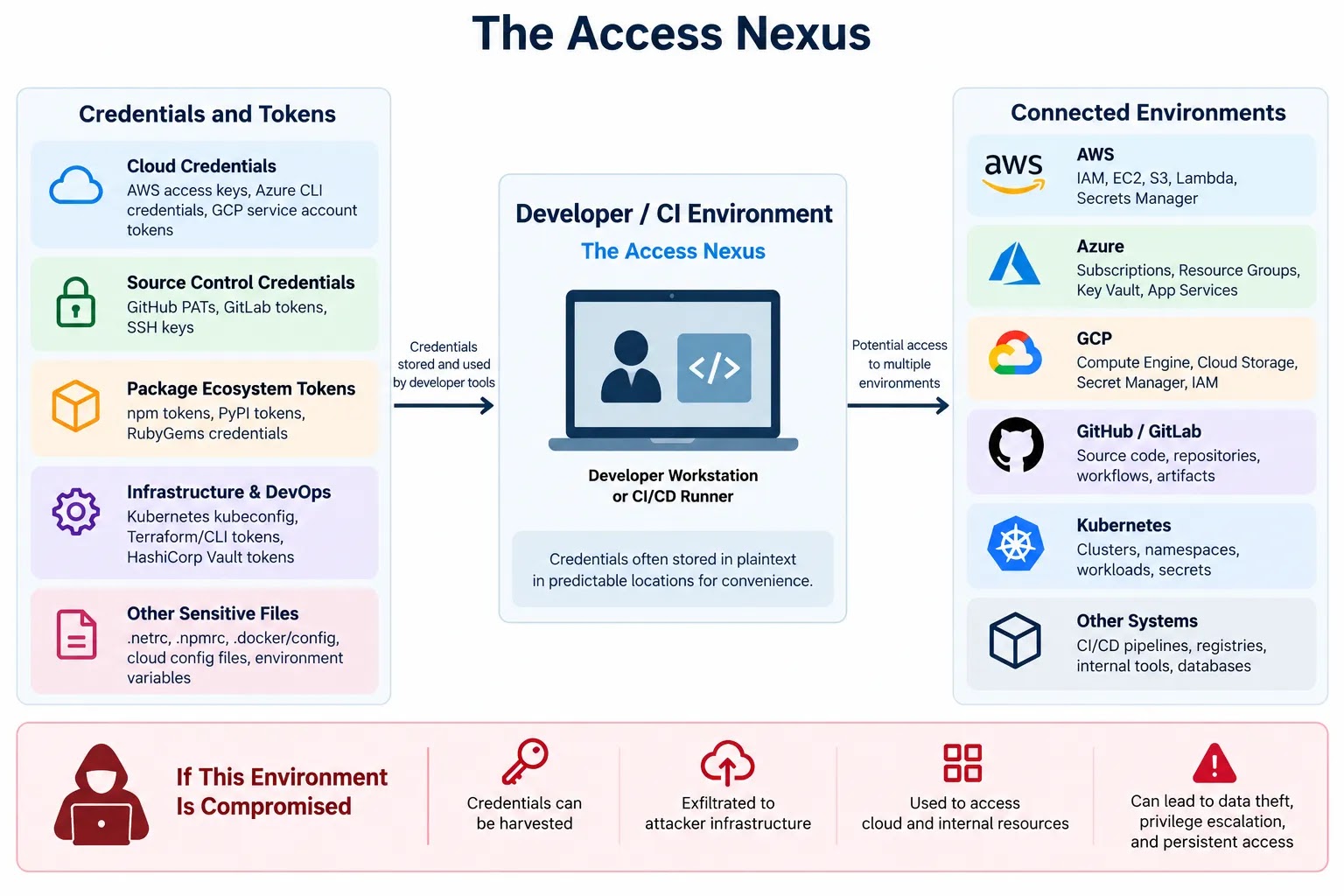
The integrity of software supply chains is under severe assault, with malicious actors increasingly embedding credential-stealing malware within seemingly innocuous software updates and development tools. This sophisticated attack vector allows threat actors to compromise developer workstations and automated build systems, gaining access to critical credentials and paving the way for extensive cloud breaches, often before any application code is even executed.
Table Of Content
According to Qualys, in a report shared with Cyber Security News (CSN), this emergent threat is not confined to a single malware family but encompasses several distinct campaigns. The “Shai-Hulud” operation first surfaced in September 2025, with subsequent iterations broadening their scope to target diverse programming ecosystems and security utilities.
Once attackers successfully exfiltrate valid credentials, they can exploit this access to infiltrate cloud storage, probe infrastructure configurations, steal sensitive data, or establish long-term persistence within the targeted environment. Qualys researchers emphasized this recurring attack pattern in their September 28 analysis, highlighting the critical need to view developer environments and cloud infrastructure as a unified attack surface rather than isolated security challenges.
Developer Machines: The New Perimeter
Developer systems are a treasure trove for attackers, frequently housing sensitive assets such as cloud access keys, repository tokens, publishing credentials, and private keys. As demonstrated by past attacks on SAP packages, the theft of these secrets can have far-reaching consequences, potentially exposing systems well beyond the immediate software project, even if the compromised application never reaches production.
The pivotal moment in these attacks often occurs during the installation phase of software packages. Package managers are designed to execute scripts automatically, inadvertently granting attackers the same privileges, environment variables, and credentials available to the developer or the build process. Conventional application security measures may not activate until after the credential theft has already taken place, rendering them ineffective at the initial point of compromise.
The initial “Shai-Hulud” campaign focused on scanning infected environments for cloud credentials and exfiltrating this stolen information to public GitHub repositories created under the guise of the victim’s account. A more aggressive variant emerged in November, incorporating backdoor functionalities and destructive capabilities that would activate if credential theft proved unsuccessful, thereby escalating the potential damage from a compromised dependency. A November variant of Shai-Hulud also introduced destructive capabilities and backdoor functions.
By May 2026, a new variant, “Mini Shai-Hulud,” emerged, employing scripts that executed even before the installation process was complete. Qualys reported that a single wave on May 19 compromised 639 package versions across 323 distinct packages. This widespread compromise of Mini Shai-Hulud packages clearly illustrates how infections can propagate through dependent libraries that are integral to cloud development workflows. Even if an installation is canceled after the malicious script begins, the payload may have already harvested repository tokens, cloud keys, and infrastructure secrets, transforming a seemingly benign package issue into a full-blown credential compromise.
Other malicious campaigns have directly manipulated the build environment. For instance, “BufferZoneCorp” distributed deceptive Ruby gems and Go modules, masquerading as legitimate developer utilities. These malicious packages were designed to collect secrets, weaken package verification processes, intercept commands, and even inject an attacker’s SSH key to maintain remote access.
The “TeamPCP” group also successfully compromised trusted scanning tools and libraries. The wider implications of stolen cloud credentials were starkly illustrated by a European Commission cloud breach, where attackers leveraged a poisoned development tool to gain unauthorized access and steal data. Between April 21 and 23, 2026, a series of related attacks hit npm, PyPI, and Docker Hub within a 48-hour window. In a subsequent May campaign, 14 packages impersonating search libraries were used to steal cloud and pipeline secrets. Attackers then exploited stolen publishing tokens to compromise even more packages, effectively transforming a single compromised developer account into a distribution channel for further widespread credential theft.
What You Should Do
Remediating a malicious package is merely the initial step in a comprehensive recovery process. Qualys advises organizations to:
- Identify All Exposed Credentials: Thoroughly identify every credential that the compromised machine or build system could have accessed.
- Revoke and Rotate Secrets: Immediately revoke or rotate all identified exposed secrets.
- Review Cloud Activity: Conduct a meticulous review of cloud activity logs for the entire duration of the exposure.
- Harden Dependency Management: Mitigate installation risks by implementing strict approval processes for dependencies, pinning package versions using lockfiles, and verifying that these lockfiles remain intact throughout the build process.
- Control Installation Scripts: Where feasible, disable automatic installation scripts. Only permit scripts that have undergone rigorous review and are absolutely essential for functionality.
- Implement Least Privilege for Build Jobs: Ensure that build jobs are granted only the minimum necessary permissions to perform their designated tasks. A job responsible for compiling code, for example, should not possess deployment authority.
- Utilize Short-Lived Credentials: Reduce reliance on permanent access keys by employing short-lived credentials.
- Strengthen Cloud Policies: Implement stringent cloud policies to prevent the unauthorized creation of administrator accounts or the disabling of logging mechanisms.
- Protect and Monitor Cloud Audits: Safeguard cloud audit records against any modification and actively monitor them for unusual activities. Investigators should prioritize examining unexpected changes in access, newly provisioned resources, and suspicious storage access patterns to understand the full scope of attacker actions post-credential theft.
- Restrict Cloud Metadata Service Access: Limit access to cloud metadata services for build systems that do not explicitly require them.
- Enforce Modern Security Practices: Mandate the use of AWS IMDSv2, prioritize federated identities or managed identities where supported, and maintain granular, narrow permissions across all cloud resources.
Effective security in this landscape demands a holistic approach, integrating developer security with robust cloud response strategies that account for the entire potential attack path.
Indicators of Compromise (IoCs)
| Type | Indicator | Description |
|---|---|---|
| Domain | webhook.site |
Legitimate webhook service identified as an exfiltration channel. Its presence alone does not establish compromise. |
Disclaimer: HackersRadar reports on cybersecurity threats and incidents for informational and awareness purposes only. We do not engage in hacking activities, data exfiltration, or the hosting or distribution of stolen or leaked information. All content is based on publicly available sources.








No Comment! Be the first one.