




New Framework Links APT Campaigns Across Strategic, Operational, Technical Layers
Key Takeaways Traditional methods for attributing Advanced Persistent Threat (APT) campaigns are proving inadequate due to adversaries constantly changing their tactics, tools, and infrastructure....

Key Takeaways
- Traditional methods for attributing Advanced Persistent Threat (APT) campaigns are proving inadequate due to adversaries constantly changing their tactics, tools, and infrastructure.
- DarkAtlas has introduced a new campaign-based attribution framework that links APT activity through partial overlaps across strategic, operational, and technical layers, rather than relying on consistent TTPs.
- This framework uses a multi-dimensional “Overlap Model” across six analytical layers to establish confidence-based attribution (high, medium, or low) between discrete campaigns.
- The new approach addresses the “Ship of Theseus” paradox in attribution by focusing on relationships between evolving campaigns, offering a more resilient method for tracking sophisticated threat actors.
Rethinking APT Attribution in an Evolving Threat Landscape
Identifying the perpetrators behind Advanced Persistent Threat (APT) campaigns has long been a formidable challenge for the cybersecurity community. For years, analysts have relied on the consistent patterns of behavior, tools, and digital infrastructure to link malicious activities to specific threat groups. However, this established approach is increasingly faltering as APT groups demonstrate a dynamic and unpredictable nature, diverging significantly from previously held assumptions of rigid operational consistency.
Table Of Content
The traditional reliance on Tactics, Techniques, and Procedures (TTPs) for attribution was effective when threat actors maintained consistent operational profiles. Today’s adversaries, however, routinely alter their personnel, switch out tools, rebuild their infrastructure, and even redefine their objectives, sometimes within the span of a single campaign. This constant evolution leaves cybersecurity analysts with disparate fragments of information, making it exceedingly difficult to establish reliable connections between different phases of an attack or across multiple campaigns. The growing disparity between how defenders track threats and how these threats actually manifest has prompted researchers to develop a fundamentally new paradigm for attribution.
Introducing the Campaign-Based Attribution Framework
Recognizing this critical gap, analysts at DarkAtlas have unveiled a novel campaign-based attribution framework. This framework is specifically designed to overcome the limitations inherent in traditional group-centric models. Instead of attempting to define APT groups as static entities, the new model focuses on discrete, time-bound clusters of activity, termed “campaigns.” Each campaign is characterized by its specific objectives, infrastructure patterns, and operational conduct. The core innovation of this approach lies in its ability to infer continuity between campaigns not through identical TTPs, but through partial and independent overlaps across various evidence layers.
The framework confronts what researchers liken to the “Ship of Theseus” paradox in attribution: if an adversary group systematically replaces every element of its operation—from its operators to its tools and infrastructure—can it still be considered the same group? Traditional attribution models struggle with such complex questions. The new campaign-linkage methodology deftly navigates this paradox by analyzing the relationships between distinct campaigns, rather than presuming a stable, unchanging group identity.
This framework does not aim to eliminate all uncertainty from attribution. Instead, it integrates a confidence-based model where conclusions are qualified as high, medium, or low confidence. This assessment depends directly on the number and strength of independent evidence layers that converge. High-confidence attribution necessitates robust, multi-layered overlap spanning strategic, operational, technical, infrastructure, and human dimensions. Medium confidence is assigned when there is partial alignment across these layers, while low confidence is reserved for instances where similarity is observed in only a single dimension or when available data is scarce.
How the Overlap Model Works in Practice
Central to the DarkAtlas framework is the “Overlap Model,” a sophisticated multi-dimensional correlation technique that replaces single-indicator attribution with a layered analytical approach. No individual artifact—be it a reused IP address, a shared tool, or a matching technique—is considered sufficient on its own to establish continuity. Instead, attribution confidence is incrementally built only when multiple, independent dimensions of evidence align.
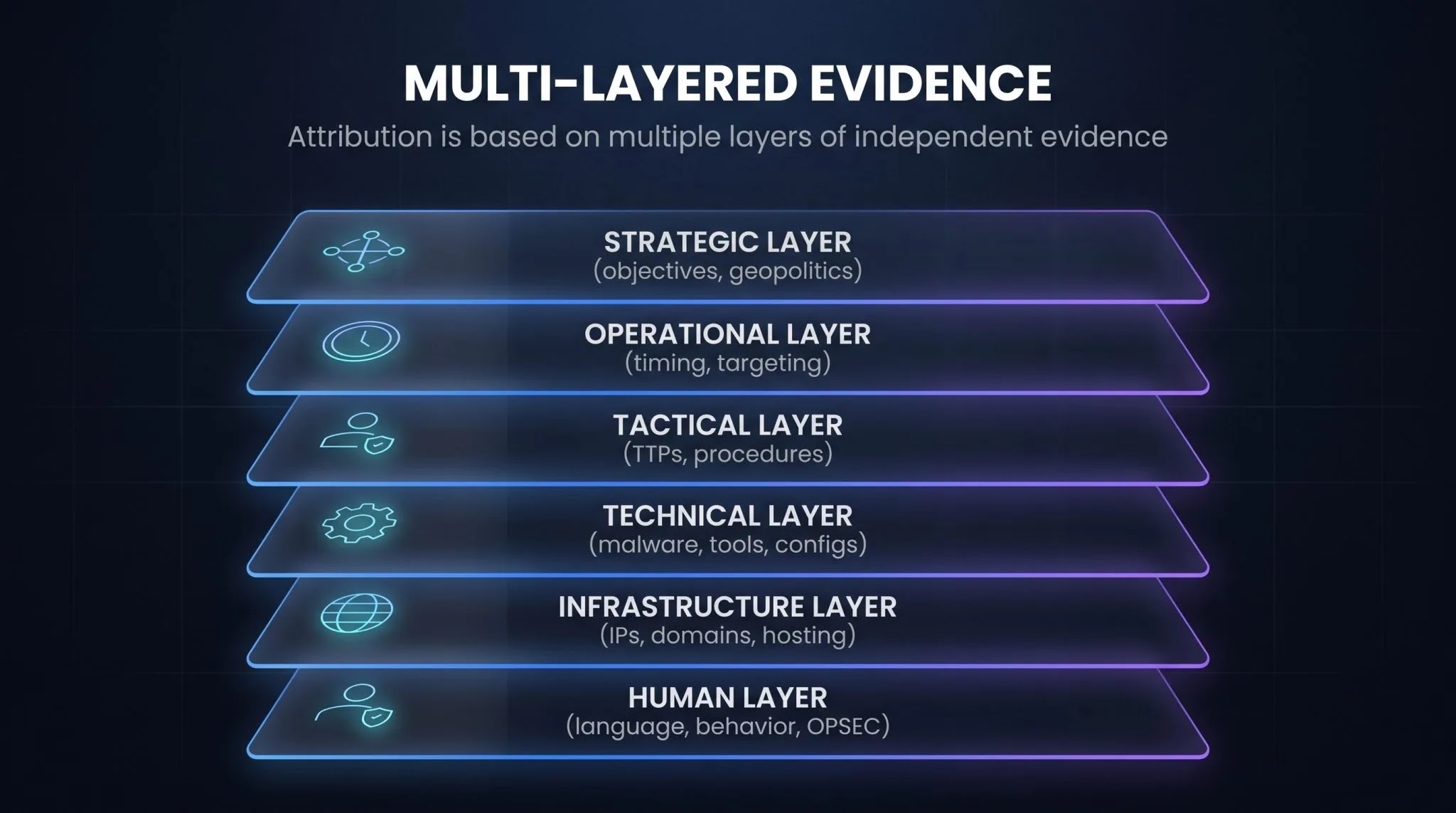
The model meticulously examines six distinct analytical layers:
- Strategic Layer: Focuses on geopolitical alignment and the overarching targeting intent, which often remains consistent even as tactical approaches evolve.
- Operational Layer: Monitors targeting patterns, campaign timing, and the sequencing of victim engagement.
- Tactical Layer: Maps the execution of procedures against established frameworks such as MITRE ATT&CK.
- Technical Layer: Analyzes characteristics of custom malware, encryption routines, and unique build artifacts.
- Infrastructure Layer: Investigates patterns in domain naming conventions, reuse of TLS certificates, and DNS behavior.
- Human Layer: Captures operator-specific traits, including coding style, language artifacts, and operational security (OPSEC) habits.
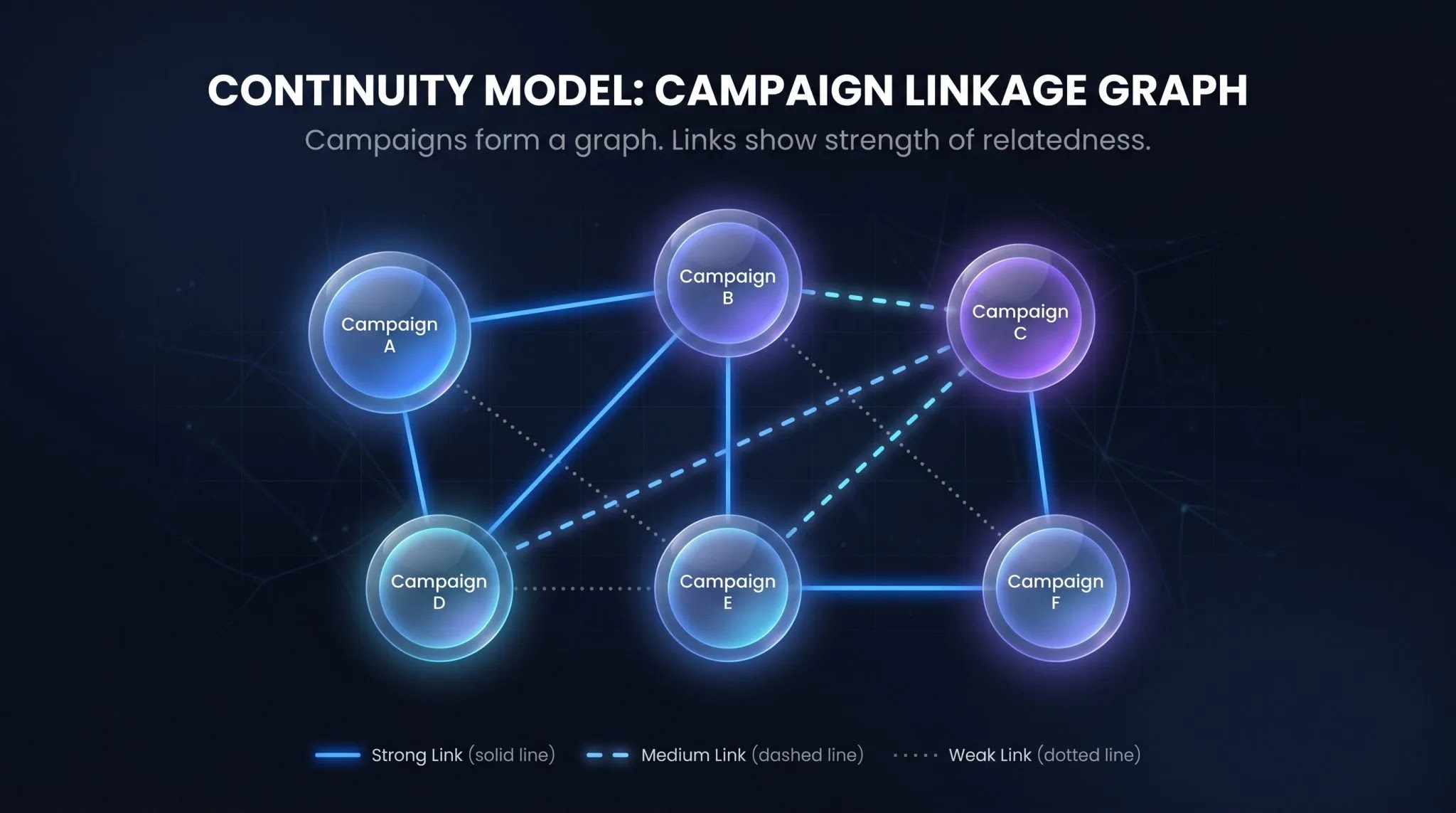
These diverse layers collectively feed into a Campaign Linkage Graph, a structured network where each node represents a distinct campaign, and each edge signifies a weighted relationship between them. Strong links denote substantial overlap across multiple layers, medium links indicate partial alignment, and weak links flag tentative connections requiring further validation. This graph-based methodology inherently accommodates adversary evolution, treating changes in tooling as new nodes, infrastructure rotations as weaker but traceable connections, and group fragmentation as branching paths within the network.
What You Should Do
Security teams and threat intelligence practitioners are advised to integrate the following recommendations based on the insights provided by this new framework:
- Transition from single-indicator attribution to requiring multi-layered evidence before drawing conclusions about campaign origins or group identities.
- Recognize TTPs as dynamic behavioral signals rather than immutable fingerprints, acknowledging that adversaries frequently modify or share techniques to obscure their tracks.
- Adopt a campaign-centric tracking model, documenting each operation as a discrete unit to facilitate the construction of relationship graphs over time, independent of fixed group labels.
- Implement confidence tiers for all attribution assessments and be prepared to revise earlier conclusions as new campaign data emerges, especially when infrastructure or tooling patterns reappear.
- Prioritize monitoring resources on more stable indicators such as victimology and geopolitical timing, as these tend to persist longer than ephemeral tools or infrastructure.
Disclaimer: HackersRadar reports on cybersecurity threats and incidents for informational and awareness purposes only. We do not engage in hacking activities, data exfiltration, or the hosting or distribution of stolen or leaked information. All content is based on publicly available sources.








No Comment! Be the first one.