




GTIG: Escalating Espionage & Supply Chain Risks for
Modern warfare now extends far beyond physical battlefields. Its reach increasingly infiltrates the digital servers and supply chains critical to national defense. Today, the sector faces a...

Modern warfare now extends far beyond physical battlefields. Its reach increasingly infiltrates the digital servers and supply chains critical to national defense.
Today, the sector faces a relentless barrage of cyber operations from state-sponsored actors and criminal groups alike.
These attacks no longer focus solely on military entities but aggressively target defense contractors, aerospace manufacturers, and individual employees to steal sensitive data and disrupt critical logistics.
The scale of this activity highlights a dangerous escalation in how foreign powers seek to undermine national security through digital means.
The primary attack vectors have evolved significantly, shifting toward the exploitation of edge devices and sophisticated social engineering.
Adversaries are bypassing traditional enterprise security perimeters by targeting unmonitored virtual private networks (VPNs) and firewalls, or by manipulating hiring processes to compromise personnel.
This strategic shift allows attackers to gain initial access and maintain long-term persistence within high-value networks without triggering standard endpoint detection systems.
Google Cloud analysts identified these escalating threats, noting a distinct rise in zero-day exploits and insider threat tactics across the global landscape.
The impact of these intrusions is profound, ranging from the theft of vital intellectual property to the potential delay of defense production capabilities during wartime environments.
By compromising the “human layer” and obscure network appliances, threat actors can silently siphon intelligence and prepare for disruptive operations that could hamper military readiness.
The Stealth of INFINITERED and Email Exfiltration
A prime example of this technical evolution is the INFINITERED malware, deployed by the China-nexus group UNC6508.
This tool exemplifies the shift toward stealthy, long-term espionage against research and defense institutions.
The malware functions as a recursive dropper, embedding itself within legitimate system files of the REDCap application to survive software updates.
This persistence mechanism ensures that even as administrators patch their systems, the malicious code is automatically reinjected into the core files, maintaining a foothold for the attackers.
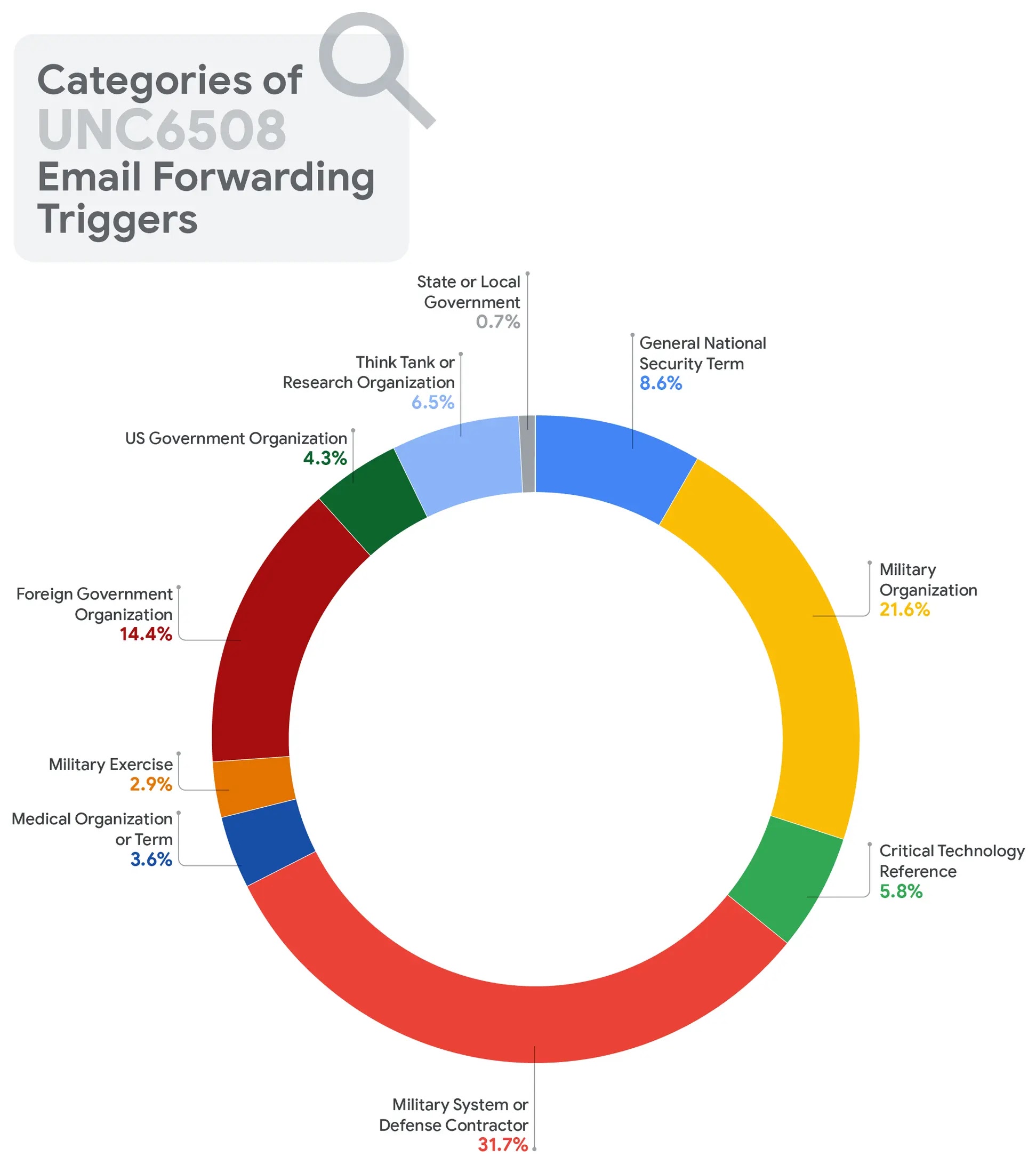
Once inside, the attackers utilize a highly specific method to exfiltrate sensitive communications without generating standard network traffic noise.
They abuse legitimate email filtering rules, modifying them to automatically forward messages that match specific keywords related to national security, military equipment, or foreign policy.
By using regular expressions to scan email bodies and subjects, the malware quietly redirects critical intelligence to actor-controlled accounts.
This technique allows the espionage campaign to remain undetected for extended periods, as it leverages authorized administrative tools rather than introducing noisy external code.
To counter these advanced threats, organizations must move beyond reactive measures. Defense contractors should implement rigorous monitoring for edge devices and enforce strict behavioral analytics for email forwarding rules.
Additionally, strengthening verification processes for remote personnel and segmenting critical supply chain networks can significantly reduce the risk of successful infiltration.
Disclaimer: HackersRadar reports on cybersecurity threats and incidents for informational and awareness purposes only. We do not engage in hacking activities, data exfiltration, or the hosting or distribution of stolen or leaked information. All content is based on publicly available sources.








No Comment! Be the first one.