




Bank of Baroda Data Breach: Employee Email Compromise Exposed Customer Data
Key Takeaways India’s Bank of Baroda confirmed a cybersecurity incident involving an employee email account compromise. Attackers gained unauthorized access to an employee’s mailbox,...

Key Takeaways
- India’s Bank of Baroda confirmed a cybersecurity incident involving an employee email account compromise.
- Attackers gained unauthorized access to an employee’s mailbox, potentially exposing internal communications and sensitive data.
- The bank’s core banking systems were reportedly unaffected, though the full scope of data exfiltration is under investigation.
- This incident highlights the pervasive threat of email compromise as an initial access vector for cybercriminals targeting financial institutions.
Bank of Baroda, a prominent Indian financial institution, has acknowledged a recent cybersecurity breach where an attacker successfully compromised an employee’s email account. This unauthorized access exposed internal communications and potentially sensitive information, raising significant concerns about customer data security and the potential for subsequent phishing attacks.
Table Of Content
Incident Details and Initial Response
The breach came to light after suspicious activity was detected within an employee’s mailbox. Investigations suggest that the attackers managed to compromise the credentials for this account, granting them access to emails, attachments, and internal correspondence associated with the employee.
Upon discovering the incident, Bank of Baroda promptly launched an internal investigation and implemented measures to contain the unauthorized access. The bank is currently reviewing affected systems, analyzing mailbox logs, and working to determine if any data was viewed, copied, or exfiltrated by the threat actors. According to a Times of India report, the bank has affirmed that its core banking systems remained untouched.
The Pervasive Threat of Email Compromise
Email compromise continues to be a primary method for cybercriminals to gain initial entry into large organizations. Attackers frequently leverage sophisticated phishing campaigns, exploit stolen credentials, employ credential-stuffing techniques, or deploy malware to infiltrate corporate mailboxes. Once inside, they can impersonate legitimate employees, search for confidential documents, identify business partners, and lay the groundwork for more extensive attacks against internal networks.
Within the banking sector, a compromised email account presents severe risks. Internal mailboxes often contain a wealth of sensitive information, including customer communications, loan applications, transaction details, employee records, operational procedures, and vendor information. Even if attackers do not directly breach core banking systems, this intelligence can be instrumental in facilitating fraud, executing social engineering schemes, or launching highly targeted phishing campaigns against customers and partners.
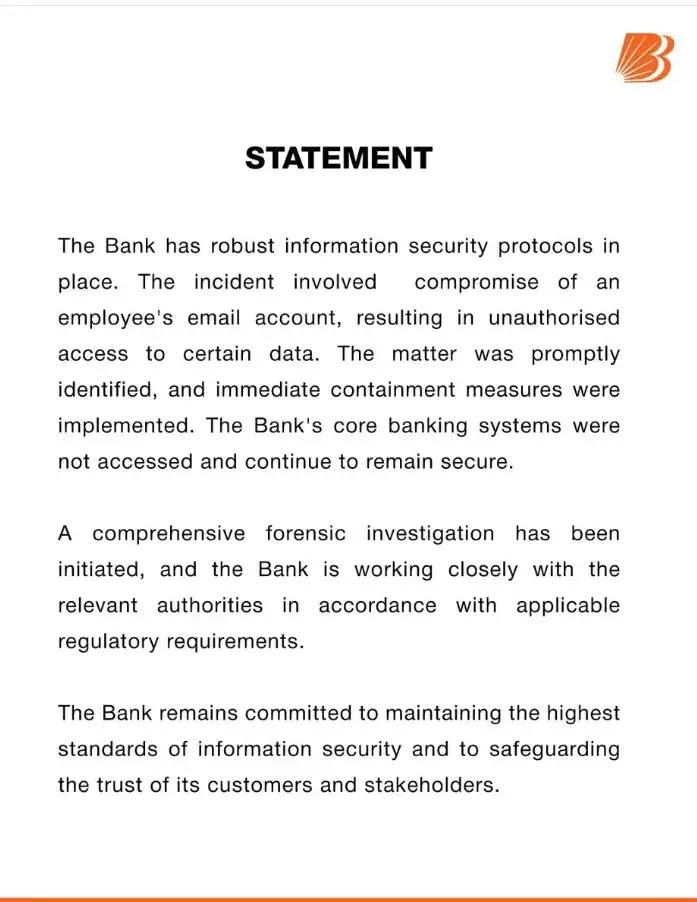
The full extent of the incident will depend heavily on the level of access and permissions held by the compromised employee, as well as the volume and sensitivity of information stored within their mailbox. Bank of Baroda has not yet publicly disclosed the specific method used to compromise the email account, nor has it confirmed whether customer data or financial records were directly impacted beyond the initial access to email.
Strengthening Defenses Against Account Takeover
This incident serves as a critical reminder of the necessity for robust security measures, particularly multi-factor authentication (MFA), for all employee accounts—especially those handling sensitive customer, financial, and administrative data. MFA significantly diminishes the risk of account takeover, even if an attacker manages to obtain a password through phishing or a previous data breach.
Organizations must also implement rigorous monitoring of email login activities, looking for anomalies such as logins from unusual geographical locations, unfamiliar devices, impossible travel patterns, and the creation of abnormal forwarding rules. Threat actors frequently establish hidden mailbox rules to silently forward emails to external addresses, allowing them to maintain persistent access and harvest information without immediate detection.
Financial institutions remain prime targets for cybercriminals due to the vast amounts of personal, transactional, and financial data they manage. Even a single compromised employee account can provide attackers with invaluable intelligence, enabling them to expand their foothold within the network or craft sophisticated social engineering attacks against customers and staff.
Bank of Baroda’s ongoing investigation is expected to provide further clarity on the full impact of the breach, including whether any data was successfully accessed or exfiltrated.
What You Should Do
- Enable Multi-Factor Authentication (MFA): Ensure MFA is active on all personal and work accounts, especially banking and email.
- Be Wary of Phishing: Remain vigilant for suspicious emails, text messages, or calls that claim to be from Bank of Baroda or any other financial institution. Do not click on unfamiliar links or download unexpected attachments.
- Verify Requests: Never provide personal information, passwords, or One-Time Passwords (OTPs) in response to unsolicited requests. If in doubt, contact your bank directly using official contact information, not details provided in a suspicious message.
- Monitor Account Activity: Regularly review your bank statements and online account activity for any unauthorized transactions or suspicious behavior.
- Report Suspicious Activity: If you suspect your account has been compromised or you receive a suspicious communication, report it immediately to your bank.
Disclaimer: HackersRadar reports on cybersecurity threats and incidents for informational and awareness purposes only. We do not engage in hacking activities, data exfiltration, or the hosting or distribution of stolen or leaked information. All content is based on publicly available sources.







No Comment! Be the first one.