




AWS Details How Stolen Cloud Credentials Lead to Full-Scale Attacks
Key Takeaways Stolen AWS credentials pose a significant threat, enabling attackers to execute multi-stage cloud breaches. Attackers often leverage compromised credentials to gain initial access,...

Key Takeaways
- Stolen AWS credentials pose a significant threat, enabling attackers to execute multi-stage cloud breaches.
- Attackers often leverage compromised credentials to gain initial access, discover resources, escalate privileges, move laterally, and exfiltrate data.
- Individual suspicious actions can appear benign; however, correlating events across AWS services like CloudTrail, VPC Flow Logs, and Route 53 Resolver logs reveals coordinated attacks.
- AWS recommends implementing robust logging, leveraging GuardDuty, and establishing custom detection rules based on organizational context to identify and respond to these sophisticated attacks.
- Proactive measures, including rapid credential revocation and comprehensive logging, are crucial for mitigating the impact of stolen cloud credentials.
The compromise of cloud credentials represents a critical vulnerability that can rapidly escalate a minor security incident into a full-scale data breach. Once an attacker obtains a valid AWS access key or session token, they can impersonate an authorized user, potentially gaining deep access to sensitive cloud infrastructure. Recent incidents involving active AWS access keys underscore the severe consequences, demonstrating how credential exposure can lead to extensive control over cloud environments.
Table Of Content
AWS security analysts have provided a detailed framework for understanding and detecting these multi-stage attack paths by emphasizing the importance of correlating security signals across various services. While individual alerts might not reveal the complete picture, linking related events can expose a coordinated intrusion attempt, as highlighted in a comprehensive guide on correlating signals.
In a report shared with Cyber Security News (CSN), AWS elaborated on how a compromised identity can facilitate reconnaissance, privilege escalation, lateral movement, and data theft within a cloud environment. The report stresses that seemingly legitimate individual actions, when analyzed in context of their timing and target, can expose a malicious campaign.
Understanding the Attack Lifecycle in AWS Environments
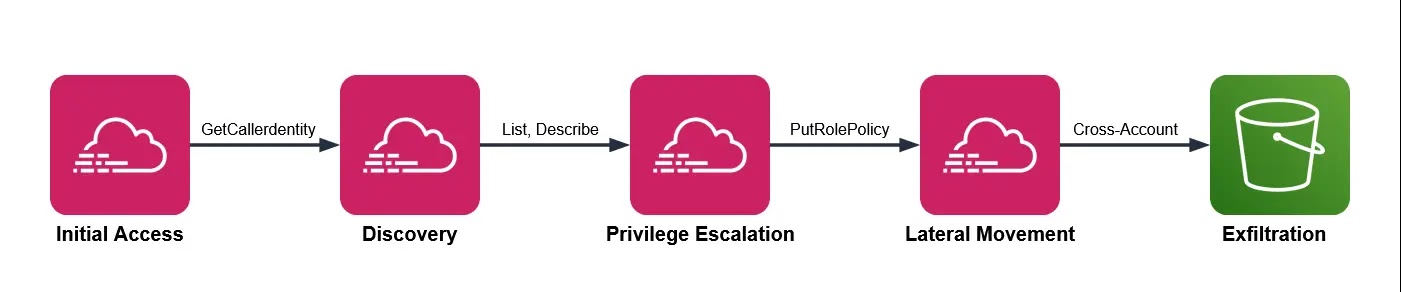
AWS outlines a five-phase attack chain: initial access, discovery, privilege escalation, lateral movement, and data exfiltration. Essential AWS services like CloudTrail, which logs API activity; VPC Flow Logs, which record network connections; and Route 53 Resolver logs, which track DNS lookups, collectively provide the telemetry necessary to reconstruct an attack timeline.
Initial Access and Discovery
Upon acquiring stolen credentials, attackers typically begin by verifying their validity. They may invoke API calls such as GetCallerIdentity, GetSessionToken, or AssumeRole from an unusual IP address to confirm the credentials are active. This is often followed by a series of enumeration requests, including List, Describe, and Get operations, to map out the accessible environment. Repeated AccessDenied errors can be a significant indicator, signaling an intruder attempting to probe the boundaries of their compromised permissions.
Privilege Escalation and Lateral Movement
Following discovery, attackers often seek to escalate their privileges. This can involve identifying and exploiting misconfigurations, such as a role chain that grants elevated permissions or a policy modification that expands their scope. AWS specifically flags actions like PutRolePolicy, CreateAccessKey, and AttachUserPolicy as critical signals in this phase. The ability of attackers to manipulate CloudTrail logs is a severe concern, as sufficient permissions can allow them to obscure their tracks and degrade the evidence crucial for defenders.
Data Exfiltration
With elevated privileges, an attacker can then proceed to exfiltrate data. This typically involves making GetObject requests against storage services like S3 buckets. AWS advises organizations to correlate high volumes of reads from sensitive buckets with outbound data transfers and DNS queries directed to new, suspicious domains, especially when the compromised principal should not have access to that data.
Building Context-Aware Cloud Detection
To enhance cloud security, AWS recommends activating and configuring security services such as GuardDuty, CloudTrail, VPC Flow Logs, and Route 53 Resolver query logging. While GuardDuty’s Extended Threat Detection can identify common attack patterns and generate high-severity findings, it lacks the specific contextual knowledge of an organization’s sensitive data, authorized roles, or expected operational windows.
This inherent limitation underscores the necessity for organizations to establish their own local context. Security teams must define normal operational parameters, including authorized data readers, legitimate role assumption chains, key ownership, and approved change windows. For instance, a deployment role assuming multiple other roles during a scheduled deployment is expected behavior. However, a human user performing similar actions at an unusual hour, followed by the creation of new access keys, warrants immediate investigation.
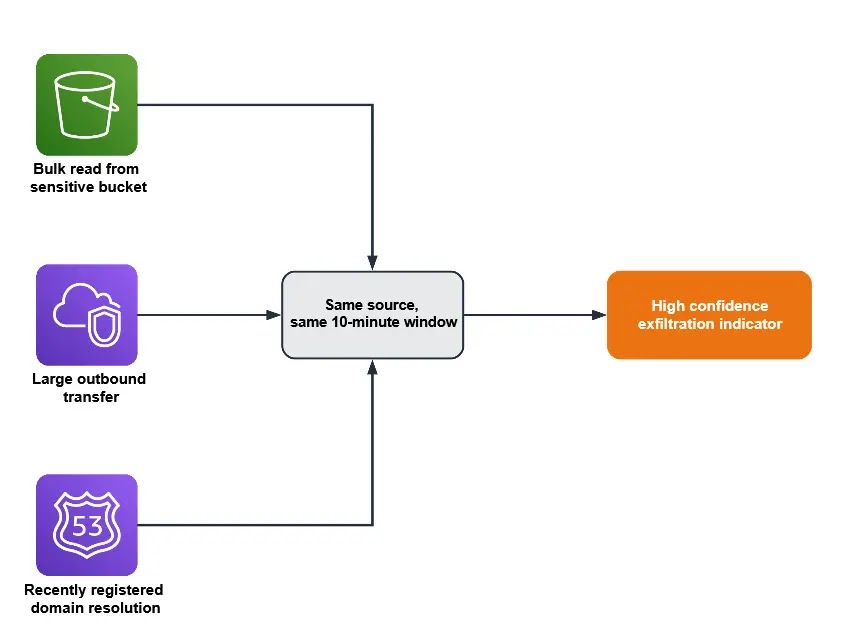
For monitoring storage, AWS advises enabling CloudTrail data events, as standard management events do not capture granular actions like GetObject requests. Organizations should establish a baseline of normal activity and configure alerts for object read volumes exceeding the 95th percentile.
Accurate correlation requires linking identity-related events to network records based on event time, not query time. Due to potential CloudTrail delivery delays (typically 5 to 15 minutes), a search window of 30 to 60 minutes can facilitate more precise correlation, allowing defenders to confirm if a suspicious identity initiated a large external transfer.
Once detection rules are validated, automation is key. AWS suggests scheduling correlation queries, routing verified findings to incident response channels, and applying the principle of least privilege to all supporting roles. When developing custom rules, organizations should begin with a single, well-tuned rule, rigorously test it against live traffic, and only expand with additional patterns once its effectiveness is proven. This strategy is particularly relevant given the rise of sophisticated phishing kits designed to steal cloud console credentials and AI-driven cloud compromise campaigns that accelerate attack timelines.
What You Should Do
- Implement Comprehensive Logging: Ensure CloudTrail data events are enabled for all critical S3 buckets and other storage services. Maintain VPC Flow Logs and Route 53 Resolver query logs.
- Leverage AWS GuardDuty: Enable GuardDuty and configure it with Extended Threat Detection to identify suspicious activities and common attack patterns.
- Establish Baseline Behavior: Document normal operational patterns for identities, roles, and resource access. Define expected roles, access locations, and activity times for privileged accounts.
- Create Context-Aware Detection Rules: Develop custom detection rules that correlate events across CloudTrail, VPC Flow Logs, and Route 53 Resolver logs, taking into account your organization’s specific context and baseline.
- Prioritize Event Time Correlation: When analyzing logs, correlate identity events with network records based on their actual event time, not query time, using a sufficient time window (e.g., 30-60 minutes) to account for log delivery delays.
- Automate Responses: Implement automation for validated security findings, directing alerts to incident response teams and enforcing least-privilege policies for roles involved in security monitoring.
- Regularly Review and Revoke Credentials: Promptly revoke any exposed or suspicious AWS access keys and sessions. Regularly audit and rotate credentials.
- Educate Users: Implement ongoing security awareness training to educate users about phishing tactics and the importance of protecting credentials.
Disclaimer: HackersRadar reports on cybersecurity threats and incidents for informational and awareness purposes only. We do not engage in hacking activities, data exfiltration, or the hosting or distribution of stolen or leaked information. All content is based on publicly available sources.








No Comment! Be the first one.