




AI Exploitation Narrows Patch Window, Posing New Threat to Defenders
Key Takeaways Advanced AI models are evolving from coding assistants to autonomous security researchers, capable of identifying vulnerabilities and orchestrating multi-stage attacks. This shift...

Key Takeaways
- Advanced AI models are evolving from coding assistants to autonomous security researchers, capable of identifying vulnerabilities and orchestrating multi-stage attacks.
- This shift drastically reduces the “patch window”—the critical time between vulnerability discovery and active exploitation—from days to potentially minutes.
- Open-source software, due to its publicly visible code, is at heightened risk, with implications extending to commercial products that integrate these components.
- Defenders must accelerate their response times, harden environments, and implement robust automated prevention and response mechanisms to counter AI-driven threats.
Artificial intelligence is fundamentally transforming the cybersecurity threat landscape, transitioning from theoretical discussions about its potential to immediate, tangible challenges for organizations worldwide. The advent of sophisticated AI models is empowering threat actors with unprecedented capabilities, enabling them to discover software flaws, comprehend intricate attack paths, and advance intrusions with significantly less human intervention than ever before.
Table Of Content
This paradigm shift is particularly critical because traditional cybersecurity defenses rely heavily on the “patch window”—the period between a vulnerability’s public disclosure and its active exploitation. If AI tools can compress this crucial window from days to mere hours or even minutes, defenders risk losing the essential time they have long depended on to implement patches and mitigations.
Researchers at Unit 42 have observed this concerning evolution, noting that frontier AI models are now behaving less like simple coding aids and more like sophisticated, autonomous security researchers. Their investigations indicate that these systems can pinpoint vulnerabilities, chain multiple weaknesses together to form complex attack sequences, and dynamically adapt their exploitation strategies with minimal human oversight.
The implications of this development are broad, extending beyond specific malware or industry sectors. The Unit 42 report highlights that open-source software faces immediate and intense pressure due to its publicly accessible source code, which provides a clear target for automated AI analysis. This risk, in turn, cascades into commercial products, as many enterprise applications incorporate open-source components within their software stacks.
Inside the AI-Powered Attack Path
A primary concern is AI’s capacity to support the entire lifecycle of an infection and exploitation campaign. Unit 42 researchers outlined a typical AI-assisted attack path:
Reconnaissance and Initial Access
An attacker can leverage frontier AI models to gather extensive public information about a target organization. This data is then used to craft highly convincing phishing messages, which AI can deliver through social engineering tactics to deploy initial malware.
Lateral Movement and Privilege Escalation
Once initial access is established, an AI-guided command system can direct the malware to perform internal network reconnaissance. This includes scanning for visible systems, identifying software versions, collecting exposed credentials, and testing accounts for useful privileges, all autonomously.
Automated Exploitation
The threat intensifies when exploitation is integrated into this automated loop. As the malware navigates the environment, an AI agent can analyze collected data, pinpoint vulnerable services, generate or refine exploit code on the fly, and then transmit this exploit back to the compromised host for execution. This continuous, self-optimizing process significantly accelerates the speed and scale of attacks.
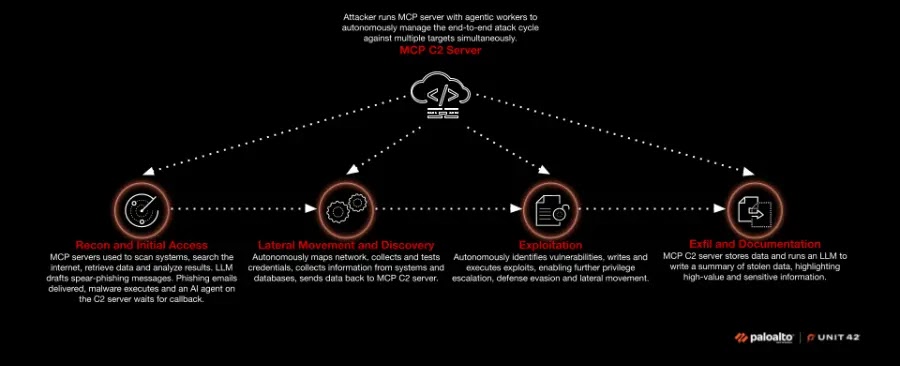
Crucially, the report emphasizes that AI is not necessarily inventing entirely new attack methodologies. Instead, it is dramatically accelerating existing, familiar techniques, enabling them to execute faster, target more systems concurrently, and require less direct human control. This development lowers the entry barrier for less skilled malicious actors while simultaneously empowering advanced threat groups to escalate the speed and intensity of their campaigns.
Ultimately, this presents a speed challenge as much as a security one. Defenders must prepare for attacks that operate autonomously, at scale, and across multiple targets simultaneously. This necessitates a shift towards hardened environments, rapid response capabilities, automated triage, and robust prevention controls designed to contain malicious activity before human teams are overwhelmed during active intrusions.
What You Should Do
To counter the evolving threat of AI-powered exploitation, security teams must implement proactive and adaptive strategies:
- Assume Breach Conditions: Operate under the assumption that a breach is inevitable and focus on robust detection, containment, and response capabilities.
- Broaden Endpoint Protection: Extend advanced endpoint detection and response (EDR) solutions across all critical assets to monitor and mitigate threats at the earliest stages.
- Accelerate Patch Deployment: Shift from routine patching schedules to an urgent “time-to-deploy” enforcement model for critical vulnerabilities, drastically shortening the window for exploitation.
- Implement Software Bill of Materials (SBOM): Maintain accurate SBOMs to understand all components within applications, especially open-source dependencies, and monitor them for known vulnerabilities.
- Strengthen Open Source Governance: Establish stricter controls and vetting processes for integrating open-source packages into development workflows.
- Secure Development Environments: Lock down build systems and securely manage developer secrets to prevent supply chain attacks.
- Automate Incident Response: Develop and implement automated incident response pipelines for rapid triage, containment, and remediation of detected threats.
- Optimize Vulnerability Disclosure Workflows: Streamline processes for handling a potential surge in vulnerability reports, ensuring quick validation and patching.
Disclaimer: HackersRadar reports on cybersecurity threats and incidents for informational and awareness purposes only. We do not engage in hacking activities, data exfiltration, or the hosting or distribution of stolen or leaked information. All content is based on publicly available sources.








No Comment! Be the first one.