




Critical Nginx-UI Vulnerability CVE-2023-52074 Lets Attackers Execute Code
Key Takeaways A critical vulnerability, CVE-2026-33026, has been discovered in the Nginx-UI backup restoration feature. Attackers can exploit a flawed cryptographic design to inject malicious...

Key Takeaways
- A critical vulnerability, CVE-2026-33026, has been discovered in the Nginx-UI backup restoration feature.
- Attackers can exploit a flawed cryptographic design to inject malicious configurations and achieve arbitrary code execution.
- The vulnerability affects Nginx-UI versions 2.3.3 and earlier.
- A public Proof-of-Concept (PoC) exploit is available, making unpatched systems immediately vulnerable.
- Administrators must upgrade to Nginx-UI version 2.3.4 to mitigate the risk.
A severe security flaw, tracked as CVE-2026-33026, has been identified within the Nginx-UI application’s backup and restore mechanism. This vulnerability enables malicious actors to manipulate encrypted backup archives and inject harmful configurations during the system restoration process.
Table Of Content
With a functional Proof-of-Concept (PoC) exploit now publicly accessible, any Nginx-UI deployments that remain unpatched face an immediate and critical risk of complete system compromise.
Cryptographic Flaw: Exploit Mechanics and PoC
The core of this vulnerability stems from a critically flawed circular trust model embedded within the application’s backup architecture. While Nginx-UI compresses files into ZIP archives and encrypts them using AES-256-CBC during backup generation, it critically fails to establish and maintain a trusted root of trust.
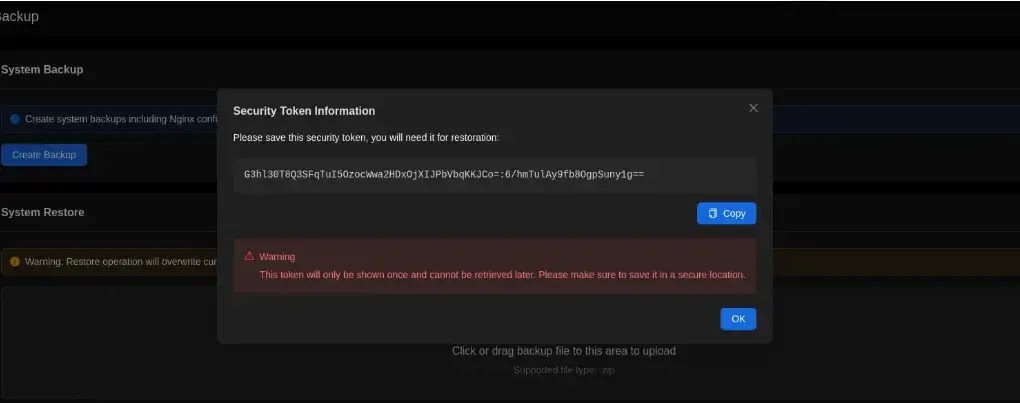
Instead of securely managing encryption parameters on the server side, the AES key and Initialization Vector (IV) are directly exposed to the client as a “backup security token.” Compounding this issue, the integrity metadata file, which contains SHA-256 hashes of the encrypted files, is itself encrypted using this same easily accessible key.
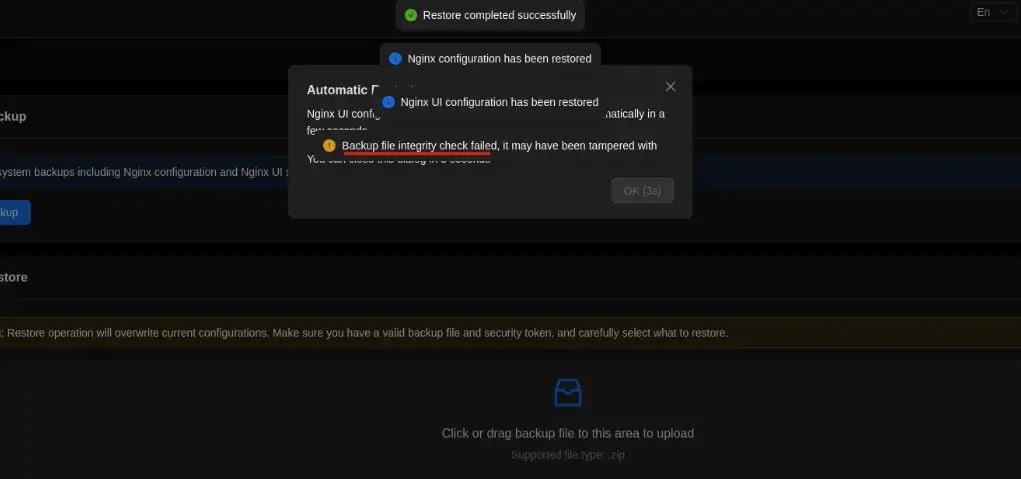
Since an attacker can readily obtain this encryption key, all cryptographic security controls become trivial to bypass. Furthermore, the restore process lacks stringent integrity verification, allowing restoration operations to proceed even when hash mismatches trigger system warnings, effectively ignoring critical security alerts.
Security researcher ‘dapickle’ successfully demonstrated how this architectural weakness could be weaponized. The publicly released PoC includes Python scripts designed to automate the decryption and reconstruction of Nginx-UI backup files.
An attacker initiates the exploit by generating a standard backup and extracting the security token from the HTTP headers. Using a decryption script, they unpack the archive and modify the internal configuration file, specifically app.ini. A common attack vector involves injecting a malicious command, such as StartCmd = bash, into this configuration file.
Following modification, the attacker employs a rebuilding script to recompress the altered files, calculate new hashes that appear legitimate, update the metadata accordingly, and then re-encrypt the entire bundle using the original token. When this tampered backup is subsequently uploaded to the Nginx-UI restore interface, the system uncritically accepts it and proceeds to execute the injected malicious payload.
Impact and Regression
This vulnerability has been assigned a Critical severity rating, achieving maximum CVSS 4.0 scores across multiple impact metrics. Successful exploitation grants attackers the ability to permanently alter application configurations, insert backdoors into Nginx routing, and achieve arbitrary command execution on the host machine.
Notably, this flaw represents a regression of a previously reported vulnerability documented in the GitHub advisory GHSA-fhh2-gg7w-gwpq. While an earlier patch aimed to address unauthorized access to backup files, it critically failed to resolve the fundamental cryptographic design issue, leaving the system inherently vulnerable to archive manipulation.
The cybersecurity community has classified the underlying weaknesses under several categories, including improper validation of integrity check values (CWE-354) and a failure to properly verify cryptographic signatures (CWE-347).
The vulnerability impacts the Go-based Nginx-UI package, specifically affecting versions 2.3.3 and all earlier releases. To mitigate this critical threat, administrators must promptly upgrade their installations to the patched release, version 2.3.4.
Beyond simply applying the latest patch, developers are strongly advised to implement a server-side trusted integrity root. This involves signing backup metadata using a private key, thereby eliminating reliance on client-exposed tokens. Furthermore, systems must be securely configured to avoid circular trust models and to strictly abort any restore operation if hash verification fails at any point.
What You Should Do
- Upgrade Immediately: Update all Nginx-UI installations to version 2.3.4 without delay.
- Review Backup Procedures: Ensure that backup and restore processes are secured and that integrity checks are rigorously enforced.
- Implement Server-Side Trust: For developers, consider implementing a server-side trusted integrity root, such as signing backup metadata with a private key, to prevent similar cryptographic bypasses in the future.
- Monitor for Anomalies: Keep a close watch on Nginx-UI logs for any unusual activity or failed restore attempts that could indicate tampering.
Disclaimer: HackersRadar reports on cybersecurity threats and incidents for informational and awareness purposes only. We do not engage in hacking activities, data exfiltration, or the hosting or distribution of stolen or leaked information. All content is based on publicly available sources.








No Comment! Be the first one.