




Best Ransomware Protection Solutions for 2024
Key Takeaways Effective ransomware defense demands a layered security strategy, not a single product, addressing various stages of the attack kill chain. Modern ransomware attacks increasingly...

Key Takeaways
- Effective ransomware defense demands a layered security strategy, not a single product, addressing various stages of the attack kill chain.
- Modern ransomware attacks increasingly prioritize data exfiltration and extortion over mere file encryption, shifting the focus of “protection.”
- Organizations must implement robust endpoint protection, ensure immutable backups, enforce system hardening, and regularly rehearse incident response to mitigate ransomware risks.
Ransomware Defense: A Multi-Layered Imperative for 2024
The landscape of ransomware attacks has evolved significantly, moving beyond simple file encryption to sophisticated multi-stage intrusions. Cybersecurity experts emphasize that no single solution can entirely halt a ransomware campaign. Instead, robust protection necessitates a comprehensive, layered approach that addresses each phase of the attack kill chain, from initial access to data exfiltration and recovery.
Table Of Content
- Key Takeaways
- Ransomware Defense: A Multi-Layered Imperative for 2024
- Mapping the Kill Chain to Defensive Controls
- Top Ransomware Protection Solutions by Role
- Prevention-Grade Endpoint Platforms
- CrowdStrike — Elite Detection and Threat Intelligence
- Microsoft Defender — Optimal Integrated Option
- Sophos — Balanced Solution for Generalist Teams
- SentinelOne — Leading Autonomous Response
- Bitdefender — Exceptional Prevention Value
- Trend Micro — Comprehensive Server-Inclusive Platform
- Specialists
- Halcyon — Dedicated Anti-Ransomware Layer
- Huntress — Managed Backstop for SMBs
- Malwarebytes — Lightweight Remediation
- Recovery
- Acronis — Integrated Backup and Anti-Ransomware
- Deploying Non-Negotiable Ransomware Defenses
- Verifying Vendor Claims and Best Practices
- Situational FAQ
- What is the best ransomware protection in 2024?
- Does ransomware rollback actually work?
- Is Microsoft Defender enough against ransomware?
- What is double extortion?
- Do backups make ransomware protection unnecessary?
- How much does ransomware protection cost?
- What You Should Do
Organizations must strategically deploy a combination of prevention-grade endpoint platforms, specialized rollback tools, containment layers, and resilient recovery mechanisms. Critically, the threat of data theft and subsequent extortion now rivals, and in some cases surpasses, the impact of encryption, fundamentally altering the definition of effective “protection.”
Mapping the Kill Chain to Defensive Controls
A successful defense strategy aligns specific security tools with distinct stages of a ransomware attack:
| Attack stage | What stops it | Tools on this list |
| Initial access (phish, edge exploits) | Email security, patching, MFA | Adjacent — see linked guides |
| Payload execution | EPP/EDR prevention, allowlisting | CrowdStrike, SentinelOne, Defender, Sophos, Bitdefender, Trend Micro |
| Privilege + credential theft | EPM, credential guards | Adjacent + platform features |
| Lateral movement | Segmentation, containment | Halcyon, platform firewalls |
| Mass encryption | Behavioural detection, rollback | SentinelOne, Sophos, Malwarebytes, Huntress |
| Exfiltration (double extortion) | Egress monitoring, DLP | Platform + SWG/DLP |
| Recovery | Immutable backup | Acronis + dedicated backup |
A critical shift in the threat landscape for 2024 and beyond is the increasing prevalence of ransomware groups that forgo encryption entirely, opting instead for extortion based solely on stolen data. While rollback capabilities can restore encrypted files, they offer no defense against data exfiltration. Consequently, rapid exfiltration detection and response mechanisms are now as crucial as traditional encryption defenses.
Top Ransomware Protection Solutions by Role
Prevention-Grade Endpoint Platforms
CrowdStrike — Elite Detection and Threat Intelligence
CrowdStrike stands out for its superior behavioral prevention capabilities, supported by its OverWatch threat hunting team and actionable adversary intelligence. Its platform provides detailed insights into specific threat actors and their anticipated next moves.
Trade-offs: This premium solution comes with modular pricing. Organizations should inquire about post-July 2024 update-staging controls.
Best for: Well-funded Security Operations Centers (SOCs).
Microsoft Defender — Optimal Integrated Option
Included with E5 licensing, Microsoft Defender for Endpoint offers robust features such as tamper protection, controlled folder access, Attack Surface Reduction (ASR) rules, and automated attack disruption that isolates compromised devices and users during an active attack.
Trade-offs: Full functionality requires P2/E5 licensing and careful tuning. ASR rules often default to audit-only mode and require manual enforcement.
Best for: Organizations deeply integrated into the Microsoft ecosystem that commit to activating and configuring its features.
Sophos — Balanced Solution for Generalist Teams
Sophos’s CryptoGuard provides a distinctive capability to roll back encrypted files, even those targeted by remote encryption from an unprotected adjacent machine. Its user-friendly console and seamless integration with EDR and MDR services make it an attractive option.
Best for: Mid-market organizations operating without dedicated cybersecurity specialists.
SentinelOne — Leading Autonomous Response

SentinelOne offers robust on-agent AI-driven containment and a one-click Windows rollback feature, leveraging VSS-backed storyline history. It exemplifies autonomous malware protection, acting decisively even outside human intervention.
Trade-offs: Requires careful tuning, and rollback efficacy depends on the integrity of Volume Shadow Copies (VSS), which attackers often target. Thorough testing is advised.
Best for: Lean IT teams seeking high levels of automation.
Bitdefender — Exceptional Prevention Value
Bitdefender delivers top-tier detection engines, tamper-resistant remediation, and integrated rollback capabilities. It provides proven endpoint security tools at a competitive mid-market price point.
Best for: Organizations prioritizing cost-effectiveness without compromising on prevention quality.
Trend Micro — Comprehensive Server-Inclusive Platform

Trend Micro offers robust behavioral protection and boasts the deepest heritage in server and workload security among the listed platforms. It effectively bridges the gap between endpoint security (EDR) and extended detection and response (XDR), crucial for protecting server assets, which are often prime targets for ransomware.
Best for: Organizations with significant server infrastructure and hybrid environments.
Specialists
Halcyon — Dedicated Anti-Ransomware Layer
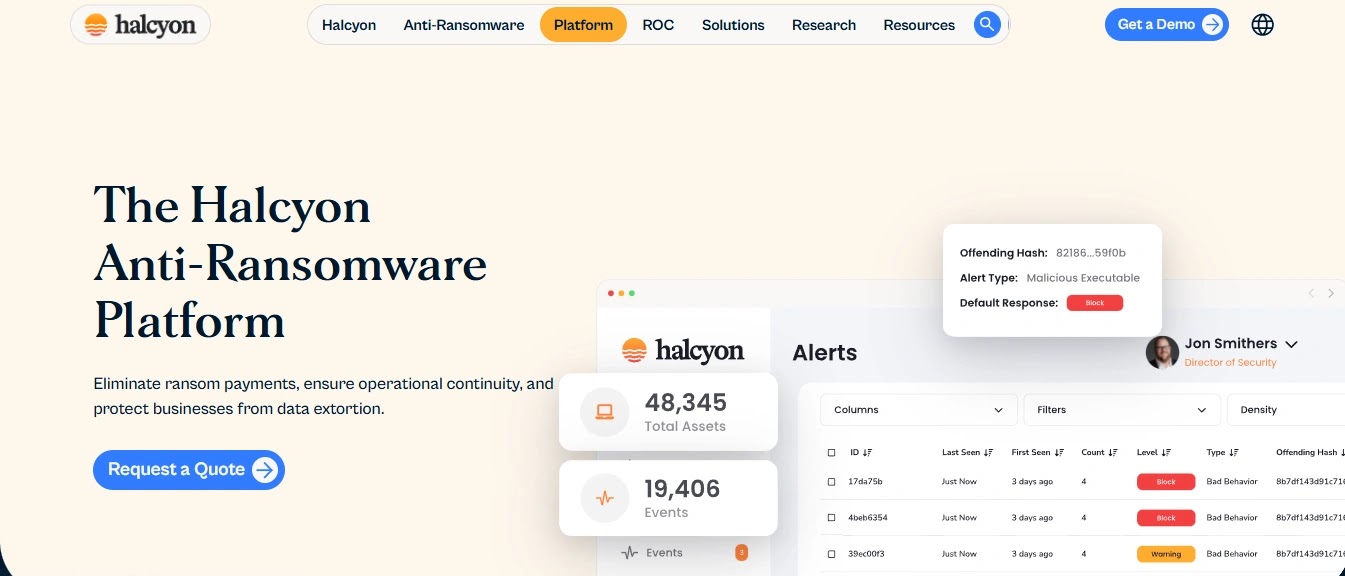
Halcyon operates as a specialized anti-ransomware platform designed to complement existing EDR solutions. It features pre-execution ransomware-specific models, key-capture capabilities for decryption if encryption begins, and exfiltration disruption, often integrated with microsegmentation tools for containment. This solution is specifically tailored to address both encryption and extortion threats.
Trade-offs: Requires an additional agent and budget line. Its overlap with advanced EDR solutions necessitates a clear justification for deployment.
Best for: High-target sectors such as healthcare, manufacturing, and local government seeking to enhance their layered defenses. Current Halcyon capabilities and packaging should be verified.
Huntress — Managed Backstop for SMBs
.webp)
Huntress offers persistent foothold detection, ransomware canaries, and 24/7 human-driven Managed Detection and Response (MDR) services, including direct contact by analysts during incidents. This is delivered at transparent, SMB-friendly pricing.
Best for: Organizations with fewer than approximately 250 endpoints and firms served by Managed Service Providers (MSPs).
Malwarebytes — Lightweight Remediation
Malwarebytes provides robust rollback and cleanup capabilities with minimal system overhead. It serves as a pragmatic security layer for smaller organizations and is highly regarded as a second-opinion scanner, adhering to core endpoint security best practices.
Best for: Small to medium-sized businesses (SMBs) and for post-incident cleanup workflows.
Recovery
Acronis — Integrated Backup and Anti-Ransomware

Acronis Cyber Protect combines immutable backup solutions with active ransomware protection designed to specifically defend backup files, which are frequently targeted by threat actors to ensure payment.
Trade-offs: While strong in backup protection, its endpoint detection depth may not match that of leading EDR platforms. It should be considered a resilient recovery solution with an added security layer, not a standalone EDR.
Best for: Organizations looking to consolidate backup and endpoint protection, and Managed Service Providers (MSPs).
Deploying Non-Negotiable Ransomware Defenses
Effective ransomware defense extends beyond product selection to fundamental security practices:
- Activate Tamper Protection Everywhere: Ransomware groups routinely attempt to disable EDR agents. Ensure tamper protection is universally enabled; otherwise, your protection is merely advisory.
- Enforce Free Hardening Features: Proactively enable and enforce built-in security features such as Microsoft Defender ASR rules, controlled folder access, macro blocking, and disabled Office child processes. Leaving these in audit mode grants attackers an advantage.
- Treat Backups as Crown Jewels: Implement immutable or offline backups, utilize separate credentials (avoiding domain admin access to backup consoles), and enforce multi-factor authentication (MFA) on backup platforms. Regularly test actual data restores, not just backup jobs, at least quarterly.
- Ring-Fence the Blast Radius: Isolate critical assets like domain controllers, backup infrastructure, and hypervisors with segmentation and stringent policies. Address the security gap where many platform agents protect Windows guests but not the hypervisor itself (e.g., ESXi, Hyper-V).
- Rehearse Incident Response: Develop and regularly rehearse a comprehensive incident response plan. Define roles for isolation, communication with insurers and legal counsel, emergency VPN shutdown, account disabling, and access to offline contact lists. An unrehearsed plan is merely a document, not an operational capability.
Verifying Vendor Claims and Best Practices
To ensure your chosen solutions are truly effective, validate vendor claims through rigorous testing:
- Test Rollback Functionality: Conduct lab tests by detonating a benign encryptor. Measure the percentage of files successfully restored, the time taken, and the outcome when Volume Shadow Copies (VSS) are purged—a common tactic by threat actors.
- Assess Remote-Encryption Defense: Simulate an attack by encrypting a shared drive from an unprotected machine to determine if files on the protected server survive. This scenario highlights the unique capabilities of solutions like Sophos’s CryptoGuard.
- Inquire About Exfiltration Detection: Understand how your chosen product detects and alerts on large data transfers, such as 40GB leaving for a file-sharing site at 2 AM. If the answer is “nothing,” your exposure to data extortion remains unaddressed.
- Confirm Canary/Decoy Behavior: Ask vendors about their use of decoy files (canaries) that trigger alerts upon access, similar to Huntress’s approach. Understand what actions trigger the first alert and at what file count.
Common mistakes to avoid include: perpetually running EDR in detect-only mode, failing to implement MFA on backup consoles, deploying flat networks despite strong endpoint protection, and mistakenly believing encryption at rest protects against ransomware, which typically encrypts data on top of existing encryption.
Situational FAQ
What is the best ransomware protection in 2024?
The optimal defense is a layered stack, not a single product. This includes a prevention-grade endpoint platform (e.g., CrowdStrike, SentinelOne, Defender for Endpoint, Sophos, Bitdefender, or Trend Micro), robust hardening and privilege controls, segmentation for critical assets, immutable backup (Acronis or a dedicated solution), and for high-target sectors, a specialized anti-ransomware layer like Halcyon. Small to medium-sized businesses (SMBs) can achieve significant protection quickly with Huntress combined with a solid Endpoint Protection Platform (EPP).
Does ransomware rollback actually work?
Ransomware rollback often works, but with limitations. VSS-based rollback (e.g., SentinelOne, Bitdefender, Malwarebytes) can restore files from shadow copies, but attackers frequently purge VSS beforehand. Furthermore, rollback does not address stolen data. Sophos’s CryptoGuard journaling offers broader coverage, including remote encryption. Always test rollback capabilities in a lab environment rather than relying solely on vendor demonstrations.
Is Microsoft Defender enough against ransomware?
When properly configured with E5 licensing, tamper protection, enforced ASR rules, controlled folder access, and enabled attack disruption, Microsoft Defender is genuinely strong. The primary failure points are often licensing complexities and features left in audit mode. Smaller organizations lacking dedicated IT security resources might find Sophos or a managed solution more suitable.
What is double extortion?
Double extortion occurs when attackers steal sensitive data before (or instead of) encrypting it, then threaten to publish the data unless a ransom is paid. This tactic renders backup-only strategies insufficient, as restoring files does not undo data publication. Consequently, egress monitoring, Data Loss Prevention (DLP), and rapid incident response are now as critical as encryption defense.
Do backups make ransomware protection unnecessary?
No. Backups are a necessary component of a ransomware defense strategy but are radically insufficient on their own. Threat actors frequently target backup systems first, dwell in networks long enough to compromise backups, and engage in data exfiltration regardless of an organization’s ability to restore files. Backups must be immutable, offline, secured with separate credentials, and regularly tested for restore functionality.
How much does ransomware protection cost?
Endpoint platforms are typically priced per endpoint per year. Huntress and Malwarebytes offer transparent, SMB-friendly rates. Halcyon and Acronis provide quote-based pricing per endpoint or workload. Often, the most impactful and cost-effective measure is to enforce the free hardening features already present in existing infrastructure.
What You Should Do
- Implement a Multi-Layered Defense: Do not rely on a single product. Combine a prevention-grade endpoint platform with specialized tools for rollback, containment, and recovery.
- Prioritize System Hardening: Activate and enforce all available tamper protection, Attack Surface Reduction (ASR) rules, controlled folder access, and macro blocking features.
- Secure and Test Backups: Ensure backups are immutable, stored offline or with air-gapped protection, secured with unique credentials, and protected by MFA. Conduct regular, timed restore drills.
- Segment Critical Assets: Isolate domain controllers, backup infrastructure, and hypervisors from the rest of the network to limit the potential blast radius of an attack.
- Develop and Rehearse Incident Response Plans: Establish clear roles and procedures for responding to a ransomware attack, including isolation, communication, and emergency account management. Practice these plans regularly.
Disclaimer: HackersRadar reports on cybersecurity threats and incidents for informational and awareness purposes only. We do not engage in hacking activities, data exfiltration, or the hosting or distribution of stolen or leaked information. All content is based on publicly available sources.








No Comment! Be the first one.