




Top XDR Platforms: A 2026 Buyer’s Guide
Key Takeaways Palo Alto Cortex XDR achieved the highest overall score in the 2026 XDR platform evaluation. CrowdStrike excelled in detection engineering and threat intelligence, securing the second...

Key Takeaways
- Palo Alto Cortex XDR achieved the highest overall score in the 2026 XDR platform evaluation.
- CrowdStrike excelled in detection engineering and threat intelligence, securing the second position.
- Microsoft Defender XDR offers significant economic advantages for organizations already utilizing Microsoft 365 E5 licenses.
- The fundamental decision between “native XDR” and “open XDR” should guide platform selection, depending on an organization’s existing security tool ecosystem.
- Effective XDR implementation hinges on accurate data ingestion cost modeling and a measurable reduction in analyst-required incidents.
HackersRadar’s 2026 assessment of Extended Detection and Response (XDR) platforms places Palo Alto Cortex XDR at the forefront, recognized for its comprehensive capabilities. Following closely in performance is CrowdStrike, particularly noted for its advanced detection engineering. Meanwhile, Microsoft Defender XDR presents a compelling economic case for enterprises already invested in Microsoft E5 licenses.
Table Of Content
- Key Takeaways
- The 2026 XDR Scorecard
- How We Scored
- The Question That Should Decide Your Shortlist
- The Platforms, Scored
- 1. Palo Alto Cortex XDR — 8.8/10
- 2. CrowdStrike — 8.5/10
- 3. SentinelOne Singularity — 8.3/10
- 4. Microsoft Defender XDR — 8.2/10
- 5. Trend Micro Vision One — 7.9/10
- 6. Cisco XDR — 7.4/10
- 7. Trellix — 7.4/10
- 8. Fortinet — 7.3/10
- 9. Sophos — 7.3/10
- 10. eSentire — 7.2/10
- Head-to-Head Comparisons Buyers Actually Make
- Buyer’s Guide
- Frequently Asked Questions
- What is XDR?
- What is the best XDR platform in 2026?
- What is the difference between XDR and SIEM?
- What is open XDR versus native XDR?
- Do I need XDR if I have EDR?
Modern XDR solutions are designed to consolidate security signals from diverse sources, including endpoints, network infrastructure, email systems, identity providers, and cloud environments. This integration aims to transform disparate alerts into cohesive, actionable incidents, thereby reducing alert fatigue and streamlining security operations rather than simply adding another monitoring console.
This report details the top ten XDR platforms, complete with their scores, and highlights a crucial architectural consideration that should inform any organization’s vendor shortlist.
The 2026 XDR Scorecard
| Rank | Platform | Data coverage (25%) | Correlation quality (25%) | Response automation (20%) | Openness (15%) | Operability (15%) | Total |
| 1 | Palo Alto Cortex XDR | 10 | 10 | 9 | 6 | 7 | 8.8 |
| 2 | CrowdStrike | 9 | 9 | 9 | 7 | 8 | 8.5 |
| 3 | Microsoft Defender XDR | 9 | 9 | 8 | 5 | 8 | 8.2 |
| 4 | SentinelOne Singularity | 8 | 8 | 10 | 8 | 8 | 8.3 |
| 5 | Trend Micro Vision One | 9 | 8 | 7 | 7 | 7 | 7.9 |
| 6 | Trellix | 8 | 8 | 7 | 7 | 6 | 7.4 |
| 7 | Cisco XDR | 8 | 7 | 7 | 8 | 7 | 7.4 |
| 8 | Fortinet | 8 | 7 | 8 | 5 | 8 | 7.3 |
| 9 | Sophos | 7 | 7 | 7 | 6 | 10 | 7.3 |
| 10 | eSentire Atlas XDR | 8 | 8 | 8 | 9 | 8 | 8.1 |
Weighted averages are rounded to one decimal place. These scores represent editorial assessments of documented capabilities and should not be interpreted as benchmark test results.
How We Scored
Our evaluation was based on structured research, focusing on documented capabilities rather than comparative lab testing. We did not conduct independent testing. Five key criteria were weighted to reflect their impact on whether an XDR solution genuinely reduces workload or inadvertently increases it:
- Data coverage (25%) — This criterion assesses the breadth of natively supported telemetry sources, encompassing endpoints, network devices, email systems, identity providers, cloud environments, SaaS applications, and operational technology (OT).
- Correlation quality (25%) — A critical factor, this measures how effectively raw security signals are transformed into a manageable number of high-fidelity incidents. This capability is central to the XDR promise and where platforms exhibit the most significant differentiation.
- Response automation (20%) — This evaluates the platform’s ability to execute automated playbooks, perform containment actions, and reduce the need for manual analyst intervention.
- Openness (15%) — This criterion examines whether third-party data sources are treated as integral components or merely grudgingly supported. It dictates how well an XDR solution can integrate with an existing security infrastructure without necessitating a complete overhaul.
- Operability (15%) — This assesses the day-to-day operational demands of the platform, specifically how much specialized expertise is required for its effective use.
Our assessments of correlation and coverage were informed by published MITRE ATT&CK Evaluation results, not by proprietary testing.
The Question That Should Decide Your Shortlist
The most fundamental decision in selecting an XDR platform revolves around one question: Native XDR or open XDR?
Native XDR platforms, exemplified by Palo Alto, CrowdStrike, Microsoft, SentinelOne, and Trend Micro, primarily correlate telemetry collected directly by the vendor’s own security products. This approach often leads to deeper and faster correlation due to consistent data formats controlled end-to-end by the vendor. However, maximizing value typically requires consolidating your security stack with that vendor’s endpoint, network, and cloud offerings.
In contrast, Open XDR solutions are designed to ingest and integrate third-party telemetry as a primary data source, allowing organizations to retain their existing security tools. While correlation may sometimes be less granular due to data inconsistencies across different vendors, this model avoids the disruptive “rip-and-replace” scenario.
Our candid advice is straightforward: if your organization is already substantially standardized on a single major platform vendor, a native XDR solution will likely deliver superior outcomes with less operational overhead. Conversely, for genuinely heterogeneous environments that are expected to remain so, an open XDR approach or a sophisticated Security Information and Event Management (SIEM) system enhanced with automation and detection engineering capabilities will generally be a more practical and effective choice. Attempting to force a native XDR platform to correlate data from multiple disparate vendors via generic connectors is a common pitfall, often resulting in paying premium platform prices for SIEM-level correlation. Organizations must clearly define their architectural strategy before engaging with vendors for quotes.
The Platforms, Scored
1. Palo Alto Cortex XDR — 8.8/10

Why it scores here: Palo Alto Cortex XDR achieved perfect scores in both data coverage and correlation quality. As a foundational platform that helped define the XDR category, its native integration of endpoint, network, cloud, and identity telemetry remains unparalleled in its depth.
Strengths: It offers genuine cross-source correlation that significantly reduces alert volume, coupled with robust behavioral and identity analytics. The platform is particularly effective for organizations utilizing Palo Alto firewalls, benefiting from native network context. Its operational resilience has been consistently validated.
Trade-offs: Optimal value is primarily realized within a Palo Alto-centric environment. Data ingestion pricing demands meticulous modeling to prevent budget overruns. Deployment and fine-tuning require more effort compared to endpoint-only solutions. Its openness score reflects that while third-party sources are supported, they are considered secondary.
Ideal buyer: Enterprises with a Security Operations Center (SOC) that are standardized on Palo Alto Networks products.
Verify before buying: Thoroughly model your expected data ingestion volume and associated costs.
2. CrowdStrike — 8.5/10
Why it scores here: CrowdStrike consistently ranks near the top across all evaluation criteria, distinguished by its leading detection engineering capabilities and superior threat intelligence context among all platforms reviewed.
Strengths: Built upon exceptional endpoint telemetry, the Falcon platform seamlessly extends into identity, cloud security, and log management, complementing top-tier EDR solutions. The OverWatch managed hunting service provides invaluable human expertise, while adversary attribution enriches incidents with actionable context. It also features robust API support and automation capabilities.
Trade-offs: Its modular pricing structure can lead to rapid cost accumulation as XDR surface coverage expands. Organizations must carefully model log ingestion and retention costs. The content update incident in July 2024 underscores the necessity of evaluating update-staging controls for CrowdStrike and all other vendors.
Ideal buyer: Enterprises seeking best-in-class detection capabilities complemented by a managed threat hunting layer.
Verify before buying: Clearly identify the specific modules required and accurately calculate the ingestion costs for all integrated data sources.
3. SentinelOne Singularity — 8.3/10
Why it scores here: SentinelOne Singularity achieved the sole perfect score for response automation and boasts the highest openness score among native XDR platforms. Its Singularity Data Lake demonstrates a more accommodating approach to ingesting third-party telemetry than many competitors.
Strengths: It offers robust autonomous response and rollback capabilities, supported by enterprise-grade malware protection. Its Storyline correlation automatically constructs attack narratives. The platform genuinely supports third-party data ingestion and provides good operability for teams lacking extensive security expertise.
Trade-offs: Its data coverage breadth is not as extensive as Palo Alto or Microsoft. Automated responses require careful tuning, and the platform’s broad expansion necessitates careful scope definition during procurement.
Ideal buyer: Organizations with smaller security teams that rely on automation to augment limited headcount.
Verify before buying: Confirm data lake ingestion pricing based on your anticipated log volume.
4. Microsoft Defender XDR — 8.2/10

Why it scores here: Microsoft Defender XDR provides excellent coverage and correlation across Microsoft’s expansive ecosystem, including endpoint, identity, email, cloud applications, and Azure. This strength is balanced by the lowest openness score in our evaluation, reflecting its tightly integrated nature.
Strengths: Its correlation capabilities spanning Entra ID, Office 365, Intune, and endpoints are exceptionally powerful and difficult to replicate. Built-in features for automated isolation of compromised devices significantly reduce triage workload. Inclusion in Microsoft 365 E5 offers extraordinary economic value for existing license holders, leveraging an immense telemetry advantage.
Trade-offs: Integrating third-party telemetry typically necessitates Microsoft Sentinel, which introduces separate costs and requires distinct skill sets. Licensing complexity across the various Defender products is a frequent source of confusion. The console’s interface is optimized for users familiar with the Microsoft ecosystem.
Ideal buyer: Organizations with Microsoft 365 E5 subscriptions, where this solution often becomes the de facto choice.
Verify before buying: Determine if your third-party data integration needs will require Sentinel, and accurately cost that at your expected volume.
5. Trend Micro Vision One — 7.9/10

Why it scores here: Trend Micro Vision One demonstrates strong coverage, natively correlating telemetry from endpoints, email, servers, cloud workloads, and networks. Notably, its handling of email as a data source surpasses several competitors.
Strengths: The inclusion of email as a first-class XDR source is crucial, given that a majority of attacks originate there. It provides excellent coverage for server and cloud workloads, leveraging a strong heritage in vulnerability research that bridges EDR and XDR. The platform offers good value at scale and incorporates risk insights to prioritize exposure alongside detection.
Trade-offs: Its correlation quality lags behind that of Palo Alto and CrowdStrike. The platform’s extensive breadth can complicate license scoping, and the console’s complexity mirrors this broad functionality.
Ideal buyer: Organizations where email and server workloads represent the primary attack surface.
Verify before buying: Understand the credit-based consumption model and its implications for your actual usage.
6. Cisco XDR — 7.4/10

Why it scores here: Cisco XDR offers good coverage and earned the second-best openness score. Cisco designed its XDR solution with third-party integration as a core principle, not an afterthought.
Strengths: It is genuinely open to integrating third-party telemetry, benefiting from strong network context derived from Cisco’s extensive networking estate, VPN architectures, and Secure Network Analytics. Leveraging Talos intelligence, it is well-suited for organizations with Cisco networking infrastructure but diverse security tooling.
Trade-offs: Its endpoint detection depth is not as specialized as that of leading EDR vendors. While correlation quality is good, it does not lead the market. Licensing complexity is typical of Cisco products.
Ideal buyer: Organizations with Cisco networking environments that utilize a variety of security tools.
Verify before buying: Confirm which of your existing tools are supported natively versus through generic connectors.
7. Trellix — 7.4/10

Why it scores here: Trellix demonstrates solid performance across data coverage and correlation, drawing upon the combined detection portfolios of McAfee Enterprise and FireEye, which span endpoint, network, email, and sandbox environments.
Strengths: It benefits from a broad native detection estate for correlation and a strong heritage in combating targeted attacks. On-premises deployment options are available for environments with cloud restrictions. The platform is positioned with an open architecture and a comprehensive integration library for enterprise SOC tools.
Trade-offs: The ongoing portfolio consolidation since the merger necessitates direct discussions regarding product roadmaps. Operability scored lowest, indicating that the platform demands more from administrators. New buyers should carefully compare Trellix against market leaders.
Ideal buyer: Existing Trellix customers seeking to consolidate their detection capabilities.
Verify before buying: Inquire about current portfolio naming conventions and the product roadmap.
8. Fortinet — 7.3/10
.webp)
Why it scores here: Fortinet offers good coverage and automation with high operability, primarily driven by its Security Fabric. For organizations with Fortinet solutions across their network, endpoint, email, and cloud, correlation and automated response are efficiently delivered.
Strengths: It provides excellent value within a Fortinet-centric environment, featuring automated, Fabric-wide responses that minimize human intervention. It offers strong network telemetry and is manageable by generalist IT teams.
Trade-offs: It has the lowest openness score, alongside Microsoft, meaning its value significantly diminishes outside the Security Fabric. Endpoint detection depth is not as advanced as specialized solutions. Fortinet’s history of exploited vulnerabilities, including those listed in CISA’s Known Exploited Vulnerabilities catalog, makes diligent patch management critical.
Ideal buyer: Organizations standardized on Fortinet products.
Verify before buying: Assess how much of your telemetry genuinely originates within the Fortinet Security Fabric.
9. Sophos — 7.3/10
Why it scores here: Sophos achieved the only perfect operability score on this list. Sophos XDR stands out as a platform genuinely manageable by a small IT team, a critical factor for a significant segment of the market, potentially outweighing correlation depth.
Strengths: It features an exceptionally user-friendly console and offers guided investigations for teams lacking extensive threat hunting experience. Its synchronized security integrates endpoint, firewall, and email protection effectively. It provides a clear escalation path to incident response tools and Managed Detection and Response (MDR) services. The February 2025 acquisition of Secureworks is expected to enhance its Counter Threat Unit research capabilities.
Trade-offs: Data coverage and correlation depth are not as advanced as market leaders. It is less suitable for mature SOCs requiring flexible query and hunting capabilities. Post-acquisition portfolio positioning is a relevant consideration.
Ideal buyer: Mid-market organizations without dedicated security analysts.
Verify before buying: Review retention limits for your chosen tier and understand how Secureworks capabilities will be integrated and positioned.
10. eSentire — 7.2/10
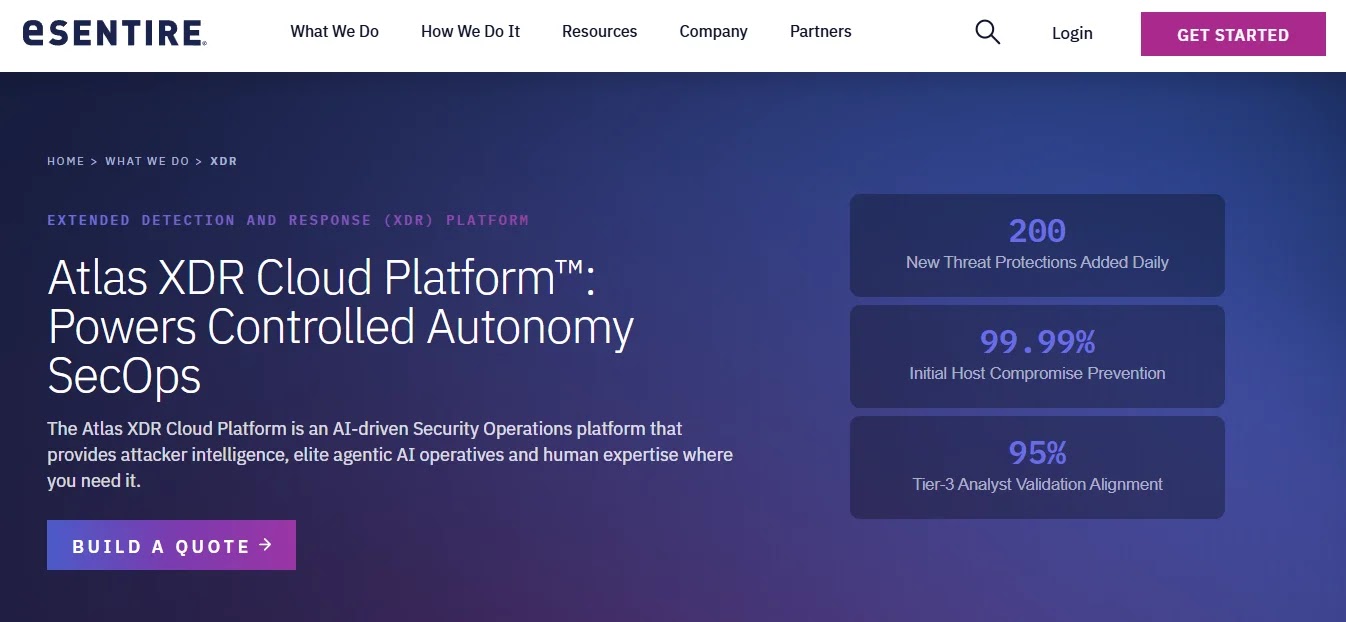
Why it scores here: eSentire’s Atlas XDR platform excels at correlating telemetry across endpoints, networks, cloud environments, identity systems, and other security sources. It combines automated detection with 24/7 security operations and expert threat hunting.
Strengths: It features an open XDR architecture and broad telemetry coverage. Its robust managed detection and response capabilities, including 24/7 threat hunting and human-led investigations, can significantly alleviate the workload for internal security teams.
Trade-offs: The platform is tightly integrated with eSentire’s managed security model. Organizations seeking a purely self-operated XDR platform should carefully evaluate the level of control and operational involvement available. Pricing is generally quote-based.
Ideal buyer: Organizations with diverse security environments that require open XDR capabilities combined with managed detection, threat hunting, and response services.
Verify before buying: Scrutinize third-party integrations, telemetry ingestion requirements, response automation features, and the precise scope of 24/7 SOC coverage included in the contract.
Head-to-Head Comparisons Buyers Actually Make
Cortex XDR — 8.8/10 vs CrowdStrike — 8.5/10. Cortex XDR provides broader native data correlation, particularly across network telemetry, while CrowdStrike offers superior endpoint telemetry, threat intelligence, and managed hunting services. For organizations already utilizing Palo Alto firewalls, Cortex XDR is often the more advantageous choice. If endpoint security is the primary concern and human-led threat hunting is a priority, CrowdStrike stands out.
Microsoft Defender XDR vs. Everyone. Within a Microsoft 365 E5 environment, Defender XDR is nearly a free solution and delivers strong performance across Microsoft’s ecosystem. The key consideration is rarely its adequacy—which it generally is—but rather the strategic implications of centralizing detection with a productivity vendor, and the additional costs associated with integrating third-party data via Microsoft Sentinel.
XDR vs. SIEM. These technologies exhibit increasing overlap and convergence. XDR streamlines the correlation of security telemetry into actionable incidents with less engineering effort. SIEM, conversely, ingests all logs, including non-security data, but typically requires organizations to build and maintain their own detections. Most mature organizations deploy both. Smaller teams should prioritize XDR, as an untuned SIEM often fails to deliver meaningful security insights.
Buyer’s Guide
- Audit your telemetry sources before taking quotes. Create a detailed inventory of all security telemetry sources you need correlated—endpoints, firewalls, email, identity providers, cloud accounts, SaaS applications—and identify which are natively supported by each vendor. This analysis will rapidly narrow down your shortlist more effectively than any feature comparison.
- Model ingestion cost explicitly. XDR pricing is increasingly tied to data volume, a common area for budget overruns. Obtain a written estimate based on your actual log volume, including a clear policy for overage charges.
- Measure alert reduction in the proof of concept. The most critical metric is the weekly number of incidents requiring analyst attention, compared to your current tooling. If an XDR solution does not reduce this number, it is not fulfilling its primary objective.
- Decide the native-versus-open question first. This is an architectural decision that dictates all subsequent choices, including the long-term suitability of the chosen platform.
- Common mistakes: These include implementing XDR without incorporating identity telemetry, a critical vector in modern attacks; assuming XDR negates the need for Managed Detection and Response (MDR) when continuous oversight is still necessary; and paying premium platform prices for poor correlation of third-party data.
Frequently Asked Questions
What is XDR?
Extended Detection and Response (XDR) integrates security telemetry from various sources—such as endpoints, networks, email, identity, and cloud environments—into unified incidents. It applies analytics across this combined data, moving beyond siloed alerts from individual security tools. The primary goal is to generate fewer, higher-quality incidents, thereby reducing alert fatigue and improving response efficiency.
What is the best XDR platform in 2026?
Palo Alto Cortex XDR ranked highest for its comprehensive data coverage and deep correlation capabilities. CrowdStrike is a strong contender, excelling in detection engineering and threat intelligence. Microsoft Defender XDR is the most practical choice for organizations already leveraging Microsoft 365 E5. For smaller teams prioritizing automation, SentinelOne Singularity offers the strongest autonomous response features.
What is the difference between XDR and SIEM?
XDR focuses on correlating security telemetry into pre-defined incidents, typically leveraging vendor-provided and maintained detection content. SIEMs, conversely, ingest logs from virtually any source, including non-security data, and generally require organizations to develop and fine-tune their own detection rules. XDR offers quicker time-to-value, while SIEM provides greater flexibility and is often essential for compliance-driven log retention. Many mature organizations utilize both.
What is open XDR versus native XDR?
Native XDR platforms primarily correlate telemetry collected by the vendor’s own security products, enabling deeper and faster correlation but often requiring vendor consolidation. Open XDR, on the other hand, treats third-party telemetry as a first-class data source, allowing organizations to maintain their existing tools, though correlation may be less granular. The choice depends on the existing standardization level of your security estate.
Do I need XDR if I have EDR?
Not necessarily. If endpoint security is your primary concern and your security team is small, a robust EDR solution with strong automation might suffice. XDR becomes essential when attack paths span multiple surfaces—e.g., from phishing to endpoint to identity to cloud—and you require a unified view of these interconnected events. Most EDR vendors offer XDR as an
Disclaimer: HackersRadar reports on cybersecurity threats and incidents for informational and awareness purposes only. We do not engage in hacking activities, data exfiltration, or the hosting or distribution of stolen or leaked information. All content is based on publicly available sources.







No Comment! Be the first one.