




Top 10 Network Security Policy Management Tools for 2026
Key Takeaways Tufin leads our 2026 Network Security Policy Management (NSPM) tool evaluation, closely followed by AlgoSec, for comprehensive multi-vendor support and advanced automation capabilities....

Key Takeaways
- Tufin leads our 2026 Network Security Policy Management (NSPM) tool evaluation, closely followed by AlgoSec, for comprehensive multi-vendor support and advanced automation capabilities.
- FireMon excels in real-time change detection, crucial for continuous compliance and identifying unauthorized policy modifications.
- Skybox Security ceased operations in February 2025; its technology assets were acquired by Tufin, with no support transfer for existing Skybox customers, necessitating immediate migration planning for affected organizations.
- NSPM tools are critical for managing complex, hybrid network security policies, reducing misconfigurations, streamlining compliance, and automating rule lifecycle management across diverse environments.
In our comprehensive 2026 assessment of Network Security Policy Management (NSPM) tools, Tufin emerges as the top performer, demonstrating exceptional breadth in device support. AlgoSec closely follows, distinguishing itself with superior application-centric automation. Meanwhile, FireMon stands out for its robust real-time change detection capabilities.
Table Of Content
- Key Takeaways
- The 2026 NSPM Scorecard
- How We Scored
- Why NSPM Matters More Every Year
- The 10 Best NSPM Tools, Scored
- 1. Tufin — Score 9.0/10
- 2. AlgoSec — Score 9.0/10
- 3. FireMon — Score 8.7/10
- 4. Forward Networks — Score 8.2/10
- 5. RedSeal — Score 8.1/10
- 6. Palo Alto Networks — Score 7.8/10
- 7. Cisco — Score 7.4/10
- 8. ManageEngine — Score 6.8/10
- 9. Indeni — Score 6.4/10
- 10. Skybox Security — Discontinued
- Head-to-Head: The Comparisons That Decide It
- How to Choose an NSPM Platform
- Frequently Asked Questions
- What is network security policy management (NSPM)?
- What is the best NSPM tool in 2026?
- Is Skybox Security still available?
- Do I need NSPM if I only use one firewall vendor?
- How much do network security policy management tools cost?
- How do NSPM tools reduce risk?
- What You Should Do
NSPM solutions are designed to streamline the discovery, analysis, and automation of firewall and security policies across complex, multi-vendor environments. These tools are instrumental in eliminating redundant rules, ensuring regulatory compliance, and facilitating policy changes without disrupting production systems. Our evaluation identifies the ten leading platforms, along with a critical market shift that organizations must consider before making any purchasing decisions.
The 2026 NSPM Scorecard
| Rank | Solution | Multi-vendor coverage (25%) | Automation (25%) | Risk & compliance (20%) | Visibility/modelling (20%) | Usability (10%) | Total |
| 1 | Tufin | 10 | 9 | 9 | 8 | 8 | 9.0 |
| 2 | AlgoSec | 9 | 10 | 9 | 8 | 8 | 9.0 |
| 3 | FireMon | 9 | 8 | 9 | 9 | 8 | 8.7 |
| 4 | Forward Networks | 8 | 7 | 8 | 10 | 8 | 8.2 |
| 5 | RedSeal | 8 | 6 | 9 | 10 | 7 | 8.1 |
| 6 | Palo Alto Networks | 6 | 9 | 8 | 8 | 9 | 7.8 |
| 7 | Cisco | 6 | 8 | 8 | 8 | 7 | 7.4 |
| 8 | ManageEngine | 7 | 6 | 7 | 6 | 9 | 6.8 |
| 9 | Indeni | 5 | 7 | 6 | 7 | 7 | 6.4 |
| 10 | Skybox Security | — | — | — | — | — | See note |
Weighted averages rounded to one decimal.
Important Market Note: Skybox Security ceased its operations in February 2025. Its technological assets were subsequently acquired by Tufin. Crucially, existing Skybox deployments did not receive any transfer of support. If Skybox Security appears on a vendor shortlist, it should be treated as an urgent migration requirement rather than a procurement option. Organizations should directly verify with Tufin regarding any available migration pathways for their specific modules. Many comparative articles in the market continue to incorrectly list Skybox as an active solution, which is no longer the case.
How We Scored
Our evaluation is a structured, research-driven assessment, distinct from practical lab testing. The scoring criteria reflect the primary challenges and priorities of NSPM buyers:
- Multi-vendor coverage (25%): NSPM’s core purpose is managing diverse infrastructure. We prioritized comprehensive support for leading vendors like Palo Alto, Cisco, Fortinet, Check Point, Juniper, alongside cloud-native security groups and Software-Defined Networking (SDN).
- Automation (25%): This criterion assesses capabilities for zero-touch change implementation, automated rule recertification, and efficient decommissioning workflows.
- Risk and compliance (20%): Focuses on rule risk scoring, adherence to regulatory frameworks (e.g., PCI DSS, NIST, ISO 27001), and the ability to generate audit evidence.
- Visibility and modelling (20%): Examines capabilities such as network topology mapping, path analysis, and the ability to determine network reachability (“can A communicate with B, and how?”) without direct network interaction.
- Usability (10%): Evaluates the platform’s time-to-value and ease of operation for typical network engineers.
Why NSPM Matters More Every Year
Rule bases expand relentlessly. Most enterprise firewall configurations contain thousands of rules, a significant portion of which are often redundant, shadowed, overly permissive, or linked to applications that are no longer in use. The reluctance to delete rules stems from the inability to confidently predict the impact of such changes. NSPM tools address this by providing usage data and path analysis, making rule cleanup a common initial project that quickly demonstrates return on investment.
Hybrid environments have rendered manual policy management obsolete. Today, a single policy change must be consistently applied across on-premises next-generation firewalls, cloud security groups, Kubernetes network policies, and Secure Access Service Edge (SASE) solutions. Attempting to manage this manually across multiple consoles inevitably leads to misconfigurations, which remain a primary cause of security exposures.
Auditors demand verifiable evidence, not just screenshots. Manually demonstrating continuous compliance across a heterogeneous, multi-vendor environment can consume weeks during each audit cycle. Automated evidence generation capabilities frequently serve as the key justification for NSPM budget allocation.
The 10 Best NSPM Tools, Scored
1. Tufin — Score 9.0/10
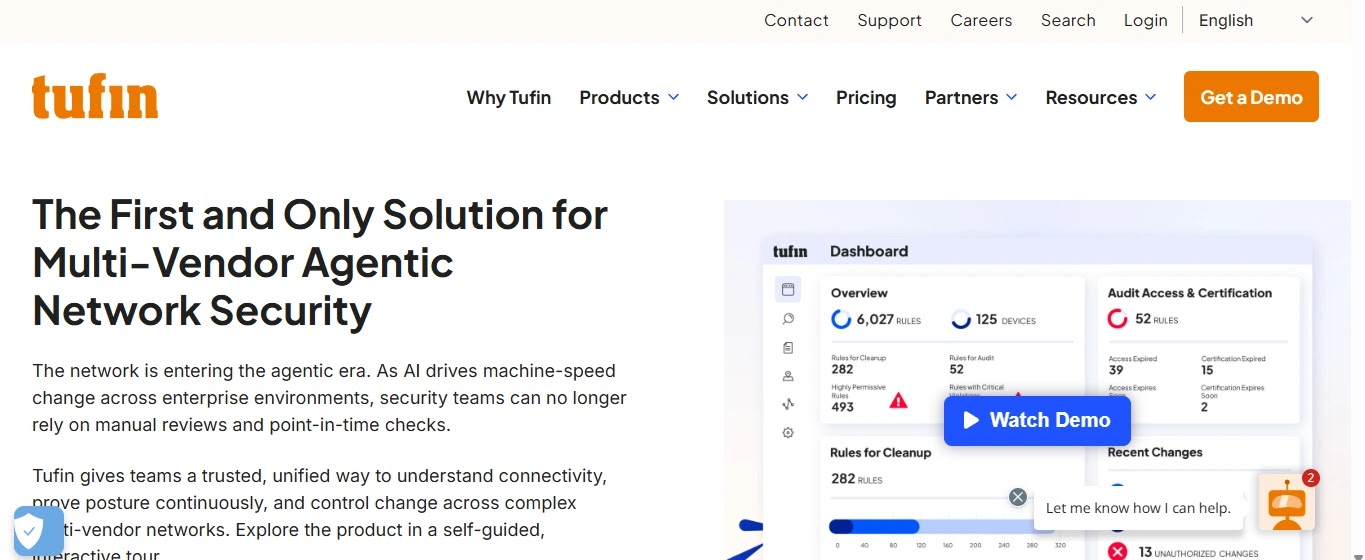
Why it scores here: Tufin distinguishes itself with the broadest device support within the NSPM category, a position further solidified by its acquisition of Skybox Security’s technology assets following Skybox’s cessation of operations in February 2025.
Strengths: Offers the most extensive multi-vendor firewall and cloud coverage. The Tufin Orchestration Suite automates the entire change process, from request to implementation, incorporating risk analysis at each step. It provides robust topology modeling and mature compliance reporting.
Trade-offs: Features enterprise-grade pricing and requires a significant implementation effort, indicating a project rather than a simple installation. Its interface is functional but lacks modern aesthetics. Smaller organizations might find the solution overly comprehensive.
Ideal buyer: Large enterprises managing genuinely heterogeneous firewall infrastructures and adhering to formal change management processes.
Verify before buying: Confirm the precise integration status of Skybox capabilities versus those still on the roadmap, especially if these features are critical to your needs.
2. AlgoSec — Score 9.0/10

Why it scores here: AlgoSec achieves the highest automation score due to its unique application-centric model. It maps policy to applications, enabling change requests in business terms (e.g., “this application needs to connect to that database”) rather than technical IP and port definitions.
Strengths: Facilitates application-centric change management accessible to non-network stakeholders. Provides exceptional zero-touch change automation and robust risk analysis prior to implementation. Offers strong coverage for cloud and SDN environments.
Trade-offs: Realizing the full benefits of application discovery requires an initial investment. It comes with premium pricing, and organizations may need to adapt culturally to its application abstraction approach.
Ideal buyer: Enterprises with numerous application owners frequently requesting network changes, particularly those with DevOps-adjacent workflows.
Verify before buying: Evaluate the accuracy of its application discovery against your actual application estate during a Proof of Concept (POC).
3. FireMon — Score 8.7/10
.webp)
Why it scores here: FireMon offers best-in-class real-time change detection. It continuously monitors security policies, flagging out-of-band changes in near real-time, which is crucial for identifying emergency rules that were never removed and pose ongoing risks.
Strengths: Provides real-time change monitoring and alerting. Delivers excellent rule usage analytics, invaluable for policy cleanup projects. Offers strong compliance assessment capabilities and a robust API for integration into automation pipelines.
Trade-offs: Its automation depth for complex, multi-step changes trails AlgoSec. Customizing reports may require professional services. Pricing scales based on the number of managed devices.
Ideal buyer: Security teams with a primary focus on continuous compliance and the detection of unauthorized policy changes.
Verify before buying: Evaluate the device-count licensing model against the size and growth of your network estate.
4. Forward Networks — Score 8.2/10

Why it scores here: Achieves the highest visibility/modelling score, tied with RedSeal. Forward Networks constructs a mathematically precise digital twin of the network, enhancing security posture by verifying intent (e.g., “confirm no path exists from the guest VLAN to the cardholder environment”) rather than merely inspecting configurations.
Strengths: Offers formal verification of network behavior, going beyond simple configuration review. Exceptionally strong for troubleshooting and pre-change validation. Integrates routing, switching, cloud, and security policies. Provides excellent search capabilities across the entire network state.
Trade-offs: Less focused on change implementation automation compared to Tufin or AlgoSec; it primarily informs what will happen, often requiring changes to be pushed via other tools. Features premium pricing, and its value is contingent on comprehensive modeling coverage for your specific device types.
Ideal buyer: Organizations with complex networks where path analysis is critical, and teams requiring robust pre-change validation.
Verify before buying: Confirm the exact device and cloud platform modeling coverage for your specific network estate.
5. RedSeal — Score 8.1/10
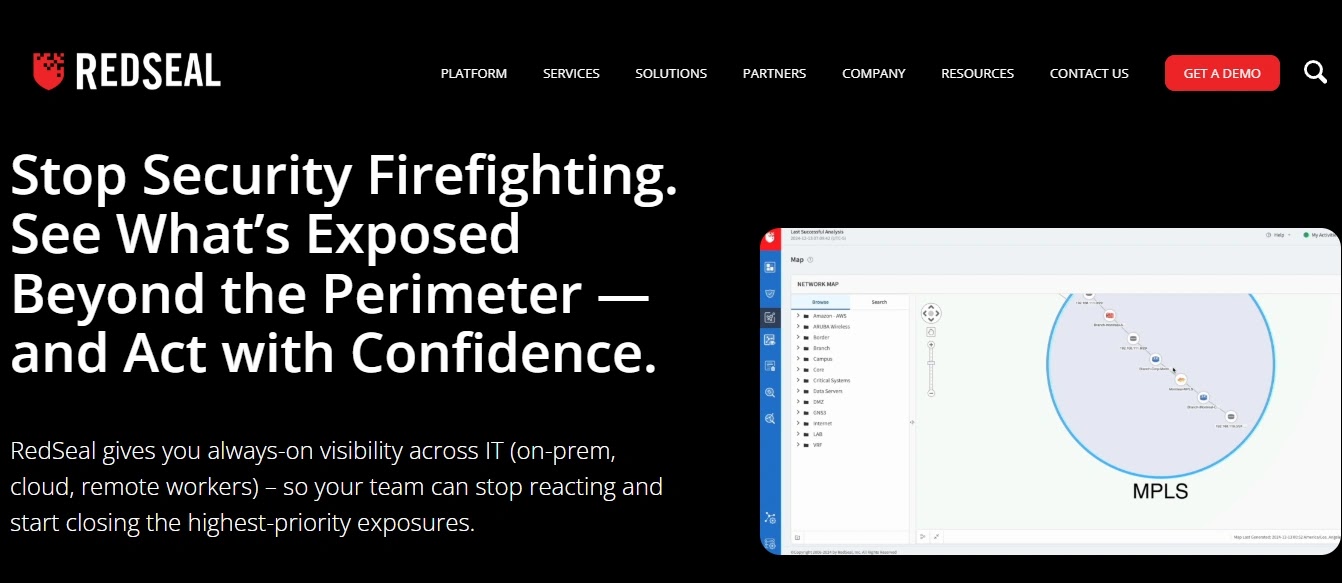
Why it scores here: Provides exceptional attack-path modeling, backed by a strong track record in the public sector. RedSeal determines how an attacker could move through your network, using advanced attack path analysis and risk modeling based on current policies and identified vulnerabilities to generate a defensible risk posture, rather than just a list of rules.
Strengths: Offers best-in-class attack path analysis. Provides strong compliance and network resilience scoring. Has a long-standing history of adoption in government and defense sectors. Excellent for demonstrating the effectiveness of network segmentation to auditors.
Trade-offs: Its change automation capabilities are less developed compared to the top three solutions. The user interface appears somewhat dated. Deployment and fine-tuning require considerable effort.
Ideal buyer: Government, defense, critical infrastructure organizations, and any entity needing to rigorously prove the efficacy of its network segmentation.
Verify before buying: Confirm current product packaging and cloud coverage details.
6. Palo Alto Networks — Score 7.8/10

Why it scores here: Delivers excellent automation and usability, though its scope is intentionally limited to Palo Alto’s own ecosystem. Panorama centralizes policy management across Palo Alto firewalls and Prisma Access, optimizing rules within a broader next-generation firewall architecture, including recommendations to convert legacy port-based rules to application-based ones.
Strengths: Provides deep, native policy optimization and identifies unused rules. Offers a single console for on-premises, cloud, and SASE within the Palo Alto portfolio. Features excellent usability and requires no additional vendor procurement.
Trade-offs: By design, it is a single-vendor solution and not an NSPM tool for heterogeneous environments. Organizations with mixed firewall vendors will still require an overarching multi-vendor NSPM layer.
Ideal buyer: Organizations standardized on Palo Alto Networks that do not require multi-vendor policy abstraction.
Verify before buying: Confirm whether your current estate is truly single-vendor and if it is projected to remain so.
7. Cisco — Score 7.4/10
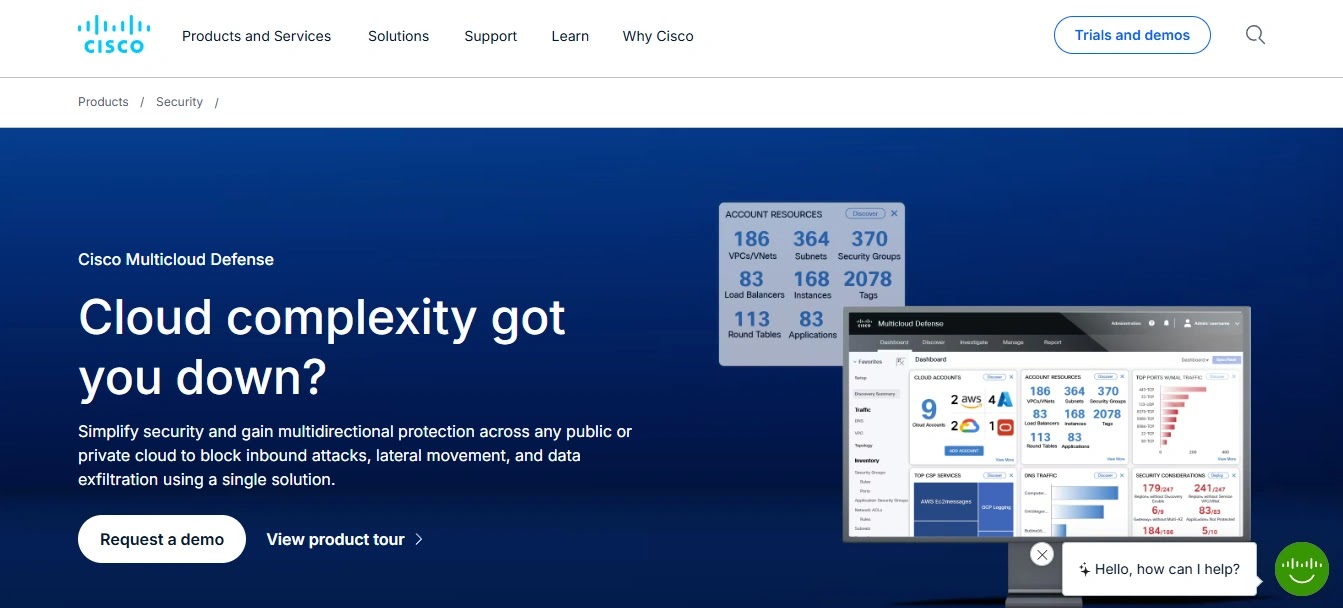
Why it scores here: Offers robust automation within the Cisco ecosystem through Security Cloud Control and Firewall Management Center. It effectively reduces the vulnerability surface across Cisco infrastructure by integrating deeply with Cisco’s broader networking and identity stack.
Strengths: Provides unified management for Secure Firewall estates. Integrates well with Cisco identity and network access control solutions. Offers cloud-delivered management options and is highly suitable for organizations already standardized on Cisco.
Trade-offs: Primarily focused on Cisco products. Historical fragmentation of management consoles means it’s crucial to confirm current device support. Multi-vendor environments will still require a dedicated NSPM solution.
Ideal buyer: Cisco-standardized networks seeking native, centralized policy management.
Verify before buying: Confirm the current naming of management platforms and the migration path for your specific generation of Cisco devices.
8. ManageEngine — Score 6.8/10

Why it scores here: Offers the best usability and lowest entry price in the category. Firewall Analyzer provides rule analysis, change tracking, and compliance reporting, making NSPM accessible to mid-market teams focusing on endpoint and firewall log management. It uniquely provides published pricing, a rarity in this segment.
Strengths: Features transparent and affordable licensing. Offers rapid deployment. Provides strong log analysis and bandwidth reporting in addition to policy management. Supports a broad range of basic multi-vendor environments and is easy for smaller teams to operate.
Trade-offs: Focuses more on analysis and reporting rather than deep change automation. Risk modeling capabilities are less advanced than leading solutions. Not designed for very large or highly complex network estates.
Ideal buyer: Mid-market organizations seeking firewall rule visibility and audit reporting without undertaking an extensive enterprise project.
Verify before buying: Confirm the depth of device support for your specific firewall models and the current pricing tiers.
9. Indeni — Score 6.4/10
Why it scores here: Indeni offers a valuable but more specialized solution: automated health and configuration validation for security infrastructure. It proactively identifies configuration drift and potential vulnerability risks before they lead to outages.
Strengths: Excels in automated maintenance and knowledge-driven checks. Highly effective at detecting configuration drift and pre-failure conditions. Complements, rather than replaces, a comprehensive NSPM platform.
Trade-offs: Features narrower device coverage. It is not a full policy orchestration or change automation platform. Has a smaller market presence. It is advisable to confirm current product direction and support commitments before committing.
Ideal buyer: Teams seeking automated device health and configuration drift detection to augment an existing policy management tool.
Verify before buying: Confirm the current company and product status, as well as the list of supported devices.
10. Skybox Security — Discontinued

Status: Skybox Security ceased all operations in February 2025. Its technology assets were acquired by Tufin; however, existing Skybox customers did not receive a support transfer.
What to do if you run Skybox: Treat this situation as an urgent, active migration project. Organizations should prioritize exporting their policy model, rule risk data, and compliance history while their environment remains functional, as no vendor support is available. Evaluate Tufin, AlgoSec, and FireMon as potential replacements, with FireMon and Tufin generally offering the closest functional parallels for attack-surface and rule-risk workflows. Organizations should prioritize remediating firewall policy gaps during this transition.
Head-to-Head: The Comparisons That Decide It
Tufin vs. AlgoSec. These are the two industry leaders, differentiated by their philosophical approaches. Tufin focuses on devices and rules, offering the broadest coverage across diverse estates. AlgoSec, conversely, adopts an application-centric view, providing a more refined automation path from request to implementation. Choose Tufin if your primary challenge is managing a sprawling multi-vendor environment. Opt for AlgoSec if your bottleneck is the volume of change requests from application owners.
FireMon vs. Tufin. FireMon excels in real-time change detection and rule usage analytics. Tufin, however, leads in overall breadth and the depth of its change orchestration capabilities. Teams prioritizing continuous compliance and the immediate detection of unauthorized changes often find FireMon to be the more suitable choice.
Forward Networks vs. RedSeal. Both platforms distinguish themselves by modeling the network rather than merely reviewing configurations. Forward Networks is superior for operational verification and troubleshooting across routing and cloud environments. RedSeal, on the other hand, is stronger for attack-path risk analysis and possesses greater credibility within the public sector. Neither solution serves as a direct replacement for a change automation platform.
Native tools vs. dedicated NSPM. Solutions like Palo Alto Panorama and Cisco’s management platforms offer excellent capabilities within their respective ecosystems, often at no additional cost. However, the moment an organization incorporates a second firewall vendor or cloud security groups into its infrastructure, native tools become insufficient. This marks the clear dividing line where a dedicated NSPM solution becomes essential.
How to Choose an NSPM Platform
Accurately assess your vendor landscape, including cloud. AWS security groups, Azure Network Security Groups (NSGs), and Kubernetes network policies all represent types of firewall policy. If these are within your scope, ensure to confirm the depth of coverage during a Proof of Concept (POC) rather than relying solely on datasheets.
Determine your primary objective: cleanup, automation, or proof. Rule cleanup (through usage analytics), change automation (via workflows and zero-touch implementation), and compliance proof (through evidence generation and attack-path modeling) are distinct but overlapping functionalities. Prioritize these needs, as your ranking will guide your vendor selection.
Insist on a POC using your actual rule base. Import your real-world configurations into the candidate platforms. The discrepancies among vendors in parsing accuracy, object resolution, and NAT handling within a complex, live environment are significantly greater than any datasheet might suggest.
Allocate budget for services and process, not just licenses. Implementing an NSPM solution fundamentally alters how change management operates. The most effective tools are those whose workflows are genuinely adopted by the organization, making this as much a process transformation project as it is a software deployment.
Common mistakes to avoid: Purchasing automation before thoroughly cleaning up your existing rule base (which only accelerates the automation of a messy environment); limiting the scope to perimeter firewalls while neglecting microsegmentation and cloud policy; and relying on outdated articles that still recommend discontinued vendors.
Frequently Asked Questions
What is network security policy management (NSPM)?
Network Security Policy Management (NSPM) is the practice of discovering, analyzing, automating, and auditing security policies, primarily firewall rules, across diverse multi-vendor and hybrid IT environments. NSPM tools are designed to identify redundant or risky rules, automate change workflows with pre-change risk assessments, model network paths, and generate robust compliance evidence.
What is the best NSPM tool in 2026?
In our 2026 evaluation, Tufin and AlgoSec share the top position. Tufin excels due to its extensive multi-vendor coverage for heterogeneous estates, while AlgoSec leads in application-centric change automation. FireMon is recognized for its superior real-time change detection, and both Forward Networks and RedSeal are noted for their advanced network modeling and attack-path analysis capabilities.
Is Skybox Security still available?
No, Skybox Security is no longer available. The company ceased operations in February 2025, and its technology assets were acquired by Tufin. Importantly, existing Skybox customers did not receive a transfer of support. Organizations currently utilizing Skybox should view migration as an urgent project and consider Tufin, AlgoSec, or FireMon as potential replacements.
Do I need NSPM if I only use one firewall vendor?
In many cases, a dedicated NSPM solution may not be strictly necessary if you exclusively use a single firewall vendor. Native management tools, such as Palo Alto Panorama or Cisco’s management platforms, often provide centralized policy management, rule optimization, and identification of unused rules within their own ecosystems without additional cost. Dedicated NSPM becomes essential when you manage multiple firewall vendors, integrate cloud security groups, or require formal, multi-team change workflows.
How much do network security policy management tools cost?
Enterprise-grade NSPM platforms are typically priced on a quote-basis, with licensing often tied to the number of managed devices. For significant estates, annual costs commonly range from five to six figures. ManageEngine Firewall Analyzer is an exception, offering published pricing suitable for the mid-market. It is crucial to budget for implementation services in addition to the software licensing fees.
How do NSPM tools reduce risk?
NSPM tools reduce risk by identifying overly permissive, shadowed, and unused rules that contribute to an expanded attack surface. They perform critical risk analysis before any changes are implemented, rather than after, and detect out-of-band modifications. Furthermore, these tools can model whether network segmentation truly prevents the specific attack paths it is designed to block. Since misconfiguration is a leading cause of security exposures, NSPM tools directly address and mitigate this fundamental risk.
What You Should Do
- For organizations currently using Skybox Security, initiate an immediate migration plan. Prioritize exporting all policy models, rule risk data, and compliance history while your system is still operational, as vendor support is no longer available.
- Evaluate Tufin, AlgoSec, and FireMon as primary replacement candidates for Skybox, noting that FireMon and Tufin are often the closest functional matches for attack-surface and rule-risk management.
- Before adopting any NSPM solution, honestly assess your entire network estate, including all cloud security groups and Kubernetes network policies, to ensure comprehensive multi-vendor coverage.
- Clearly define your organization’s primary NSPM objective—whether it’s rule cleanup, change automation, or compliance proof—as this will significantly influence the most suitable vendor choice.
- Always insist on a Proof of Concept (POC) using your actual network configurations to evaluate a vendor’s parsing accuracy, object resolution, and NAT handling capabilities in a real-world scenario.
- Budget not only for software licenses but also for implementation services and process re-engineering, as successful NSPM adoption requires organizational workflow adjustments.
Disclaimer: HackersRadar reports on cybersecurity threats and incidents for informational and awareness purposes only. We do not engage in hacking activities, data exfiltration, or the hosting or distribution of stolen or leaked information. All content is based on publicly available sources.








No Comment! Be the first one.