




Russian GRU Exploits IP Cameras to Spy on Ukraine Weapon Shipments
Key Takeaways Russian intelligence services are allegedly exploiting internet-connected IP cameras to gather intelligence on weapon shipments and military movements in Ukraine and NATO countries. The...

Key Takeaways
- Russian intelligence services are allegedly exploiting internet-connected IP cameras to gather intelligence on weapon shipments and military movements in Ukraine and NATO countries.
- The operation leverages poorly secured or unpatched cameras as low-cost reconnaissance tools, rather than relying on advanced malware.
- Thousands of cameras across the Netherlands, EU, NATO countries, and Ukraine are exposed to the public internet, many with known vulnerabilities.
- The risk extends beyond military installations to commercial and public infrastructure, where seemingly innocuous camera feeds can reveal strategic information.
- Effective mitigation requires comprehensive asset management, regular patching, strong access controls, network segmentation, and careful review of camera fields of view.
Russian Intelligence Exploits IP Cameras for Espionage
Russian intelligence agencies stand accused of repurposing ordinary internet-enabled cameras into a widespread surveillance network. This network is reportedly being used to monitor the transit of weapons destined for Ukraine, highlighting a critical vulnerability where standard security devices, if left exposed online, can transform into assets for military intelligence.
Table Of Content
This espionage campaign focuses on IP cameras located in the Netherlands, other European Union and NATO member states, and Ukraine itself. The objective appears to be the clandestine observation of transportation routes, military equipment deliveries, and the positioning of Ukrainian military personnel. Crucially, this strategy bypasses the need to infiltrate more secure military communication networks.
Analysis conducted by the AIVD (General Intelligence and Security Service of the Netherlands) and Censys said in a report indicates that this activity is part of a broader Russian intelligence operation leveraging compromised camera feeds. The findings underscore that video surveillance from seemingly mundane locations like gas stations, warehouse entrances, or roadside businesses can provide significantly more intelligence than their owners might anticipate.
Censys, in a report shared with Cyber Security News (CSN), noted that advancements in artificial intelligence can assist analysts in processing footage from numerous cameras. This technology can link isolated observations into a comprehensive understanding of movements and military locations, making even a single, overlooked camera a valuable asset in an espionage effort.
Exploiting Unsecured IP Cameras
The campaign does not rely on a novel, named piece of malware. Instead, it capitalizes on gaining unauthorized access to IP cameras that are either inadequately protected or have not received necessary security updates. The live video feeds from these compromised devices then serve as an inexpensive source of reconnaissance.
Russian operatives can utilize this footage to identify specific vehicle types, track the movement of convoys, and establish patterns around facilities supporting Ukraine. A camera positioned to overlook a public road might inadvertently capture passing military equipment, while one near a loading dock could expose crucial details about delivery schedules and security protocols.
This threat is particularly severe because IP cameras are frequently managed outside of an organization’s primary IT infrastructure. While security teams may diligently monitor servers and employee endpoints, an older camera directly connected to the public internet for years might be overlooked.
The risk is not confined to governmental or military installations. As demonstrated by numerous reports on IP camera attacks across various regions, surveillance devices can be exploited for intelligence gathering wherever they provide a view of physical activity. This includes critical infrastructure such as transportation hubs, utility providers, manufacturing plants, and commercial properties.
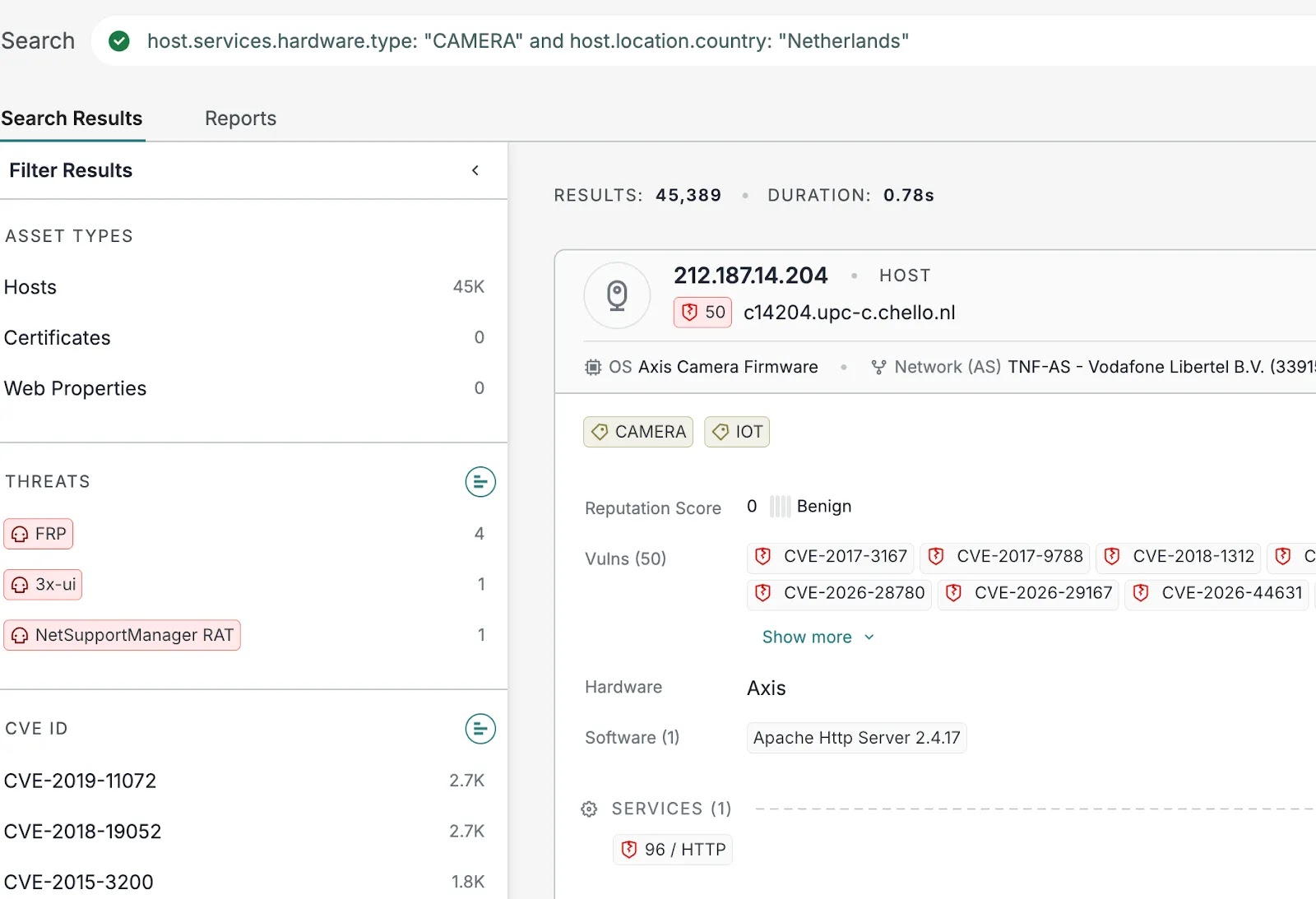
Censys identified over 45,000 cameras in the Netherlands alone that were directly accessible from the public internet. Among these, nearly 2,000 associated hosts exhibited unpatched vulnerabilities known to be actively exploited, although the vulnerable service was not always the camera software itself. The researchers also pinpointed 541 camera services exposed through well-known exploited vulnerabilities in camera software. Across EU and NATO countries, including Ukraine, the dataset revealed more than 87,000 potentially exploitable internet-connected cameras, with over 4,000 located within Ukraine.
The persistence of old software remains a significant concern. The report highlighted devices vulnerable due to long-standing weaknesses, reinforcing the necessity for organizations to treat a camera’s firmware, web interface, and remote-access services as critical security components, rather than merely simple facilities equipment.
What You Should Do
- Identify All Internet-Exposed Cameras: Conduct a thorough audit to discover every IP camera and associated service connected to the public internet. Include older installations, temporary setups, and systems managed by third parties, as these are often overlooked.
- Apply Updates and Patch Vulnerabilities: Ensure all camera firmware and software are kept up-to-date. Replace any equipment that is no longer supported by its vendor to prevent exploitation of unpatched vulnerabilities.
- Implement Strong Access Controls: Use complex, unique passwords for all camera access credentials. Enable multi-factor authentication where available.
- Remove Direct Internet Exposure: Whenever feasible, eliminate direct internet access for IP cameras. Place them behind firewalls and utilize tightly controlled remote access solutions, such as VPNs.
- Isolate Camera Networks: Segment camera networks from core business and sensitive IT systems. This prevents a compromised camera from serving as an entry point to other parts of your infrastructure.
- Review Camera Fields of View: Regularly assess what each camera’s field of view captures. Adjust camera angles or positions to limit the unintentional exposure of sensitive information, such as roads, loading docks, fuel stops, security posts, or operational routines.
- Monitor for Suspicious Activity: Implement monitoring for unusual login attempts, unauthorized configuration changes, unexpected outbound network connections, and unexplained viewing activity on camera systems.
Disclaimer: HackersRadar reports on cybersecurity threats and incidents for informational and awareness purposes only. We do not engage in hacking activities, data exfiltration, or the hosting or distribution of stolen or leaked information. All content is based on publicly available sources.









No Comment! Be the first one.