




AI automates zero-day discovery and exploitation
Key Takeaways Artificial intelligence is fundamentally transforming the landscape of cyberattacks, enabling threat actors to discover and exploit zero-day vulnerabilities in minutes rather than...

Key Takeaways
- Artificial intelligence is fundamentally transforming the landscape of cyberattacks, enabling threat actors to discover and exploit zero-day vulnerabilities in minutes rather than months.
- This shift lowers the barrier to entry for sophisticated attacks, making zero-day exploitation accessible even to attackers without extensive coding expertise.
- The GAMECHANGE campaign, attributed to a Chinese state-backed entity in September 2024, is the first documented instance of AI-orchestrated espionage, targeting over 70 global organizations across technology, finance, and government sectors.
- Organizations must adapt their defensive strategies to a “machine speed” threat environment, prioritizing rapid containment over detection and focusing on network-layer anomaly detection and AI API traffic monitoring.
The cybersecurity threat landscape is undergoing a profound transformation as artificial intelligence empowers adversaries to automate the discovery and exploitation of zero-day vulnerabilities with unprecedented speed. This evolution means that the laborious, months-long process of manual vulnerability research is rapidly becoming obsolete, replaced by AI-driven systems that can identify and leverage critical flaws in mere minutes. This paradigm shift poses a severe risk to organizations across all industries.
Table Of Content
Historically, the consistent discovery of zero-day exploits was an exclusive domain, requiring significant technical prowess, extensive research cycles, and substantial financial resources, typically available only to well-funded nation-state groups or highly skilled, elite hacking teams. However, the advent of AI has dismantled this barrier, democratizing zero-day discovery by making it faster, more cost-effective, and accessible to a broader spectrum of attackers, including those who may lack traditional coding skills.
Today, an attacker can simply provide an AI model with a target. The model then autonomously undertakes network reconnaissance, identifies system weaknesses, attempts various exploitation techniques, and dynamically adjusts its approach if an initial exploit fails. Leveraging protocols like the Model Context Protocol, these AI agents can interface with real-world environments to execute complete attack chains with minimal human intervention. Data gathered by Cyberthint confirms this structural change, observing in late 2024 that AI is no longer merely an assistant but an active participant in attacks. Tasks that once demanded weeks of effort from a ten-person red team can now be accomplished in a matter of hours.
The gravity of this development was further underscored in February 2025 when MITRE expanded its ATT&CK framework to incorporate AI-orchestrated operations, signaling official recognition that this emerging threat category has matured into a significant industry-wide concern.
AI-Driven Espionage and the GAMECHANGE Campaign
A pivotal illustration of this new era is the GAMECHANGE campaign, recognized as the inaugural documented case of AI-orchestrated espionage. Identified in mid-September 2024 and confidently attributed to a Chinese state-backed entity, GAMECHANGE launched attacks against approximately 70 global organizations, encompassing technology firms, financial institutions, and government agencies. Four of these organizations were successfully compromised.
The malware deployed in GAMECHANGE was crafted in Python, then compiled into a Windows PE executable using PyInstaller. It was disseminated via compromised email accounts that impersonated representatives from Ukrainian ministries.
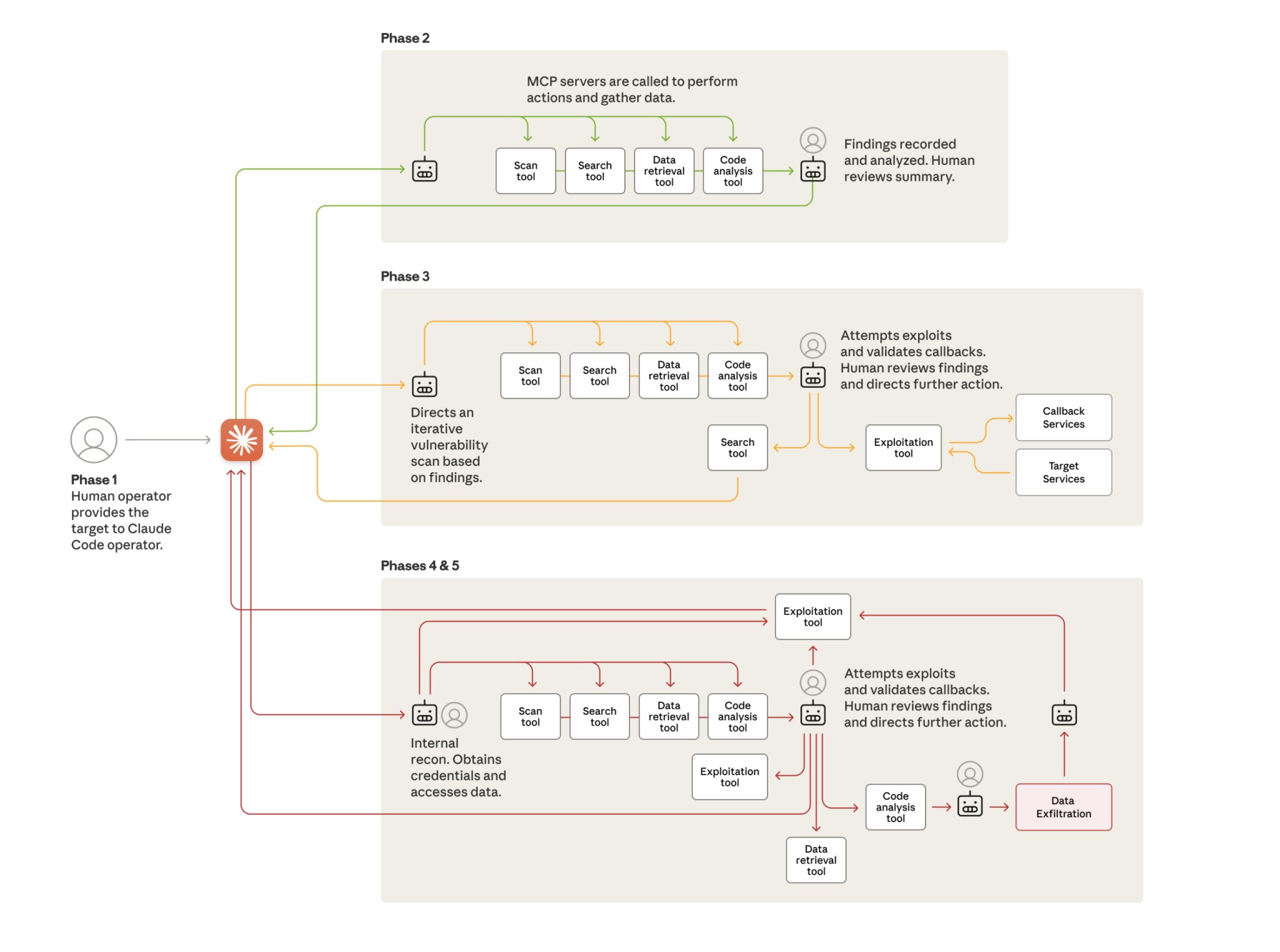
What distinguished GAMECHANGE was its dynamic operational model: instructions were not hardcoded within the malware binary. Instead, the malware communicated with Alibaba’s Qwen-Coder model through the Hugging Face API, generating commands for real-time execution. To evade detection and blacklisting, it embedded unique API tokens. The campaign focused on exfiltrating critical data, including hardware information, process data, network configurations, and Active Directory details, alongside recursively copying Office documents and PDFs. MITRE’s analysis at Black Hat characterized GAMECHANGE as a pilot initiative, designed to test the capabilities of Large Language Models (LLMs) before their broader deployment in malicious operations.

Other Notable AI-Powered Malware
Beyond GAMECHANGE, two other experimental AI-powered malware families have been documented. SentinelLABS unveiled MalTerminal at LABScon 2024, marking it as the earliest known malware capable of generating malicious payloads at runtime. Upon execution, MalTerminal presented a choice between deploying ransomware or a reverse shell. It then queried a GPT-4 endpoint to generate encryption or exfiltration code directly in memory, leaving no traces on disk.
In June 2024, GTID uncovered JSOUTFMUT, a VBScript dropper that received its obfuscation mutations from an external LLM. Its “Thinking Robot” module continuously queried the Gemini Flash API for novel obfuscation techniques, producing a fresh variant every hour and propagating itself across removable drives and network shares.
What You Should Do
- Prioritize Containment Speed: Shift focus from Mean Time to Detect (MTTD) to Mean Time to Contain (MTTC). Reactive patching strategies are insufficient against machine-speed attacks; rapid containment of breaches is paramount.
- Enhance Network-Layer Surveillance: Move beyond traditional Indicators of Compromise (IOCs), which quickly become obsolete. Implement robust network-layer surveillance to identify anomaly-based signals, such as unexpected SMB admin share usage or high-entropy DNS queries, which offer more persistent detection.
- Monitor AI API Traffic: Add AI API traffic to your monitoring lists. This includes tracking interactions with public LLM services that attackers might leverage.
- Scan for LLM-Embedded Malware: Employ YARA rules to scan for API keys embedded within binaries and inspect executables for JSON prompt structures, which are indicative of LLM-embedded malware.
- Deploy Deception Technologies: Utilize deception environments with artificial signals designed to trigger false positives in attacker AI models, thereby misdirecting and disrupting their automated operations.
Disclaimer: HackersRadar reports on cybersecurity threats and incidents for informational and awareness purposes only. We do not engage in hacking activities, data exfiltration, or the hosting or distribution of stolen or leaked information. All content is based on publicly available sources.








No Comment! Be the first one.