




XLoader Malware Uses Decoy Servers to Hide C2 Traffic
Key Takeaways XLoader, an advanced information-stealing malware, has received significant upgrades, making it substantially more difficult to detect and analyze. The malware now employs sophisticated...

Key Takeaways
- XLoader, an advanced information-stealing malware, has received significant upgrades, making it substantially more difficult to detect and analyze.
- The malware now employs sophisticated obfuscation and network encryption, including the use of 65 decoy C2 servers to conceal its true command-and-control infrastructure.
- XLoader targets web browsers, email clients, and FTP applications to exfiltrate sensitive credentials and can also execute arbitrary commands and deploy secondary payloads.
- The latest version, 8.7, continues to enhance evasion tactics, posing a persistent threat to individuals and organizations.
- Detection requires advanced network monitoring and endpoint security solutions capable of identifying subtle traffic anomalies and the specific Win32.PWS.XLoader signature.
XLoader Malware Evolves with Decoy Servers and Advanced Obfuscation
XLoader, a prevalent information-stealing malware, has undergone significant enhancements in its recent iterations, rendering it considerably more elusive to both detection and analysis. This evolution, detailed in a comprehensive report, highlights a strategic move by its developers to fortify the malware against contemporary cybersecurity defenses.
Table Of Content
Originally emerging in 2016 as a variant of the FormBook malware family, XLoader was re-launched with a new identity in early 2020. Since then, its creators have consistently pushed updates, ensuring the malware remains potent and effective in its malicious operations.
XLoader’s primary objective is to compromise web browsers, email clients, and FTP applications, facilitating the theft of passwords, cookies, and other critical credentials from infected systems. Beyond data exfiltration, the malware grants attackers the capability to execute arbitrary commands and deploy additional malicious payloads, providing extensive control over compromised hosts. Version 8.7 represents the latest observed iteration, showcasing ongoing development focused on introducing new features and evasion techniques with each release.
The malware typically infiltrates systems through phishing emails and malicious file attachments. These social engineering tactics remain highly effective, exploiting human vulnerabilities rather than relying solely on technical exploits. Once a system is compromised, XLoader operates stealthily in the background, systematically collecting credentials from popular applications such as Google Chrome and Microsoft Outlook. This stolen data is then transmitted to its command-and-control (C2) servers, utilizing an encrypted and cleverly disguised communication protocol.
Researchers at Zscaler identified these latest versions of XLoader, noting a significant shift in its obfuscation and network encryption strategies starting with version 8.1. Their analysis revealed that these updates are meticulously planned and implemented, specifically designed to thwart both automated analysis tools and the manual reverse engineering efforts of security professionals. ThreatLabz concluded that XLoader is expected to remain a substantial threat, particularly due to its enhanced stealth capabilities that allow it to bypass conventional security systems largely undetected.
How XLoader Evades Detection with Decoy C2 Infrastructure
A critical upgrade in XLoader’s operational methodology involves its sophisticated technique for obscuring its actual command-and-control (C2) servers within a vast network of decoy addresses. The malware’s code embeds 65 distinct C2 IP addresses, each individually encrypted. These addresses are only decrypted at runtime, precisely when they are about to be utilized, posing significant challenges for static analysis of the binary by security researchers.
During a communication cycle, XLoader randomly selects 16 of these 65 IP addresses. It then proceeds to send HTTP requests to each selected address sequentially. Both types of internal requests—POST requests carrying stolen credentials and GET requests fetching commands—are indiscriminately distributed across this entire pool of addresses. This strategy makes it exceedingly difficult for malware sandboxes and automated detection tools to differentiate between legitimate C2 servers and decoys without actively verifying each address through live network interaction.
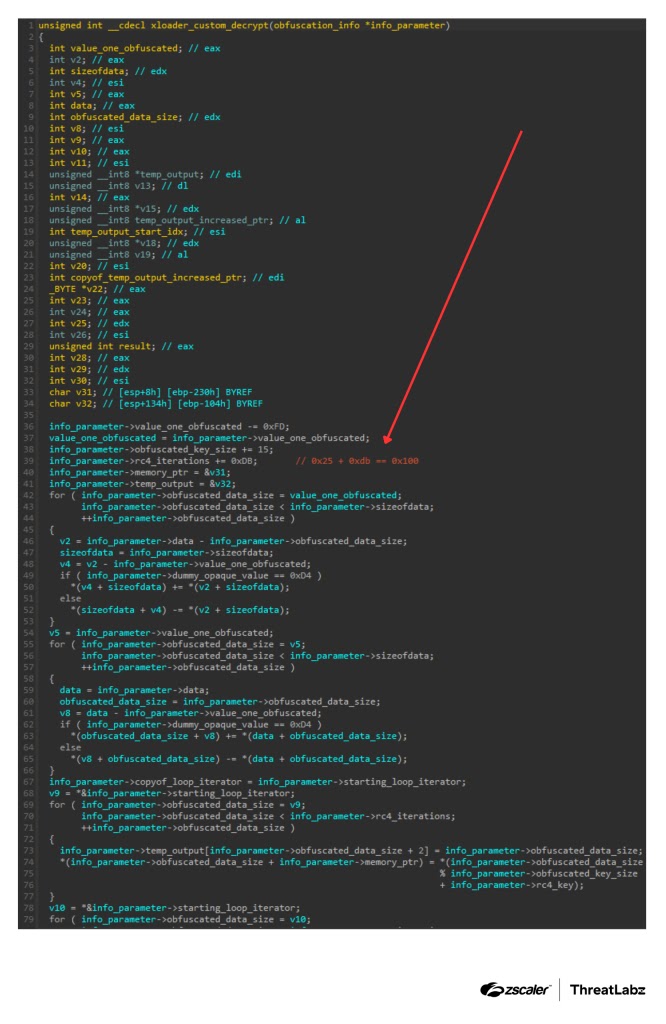
To further secure its communications, XLoader employs multiple layers of encryption, leveraging RC4 ciphers and SHA-1 hashing of the C2 URL. The encryption keys are dynamically generated from the C2 URL seed and are only disclosed at specific points during execution. This intricate process ensures that simply intercepting the traffic is insufficient to expose the malware’s underlying activities. Even though the data travels over plaintext HTTP, the robust encryption layers make decoding the actual content without the correct keys virtually impossible.
What You Should Do
- Monitor Network Traffic: Look for unusual HTTP traffic patterns, specifically repeated requests to multiple IP addresses within a short timeframe, especially if they contain Base64-encoded parameters with randomly generated names.
- Utilize Network Emulation Tools: Employ tools capable of establishing actual network connections and verifying server responses to accurately distinguish between real C2 servers and decoy addresses.
- Keep Endpoint Detection Tools Updated: Ensure all endpoint detection and response (EDR) solutions are current and configured to detect XLoader activity, which is currently tracked under the indicator Win32.PWS.XLoader.
- Strengthen Email Security: Implement robust email security gateways and user awareness training to mitigate the risk of phishing emails and malicious attachments, which are primary infection vectors.
- Regularly Patch Systems and Applications: Maintain an aggressive patching schedule for operating systems, web browsers, email clients, and FTP applications to close potential vulnerabilities that XLoader might exploit.
Disclaimer: HackersRadar reports on cybersecurity threats and incidents for informational and awareness purposes only. We do not engage in hacking activities, data exfiltration, or the hosting or distribution of stolen or leaked information. All content is based on publicly available sources.









No Comment! Be the first one.