




AI-Powered Surveillance Fuels Government Biometric Data Collection
Key Takeaways Government surveillance capabilities are rapidly expanding through AI-powered tools, biometric data collection, and commercial spyware, significantly increasing state oversight over...

Key Takeaways
- Government surveillance capabilities are rapidly expanding through AI-powered tools, biometric data collection, and commercial spyware, significantly increasing state oversight over populations.
- A recent analysis of 193 countries revealed 31 nations pose a high or very high risk for digital surveillance, with an additional 55 categorized as medium risk, often targeting political opponents, journalists, and activists.
- Foreign nationals and business travelers in high-risk regions face severe threats, including corporate data theft, intellectual property loss, reputational damage, and even physical detention due to digitally acquired intelligence.
- The proliferation of commercial spyware, with approximately 100 countries having procured such tools by April 2026, lowers the barrier for state-level intrusion and exacerbates global surveillance risks.
AI-Driven Surveillance: A Global Expansion
Government surveillance capabilities are undergoing a profound transformation, with states increasingly leveraging advanced technologies to monitor their citizens and visitors. A recent report highlights that AI-powered surveillance systems, extensive biometric data collection, and readily available commercial spyware are dramatically expanding the scope of digital oversight. This escalating trend is raising significant concerns among cybersecurity professionals and human rights organizations worldwide.
Table Of Content
A comprehensive study encompassing 193 nations has categorized 31 countries as presenting a high or very high risk for government digital surveillance. These state actors are actively exploiting telecommunications infrastructure, deploying sophisticated commercial spyware, and utilizing AI-driven tools to track individuals, particularly foreign nationals, often with minimal legal accountability. An additional 55 countries are identified as medium-risk, where surveillance is frequently directed at political opponents, journalists, and activists.
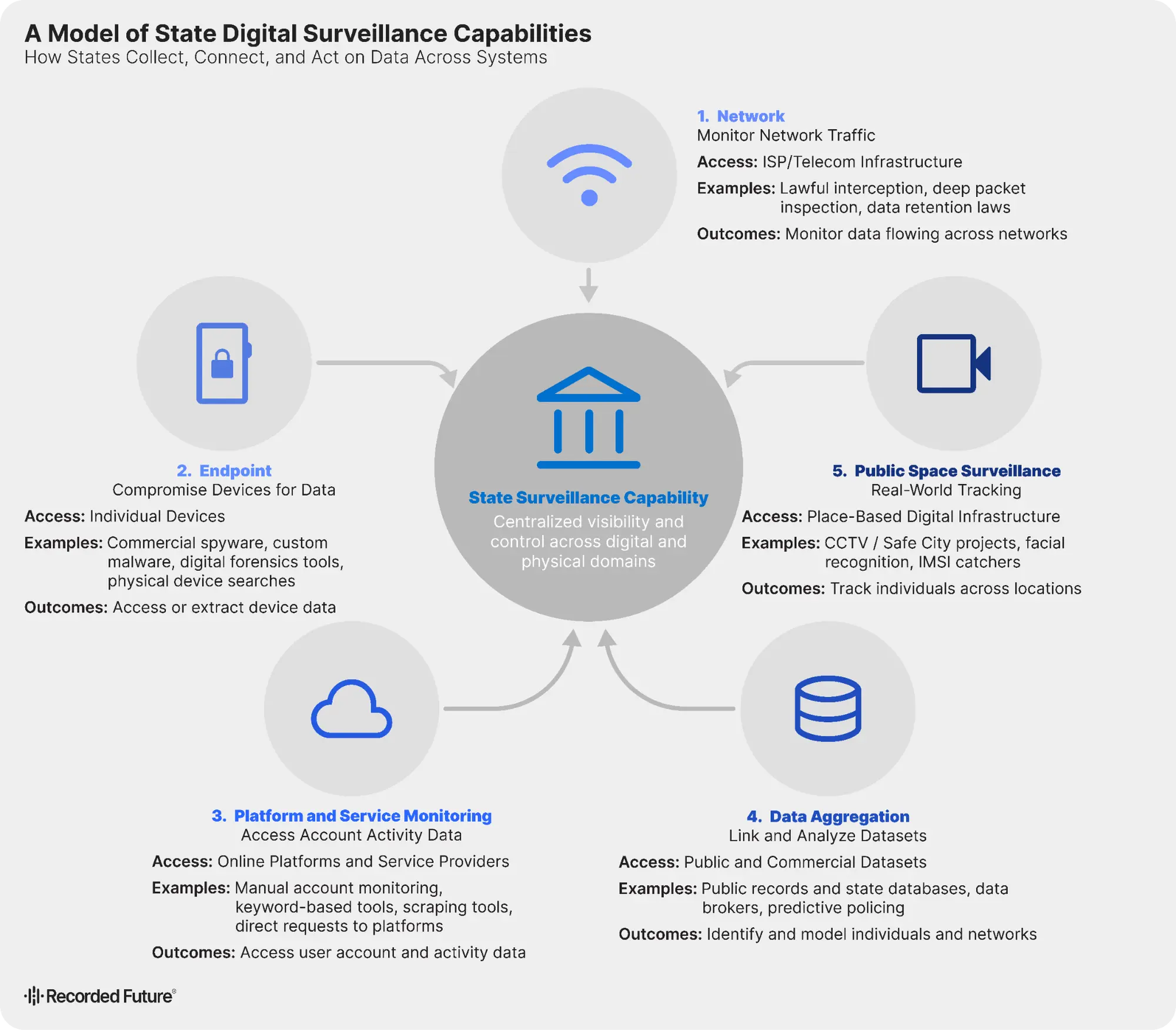
Analysts at Recorded Future detailed five primary categories of surveillance capabilities: network interception, endpoint compromise, platform-level access, public space surveillance, and data aggregation. The Insikt Group, Recorded Future’s research arm, underscored that the potential for abuse of these technologies is substantially higher in nations lacking robust independent oversight mechanisms.
For foreign nationals and business travelers, especially those venturing into high-risk jurisdictions, the exposure is critical. Potential consequences include the theft of sensitive corporate data, loss of intellectual property, severe reputational damage, and in some documented instances, physical detention based on intelligence gathered digitally. The Insikt Group explicitly warned that travelers failing to adequately prepare before entering such countries put both themselves and their organizations at considerable risk.
The convergence of commercial spyware, sophisticated AI tools, and expanding biometric databases is accelerating this threat landscape. By April 2026, the United Kingdom estimated that around 100 countries had acquired commercial spyware, indicating a significant reduction in barriers to state-level digital intrusion. Without enhanced global oversight, individuals and organizations face increasing vulnerability.
AI-Powered Public Surveillance and Biometric Data Collection
AI-driven public surveillance has become a cornerstone of government monitoring, particularly in authoritarian regimes. “Safe City” initiatives, often built with hardware from Chinese technology firms, are prevalent across cities in Africa, Central Asia, and Eastern Europe. These systems integrate facial recognition and license plate readers to establish pervasive oversight. For example, in Turkey, authorities utilized AI facial recognition in March 2025 to identify and detain demonstrators shortly after protests.
Biometric databases form a deeply intrusive layer within this surveillance architecture. Russia’s Unified Biometric System mandates that foreigners submit biometric data to a state repository when acquiring mobile services, contributing to a comprehensive digital profile compiled from at least 14 different government agencies. Similarly, Myanmar’s military has consolidated SIM card records, airport data, CCTV footage, and identity files into a single, unified database, effectively eliminating anonymity for its population.
The introduction of predictive policing tools further exacerbates these concerns. South Korea’s Dejaview system, for instance, employs historical crime data alongside real-time CCTV analysis to flag potential criminal behavior. Digital rights advocacy groups warn that such tools often violate principles of necessity and proportionality, carrying significant risks of bias against minority communities.
Commercial Spyware and Endpoint Surveillance
Beyond public surveillance, governments are increasingly deploying endpoint tools designed to directly compromise individual devices. Between 2024 and 2026, the Insikt Group uncovered evidence that at least 16 countries used Predator or Candiru spyware to target journalists and members of civil society. In February 2026, Amnesty International confirmed the targeting of an Angolan journalist with Predator, marking the first forensically verified instance against Angolan civil society.
State-built custom malware poses an even greater detection challenge. Leaked data from the Chinese firm Knownsec exposed GhostX, a Windows remote access trojan capable of screen monitoring, keystroke logging, and password extraction. Furthermore, Belarus’s KGB has been linked to ResidentBat, an active malware since at least 2021, used to extract call logs and stored files from detained activists.
The misuse of legitimate digital forensics tools is also a growing concern. In early 2026, Kazakh authorities reportedly used Cellebrite’s extraction system to unlock an activist’s phone. Concurrently, Serbian police are alleged to have used similar forensic tools to install NoviSpy spyware on detainees’ devices during interrogations. These incidents underscore how tools designed for legitimate forensic purposes can be repurposed into instruments of repression in the absence of stringent oversight.
What You Should Do
- For Very High-Risk Countries: Travel with only sterile devices, preferably stored in a Faraday bag to prevent remote access and data interception. Assume all digital communications are monitored.
- For High-Risk Countries: Utilize a reputable Virtual Private Network (VPN) for all internet traffic. Ensure all device firmware and software are patched and updated before departure. Employ end-to-end encrypted messaging and communication applications exclusively.
- For Medium-Risk Countries: Keep all applications updated to mitigate known vulnerabilities. Exercise caution with politically sensitive content online and avoid engaging in discussions that could attract state attention. Implement the strictest possible privacy settings across all social media platforms and online accounts.
- General Best Practice: Be aware of the digital footprint you leave. Consider using burner phones or temporary devices for travel, especially if carrying sensitive information. Regularly review and strengthen your personal and organizational cybersecurity posture.
Disclaimer: HackersRadar reports on cybersecurity threats and incidents for informational and awareness purposes only. We do not engage in hacking activities, data exfiltration, or the hosting or distribution of stolen or leaked information. All content is based on publicly available sources.








No Comment! Be the first one.