




Top 5 Best Tools for Simulated DDoS Attacks in 2026
Key Takeaways Distributed Denial of Service (DDoS) attacks are escalating in scale and sophistication, with a record 31.4 Tbps attack observed last year, necessitating robust defense validation....

Key Takeaways
- Distributed Denial of Service (DDoS) attacks are escalating in scale and sophistication, with a record 31.4 Tbps attack observed last year, necessitating robust defense validation.
- Simulated DDoS testing is crucial for organizations to proactively identify infrastructure vulnerabilities, validate mitigation strategies, and train incident response teams under controlled conditions.
- Cloud providers like AWS and Azure mandate the use of approved third-party partners for DDoS simulations to maintain service integrity and compliance.
- The top five DDoS simulation tools for 2026—Red Button, RedWolf Security, NimbusDDOS, Keysight BreakingPoint & CyPerf, and Cyttack.ai—offer diverse approaches, from expert-guided services to self-service platforms and in-house lab solutions.
- Effective DDoS simulations require careful planning, clear scope definition, stakeholder permission, continuous monitoring, and post-mortem analysis to maximize value and ensure safety and compliance.
The digital landscape faces an ever-present threat from Distributed Denial of Service (DDoS) attacks, which continue to grow in intensity and complexity. Last year alone witnessed an unprecedented 31.4 terabits per second (Tbps) of malicious traffic directed at a single target. This staggering volume, akin to simultaneously streaming every film available on Netflix, has prompted critical self-reflection among corporate boards, regulatory bodies, and cloud operations teams: are our current defenses truly capable of withstanding such hostile conditions?
Table Of Content
- Key Takeaways
- What is Simulated DDoS Testing and Why It Matters
- How We Picked the Winners
- 1. Red Button – Best for Expert-Guided DDoS Drills
- 2. RedWolf Security – Best Self-Service Platform with Massive Scale
- 3. NimbusDDOS – Best for White-Glove Team Training
- 4. Keysight BreakingPoint & CyPerf – Best DIY Lab Solution
- 5. Cyttack.ai – Best Emerging SaaS for Quick, Budget-Friendly Drills
- Quick Comparison at a Glance
- Honorable Mentions and Niche Options
- How to Choose the Right DDoS Testing Tool for Your Needs
- Safety, Ethics, and Legal Considerations
- Best-Practice Tips for High-Value Drills
- Conclusion
- What You Should Do
In response to this escalating threat, controlled DDoS simulations have emerged as an indispensable practice. By intentionally generating attack traffic, organizations can effectively validate their scrubbing mechanisms, pinpoint system bottlenecks, and meticulously rehearse incident response protocols long before actual adversaries strike.
While numerous online “stressers” exist, promising easy access to attack capabilities, the vast majority are either illegal or inherently unsafe. Only a select group of vetted providers possess the capability to conduct large-scale simulations without breaching cloud provider policies. Among these, Red Button’s DDoS testing stands out as an AWS-approved service. It transforms a potential crisis into a structured, educational exercise, offering critical features such as immediate kill switches, real-time expert guidance, and comprehensive, audit-ready reports.
This report will detail the methodology used to rank the top five DDoS simulation platforms for 2026, explain the rationale behind each selection, and provide guidance on conducting tests that deliver tangible value without jeopardizing production environments.
What is Simulated DDoS Testing and Why It Matters
A “DDoS simulation” refers to a meticulously controlled attack orchestrated against an organization’s own infrastructure. Rather than passively waiting for criminal elements to overwhelm bandwidth, these simulations involve deploying distributed traffic generators designed to emulate the behavior of real-world botnets. These generators bombard every layer of the network stack, from basic UDP floods to sophisticated HTTP/2 reset attacks, allowing security dashboards to illuminate and mitigation systems to prove their efficacy.
Consider these simulations as a critical fire drill for maintaining uptime. They uncover hidden choke points, confirm that rate-limiting mechanisms activate as intended, and provide invaluable practice for incident response teams. A single well-executed simulation can often expose latent dependencies that conventional load tests might miss, such as an overlooked DNS endpoint or a TLS termination node that falters under intense handshake storms.
This proactive validation is no longer merely a best practice; it is increasingly a regulatory imperative. European regulators now expect critical infrastructure providers to demonstrate resilience, while the U.S. SEC mandates public companies disclose material cybersecurity incidents within four business days. Presenting auditors with a report confirming that a 150 Gbps onslaught had no impact on customers significantly streamlines compliance discussions.
The complexities of cloud environments introduce an additional layer of consideration. Both AWS and Azure strictly prohibit customers from launching self-initiated floods from their instances. Instead, they require tests to be conducted exclusively through approved partners. Utilizing the correct tool ensures both operational safety and continued compliance with cloud provider policies.
Ultimately, simulated DDoS drills cultivate confidence. Witnessing your scrubbing service successfully repel a deliberate 50 Gbps wave transforms the anxiety associated with future headline-grabbing attacks into the calm assurance of managing a routine smoke alarm: loud, but already under control.
How We Picked the Winners
The selection process for ranking DDoS simulation platforms was not subjective; it was based on a rigorous scoring methodology. A comprehensive scoring sheet was developed, prioritizing the factors most critical to cybersecurity practitioners, allowing objective data to drive the final rankings.
Safety and compliance were paramount. A simulated attack is only beneficial if it remains fully controlled. Consequently, each vendor was evaluated on the presence of kill switches, options for gradual traffic ramp-up, and official approval from major cloud providers.
Next, attack realism was assessed. The most effective tools accurately replicate contemporary threats, ranging from widespread UDP carpet-bombing to the sophisticated HTTP/2 reset technique that set new records last year. A broad spectrum of attack vectors, frequent updates to attack libraries, and the ability to combine Layer 3, Layer 4, and Layer 7 traffic types all contributed to higher scores.
Raw firepower remained a crucial metric. We measured each service’s peak scale and geographical distribution. The ability to generate hundreds of gigabits, or even terabits, of traffic from multiple global regions scored higher than solutions limited to a single data center or lower bandwidths.
A simulation without actionable insights is merely noise. Therefore, the depth and speed of reporting were closely scrutinized. We sought platforms that could rapidly translate chaotic packet data into executive-ready narratives and clear, prioritized remediation steps.
Finally, ease of use, vendor credibility, and pricing flexibility were considered. Self-service portals earned points for operational speed, while hands-on guidance was valued for teams new to DDoS drills. Established track records and demonstrable value further enhanced scores.
All criteria were integrated into a 100-point scale. The five platforms highlighted below distinguished themselves by ensuring tests were safe, highly realistic, and provided rich, actionable information, all while remaining mindful of budget and network impact.
1. Red Button – Best for Expert-Guided DDoS Drills
Red Button’s DDoS testing, an authorized partner for both AWS and Azure, approaches DDoS simulations with the precision of a surgical procedure. Their methodology combines meticulous planning, exact execution, and a commitment to eliminating surprises.
Every engagement commences with an in-depth discovery workshop. The Red Button team collaborates with clients to delineate critical pathways, establish precise stop metrics, and formulate an attack strategy that mirrors actual adversary tactics. On the day of the test, Red Button engineers integrate into the client’s war-room bridge, verbally guiding each traffic ramp-up phase as dashboards react. Should latency or error rates exceed predetermined thresholds, they can instantly terminate the traffic flow within seconds.
This expert oversight is supported by significant technical capability. Their cloud attack network can generate approximately 300 Gbps across over 100 distinct attack vectors, sufficient to replicate ransom-grade botnets without impacting unrelated systems.
Red Button is one of the exclusive providers approved by both AWS and Azure for live DDoS simulations. This pre-clearance under provider policy streamlines the process, circumventing the need for last-minute tickets to cloud abuse desks.
Post-simulation, clients receive more than raw data. The comprehensive report integrates packet captures with an executive resiliency score, prioritized recommendations for remediation, and verifiable evidence suitable for regulators or board presentations. The service is also available via the AWS Marketplace, simplifying procurement for larger organizations.
While pricing is positioned at a premium, a single well-executed drill can uncover critical configuration oversights that could otherwise lead to a major outage. For financial institutions, SaaS providers, and critical infrastructure operators, Red Button offers the most secure path to confronting a 300-gigabit flood with confidence.
2. RedWolf Security – Best Self-Service Platform with Massive Scale
There are scenarios where an organization needs to initiate a DDoS drill at 2 a.m. without the delay of waiting weeks for a consultant. This exact need is precisely what RedWolf addresses.
Upon logging in, users can select from over 300 attack vectors, define peak bandwidth, choose launch regions, and schedule the attack. The platform’s portal is designed more like a DevOps dashboard than a conventional ticketing system, providing users with complete control from the initial packet to the final report.
Its core strength lies in its immense power. The distributed cloud engine is capable of delivering multi-terabit floods, enabling organizations to push telecom-grade defenses to their limits rather than merely estimating their resilience beyond 200 Gbps. Traffic ramps up through carefully controlled phases, and an automated kill switch can halt the flow within ten seconds if error rates exceed predefined limits.
Real-time graphs visually depict the attack progression. If a bottleneck is identified—for instance, a regional load balancer struggling at 600,000 requests per second—users can immediately modify vectors or escalate the rate to further validate the weakness. Few other platforms offer this level of granular, real-time control.
Following the completion of a test, a same-day report combines attack telemetry with the client’s own logs. This provides precise insights into when services like Shield, the Web Application Firewall (WAF), or rate-limiting mechanisms engaged, alongside actionable recommendations for optimizing settings before subsequent drills.
RedWolf offers flexible pricing models, including usage-based subscriptions for regular monthly tests or pay-per-event bundles for large-scale, one-off drills. This eliminates consultant lead times and ensures clients only pay for the traffic they generate.
For organizations requiring frequent, high-scale, and self-directed DDoS drills, RedWolf transforms the complex process of DDoS testing into a streamlined, push-button experience.
3. NimbusDDOS – Best for White-Glove Team Training
If Red Button is likened to a surgical strike and RedWolf to a firing range, NimbusDDOS functions as a live-action coach, focusing on comprehensive team training.
Preparation for a NimbusDDOS engagement begins with an intensive discovery call where the team meticulously maps the client’s technology stack and, crucially, their existing incident response playbooks. They ascertain who is on call, how alerts escalate, and where previous incidents encountered difficulties. The resulting attack plan prioritizes exercising every component of the incident response process over simply generating maximum bandwidth.
On the day of the simulation, a Nimbus engineer integrates into the client’s war room. They announce each attack phase, collaboratively monitor dashboards, and adapt the attack in real time. If a 100 Gbps SYN flood is mitigated faster than anticipated, they pivot to an application-layer barrage or introduce DNS amplification to sustain pressure. The entire session is designed to feel like a cyber scrimmage, complete with immediate, mid-play feedback.
The human-guided nature of the traffic generation ensures high safety standards. The instant latency or error rates surpass agreed-upon thresholds, the operator can reduce the flow, stressing systems effectively without risking harm to customers.
The true value of NimbusDDOS becomes evident in the post-mortem analysis. They provide a highly granular timeline that correlates attack vectors, mitigation triggers, and human responses. Clients can see precisely when their Shield engaged, when the Security Operations Center (SOC) paged DevOps, and the duration it took to update the status page. The report reads like a sports replay, highlighting successful actions, identifying hesitations, and recommending specific drills to shave precious seconds off future response times.
Engagements are priced per scenario, meaning costs adjust based on the ambition and complexity of the drill. For organizations that prioritize the development of muscle memory in addition to hardware validation, NimbusDDOS transforms a DDoS simulation into a comprehensive training camp beneficial for the entire team.
4. Keysight BreakingPoint & CyPerf – Best DIY Lab Solution
Some organizations require a private, controlled testing environment rather than exposure to an external storm. Keysight’s BreakingPoint hardware and CyPerf software deliver precisely this: a self-contained, repeatable in-house DDoS laboratory that can be activated whenever there are changes to code or infrastructure.
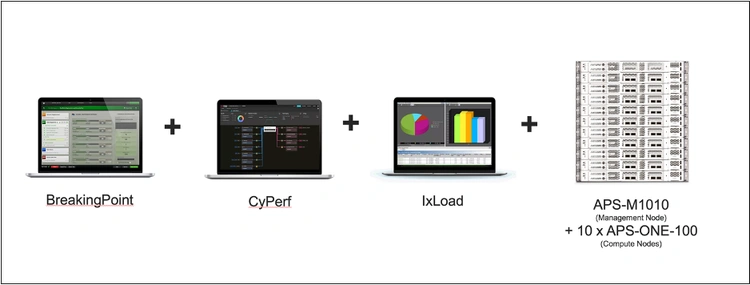
BreakingPoint is a rack-mountable appliance capable of generating traffic at line rate, reaching approximately 150 Gbps per chassis, and achieving terabit levels when units are clustered. CyPerf extends this same powerful engine to virtual agents deployable across various cloud regions. Together, they form a controllable “friendly botnet,” capable of blending over 36,000 attack signatures with legitimate user traffic to observe how network equipment performs under mixed stress conditions.
This tooling excels in pre-production environments. For instance, if a new firewall, WAF rule set, or Kubernetes ingress requires certification before customer deployment, a scripted scenario can be launched: nine seconds of HTTP/2 resets, a one-second pause, followed by a UDP carpet bomb. Running this scenario repeatedly allows for configuration tuning, with the identical load ensuring true apple-to-apple comparison of results.
Because these tests are confined within the client’s lab VLAN or pre-approved cloud accounts, interactions with cloud provider abuse desks are avoided. This autonomy allows for the capture of every packet, integration of results into CI/CD pipelines, and the scheduling of nightly “chaos bursts” to detect regressions before they impact production.
The primary trade-off is ownership. Licenses represent a significant capital investment, and internal staff must be trained to operate the console, create scenarios, and maintain the attack library subscription. For organizations conducting drills only annually, a managed service might be more cost-effective. However, for telecommunications companies, appliance vendors, or enterprises committed to continuous validation, Keysight offers unparalleled autonomy, scale, and depth of testing capabilities.
5. Cyttack.ai – Best Emerging SaaS for Quick, Budget-Friendly Drills
Not every organization requires terabit-scale storms or dedicated live coaching. Some simply need a rapid, affordable verification that their WAF and rate limits are configured appropriately. Cyttack.ai addresses this specific need with an AI-guided SaaS platform designed for lean security teams.
Onboarding is as straightforward as any cloud application. A wizard prompts for details about the technology stack, anticipated peak traffic, and current mitigation strategies. Behind the scenes, Cyttack’s AI model translates these inputs into a right-sized attack plan, typically ranging from 20 to 100 Gbps, utilizing the most relevant attack vectors. Users select a time window, click launch, and monitor real-time charts displaying latency and error rates. A prominent “Stop” button is always visible for immediate termination of the test.
The core value is delivered in the post-test email, which arrives minutes after the simulation concludes. It provides a plain-language summary of results and offers prescriptive solutions, such as sample WAF rules, Nginx rate-limit snippets, and Terraform blocks for scaling thresholds. This feels less like a generic report and more like personalized guidance from a junior consultant.
Cyttack’s tiered pricing model is equally accessible. Plans begin at a few hundred dollars per month for multiple drills, with higher tiers offering increased traffic ceilings and API access for CI integration. Chat support is available during test windows, though there is no on-call engineer, making the platform ideal for teams comfortable interpreting their own metrics.
While Cyttack.ai is an emerging solution and lacks decades of case studies, and its capabilities cap out below triple-digit gigabit floods, it effectively shifts DDoS testing from a daunting budget item to an approachable, repeatable practice for SaaS companies, fintech startups, or regional enterprises priced out of traditional services.
Quick Comparison at a Glance
Having introduced the leading contenders, the following table offers a concise, side-by-side comparison, distilling key specifications for quick reference.
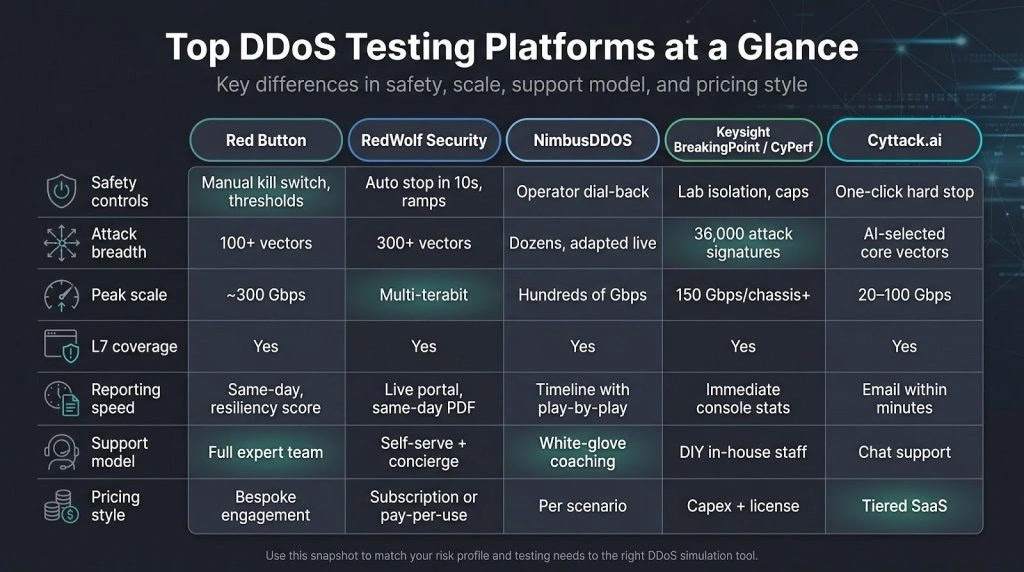
| Provider | Safety controls | Attack breadth | Peak scale | L7 coverage | Reporting speed | Support model | Pricing style |
| Red Button | Manual kill switch, pre-set thresholds | 100+ vectors | ~300 Gbps | Yes | Same-day with resiliency score | Full expert team | Bespoke engagement |
| RedWolf Security | Auto stop in 10 s, phased ramps | 300+ vectors (weekly updates) | Multi-terabit | Yes | Live portal, same-day PDF | Self-serve, optional concierge | Subscription or pay-per-use |
| NimbusDDOS | Operator-controlled dial-back | Dozens, adapted live | “Hundreds” Gbps | Yes | Timeline with play-by-play | White-glove coaching | Per scenario |
| Keysight BreakingPoint / CyPerf | Lab isolation, user-defined caps | 36,000 attack signatures | 150 Gbps per chassis (clusterable) | Yes | Immediate console stats | DIY (in-house staff) | Capex + license |
| Cyttack.ai | One-click hard stop | AI-selected core vectors | 20–100 Gbps | Yes | Email within minutes | Chat support | Tiered SaaS |
This comparison table serves as a guide to align an organization’s specific risk profile and operational needs with the most suitable tool. For quarterly testing requiring hands-on expert guidance, Red Button or NimbusDDOS would be appropriate. If weekly, autonomous testing is a priority, RedWolf Security or Keysight may be a better fit. When budget constraints are a factor but due diligence remains critical, Cyttack.ai offers an accessible entry point without significant financial outlay.
Honorable Mentions and Niche Options
While the Top 5 platforms address the majority of enterprise requirements, a few specialized solutions warrant an honorable mention for their unique offerings.
MazeBolt RADAR specializes in “micro-attacks” that are non-disruptive. Instead of a single, large-scale event, this platform continuously launches low-Gbps probes around the clock to identify configuration vulnerabilities without risking downtime. It is particularly well-suited for teams unable to schedule maintenance windows but still requiring continuous assurance.
LoDDoS strikes a balance between self-service and expert guidance. Users design tests via a web console, while LoDDoS engineers actively monitor the run in real time, prepared to throttle traffic if key performance indicators (KPIs) become unstable. This model offers both safety and flexibility, though its subscription costs tend towards the premium end.
Finally, traditional open-source flooders such as LOIC, hping3, and Slowloris remain available. These tools can be useful for laboratory demonstrations in isolated environments. However, it is crucial to remember they typically launch from a single host, lack essential safety features like kill switches, and can quickly violate cloud provider terms of service. Their use should be strictly confined to isolated networks and never on production infrastructure.
If an organization’s needs fall outside the scope of mainstream tooling—for example, requiring 24/7 low-impact validation or a human safety net within a tight budget—these alternatives might bridge the gap. It is imperative to carefully assess their limitations before entrusting them with critical uptime.
How to Choose the Right DDoS Testing Tool for Your Needs
The selection process should begin with a fundamental question: What specific objective are we trying to achieve through this test?
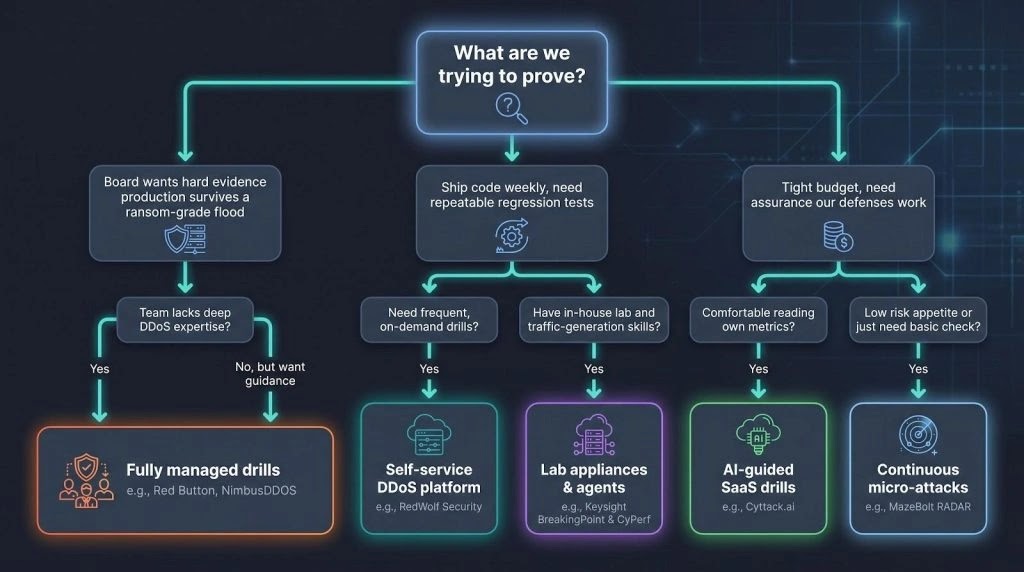
If the board requires concrete evidence that production systems can endure a ransom-grade flood, a fully managed drill with Red Button or NimbusDDOS offers the highest level of credibility. Their experts meticulously control the attack, capture every relevant metric, and provide an audit-ready report.
Conversely, if code is deployed weekly and repeatable regression tests are needed, a self-service solution like RedWolf Security or an in-house lab appliance from Keysight would be more appropriate. These options allow for scenarios to be run whenever a new microservice is rolled out, enabling rapid detection of regressions and eliminating scheduling complexities.
Budget is a consideration, but the focus should be on the value derived per insight, rather than just the sticker price. A single unmitigated outage can incur millions in costs. For organizations with tighter budgets, starting small with Cyttack’s SaaS tier or a MazeBolt continuous probe can demonstrate value, allowing for scaling up once leadership recognizes the benefits.
Team skill sets are also a critical factor. If the internal team lacks deep DDoS expertise, vendor-guided services offer a safer approach than attempting a solo operation. Conversely, organizations already managing large scrubbing centers may prioritize complete control and granular packet visibility.
Finally, respect the operational environment. Cloud-based workloads necessitate approved provider partners, while on-premise labs offer greater freedom. Define all constraints upfront, then shortlist tools that satisfy every compliance and operational requirement.
By addressing these five key checkpoints—objective, frequency, budget, expertise, and environment—the optimal choice typically becomes apparent.
Safety, Ethics, and Legal Considerations
Initiating a DDoS test without appropriate safeguards is akin to igniting fireworks in a server room: exhilarating until something catches fire.
First and foremost, secure explicit written permission from all relevant stakeholders. This includes hosting providers, upstream ISPs, cloud account administrators, and business owners. AWS and Azure explicitly forbid self-initiated floods, permitting tests only through approved partners. Bypassing this crucial step could result in account suspension or more severe repercussions.
Secondly, define a precise scope. Clearly list target IP addresses and domains, establish maximum traffic ceilings, and agree upon kill thresholds for metrics such as latency, error rates, or CPU load. Communicate this plan to all support teams to prevent any confusion between the drill and a genuine attack.
Thirdly, schedule tests during periods of low traffic and maintain continuous, comprehensive monitoring. Ensure the Network Operations Center (NOC), Security Operations Center (SOC), customer support, and communications teams are all connected on the same bridge. If metrics unexpectedly spike beyond the planned parameters, activate the kill switch immediately. A robust provider or tool facilitates this with a single click.
Fourth, under no circumstances should firepower be sourced from illicit “booter” services. Many of these rely on compromised IoT devices, and patronizing them directly funds criminal activities. Always utilize reputable platforms that generate traffic from infrastructure they legally own or lease.
Finally, thoroughly document the entire exercise. Packet captures, detailed timeline logs, and chat transcripts serve as vital proof of due diligence for auditors and cyber-insurance claims. Following the test, conduct a blameless post-mortem review, address identified gaps, and schedule the subsequent drill. Safety is not a one-time checkmark; it is an ongoing operational habit.
Best-Practice Tips for High-Value Drills
Approach every simulation as if it were a real incident. Position monitoring dashboards prominently, establish clear success metrics, and precisely time the interval between the initial alert and the first human response.
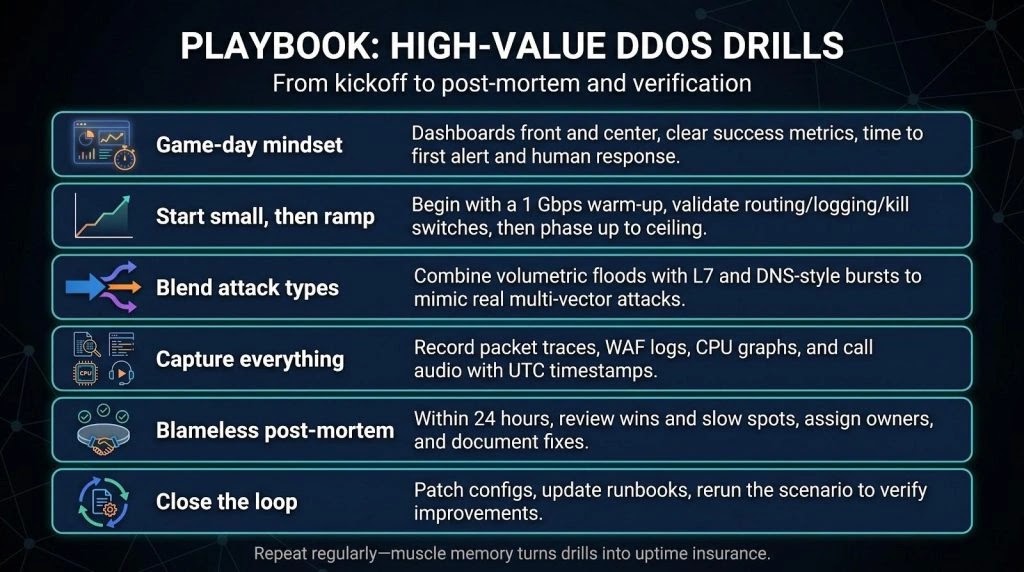
Begin with a modest scale and gradually escalate. A gentle 1 Gbps warm-up confirms that routing, logging, and kill switches function as expected. Once confidence is established, incrementally increase traffic in phases until the agreed-upon ceiling is reached.
Diversify traffic types. Attackers rarely rely on a single method; therefore, combine a volumetric flood with an application-layer assault or a DNS amplification burst. Observing how your stack handles mixed attack vectors provides far more insightful data than a monochromatic blast.
Capture all relevant data. Packet traces, WAF logs, CPU utilization graphs, and call recordings offer richer insights during subsequent analysis. Label all files with UTC timestamps to ensure timeline synchronization across different teams.
Conduct a blameless post-mortem within 24 hours. Acknowledge quick successes, catalogue slower reactions, and assign ownership for every identified remediation task. Schedule the next test before institutional memory fades; repetition is key to transforming lessons into ingrained muscle memory.
Ultimately, close the loop. Implement configuration patches, update runbooks, and rerun the identical scenario to verify the effectiveness of improvements.
Conclusion
A DDoS drill is truly complete only when it can be definitively proven that the next real flood will cause less harm. Whether an organization requires bespoke expert guidance (Red Button), autonomous self-service firepower (RedWolf Security), white-glove coaching (NimbusDDOS), an in-house laboratory (Keysight BreakingPoint / CyPerf), or a budget-friendly SaaS check (Cyttack.ai), the appropriate platform transforms an unknown risk into a measurable, repeatable rehearsal.
The strategy for success involves starting small, diversifying attack vectors, meticulously capturing every metric, conducting a blameless post-mortem, and proactively addressing every vulnerability before the subsequent test. Executed effectively, simulated DDoS testing elevates the next genuine attack from an emergency into a routine event—an event that your infrastructure and personnel have already successfully navigated countless times through dashboard monitoring, runbook execution, and honed muscle memory.
What You Should Do
- Obtain Written Permissions: Before any simulation, secure written consent from all stakeholders, including cloud providers (AWS, Azure), ISPs, and business owners, to avoid service disruptions or account suspension.
- Define Clear Scope and Thresholds: Establish precise target IPs/domains, maximum traffic volumes, and critical kill thresholds (e.g., for latency or error rates) to maintain control and prevent unintended impact.
- Monitor Extensively: Conduct tests during low-traffic periods and ensure continuous, real-time monitoring by NOC, SOC, and support teams. Have an immediate kill switch readily available.
- Use Reputable Tools: Only utilize approved, legitimate DDoS simulation platforms. Avoid illegal “booter” services that contribute to criminal activities and pose significant legal and ethical risks.
- Document and Review: Record all aspects of the drill (packet captures, logs, communications). Conduct a blameless post-mortem to identify weaknesses, assign remediation actions, and schedule follow-up tests to validate improvements.
Disclaimer: HackersRadar reports on cybersecurity threats and incidents for informational and awareness purposes only. We do not engage in hacking activities, data exfiltration, or the hosting or distribution of stolen or leaked information. All content is based on publicly available sources.









No Comment! Be the first one.